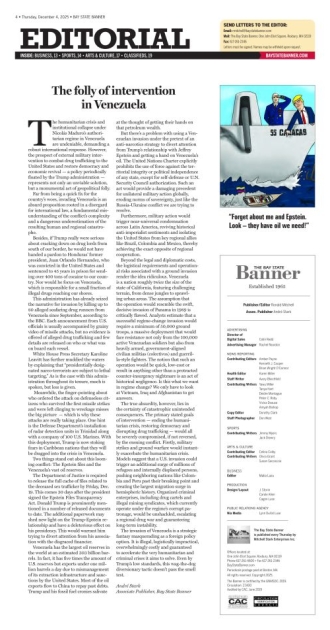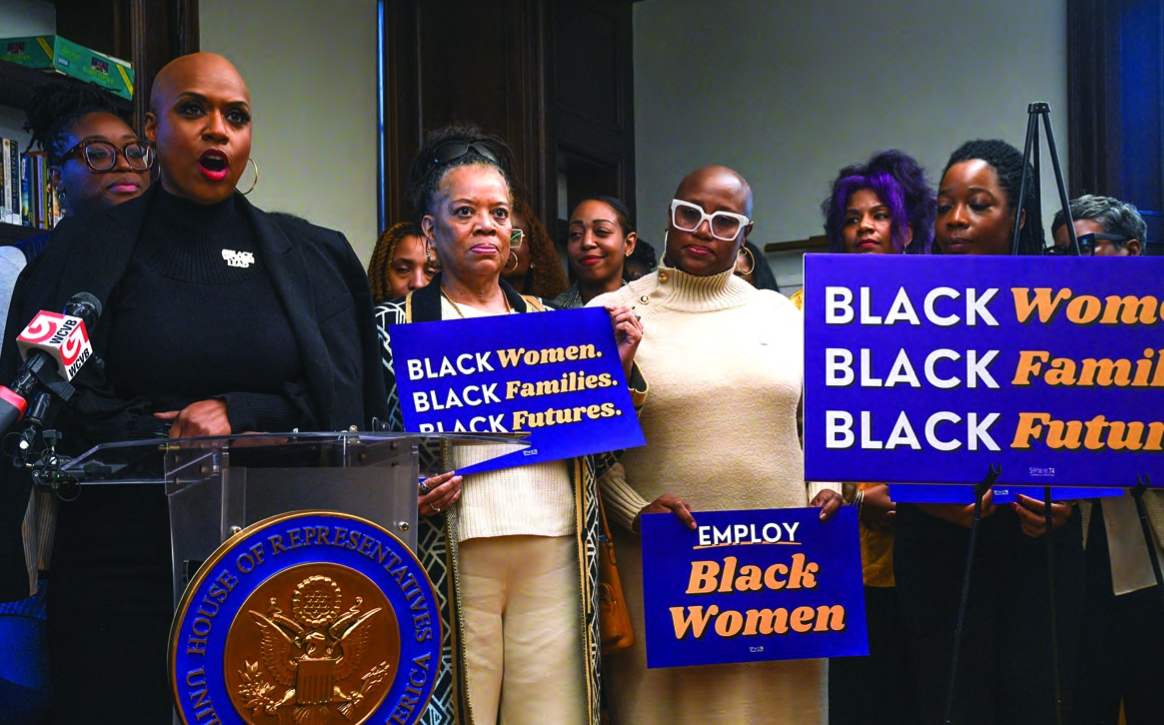
Rep. Ayanna Pressley speaks at a press conference about unemployment among Black women. The press conference, Nov. 24, followed a roundtable discussion after federal jobs numbers for September showed that Black women 20-years-old and older faced an unemployment rate of 7.5%, about three percentage points higher than the unemployment rate generally.
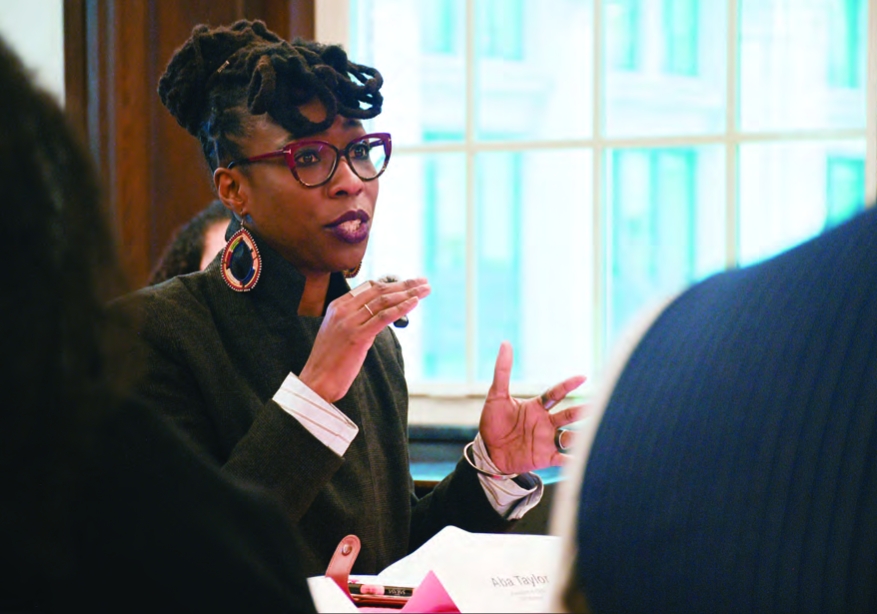
Aba Taylor, president and CEO of YW Boston, speaks at a roundtable event about unemployment among Black women. The event, organized by Rep. Ayanna Pressley and hosted Nov. 24 at the YW Boston headquarters, focused on federal jobs numbers for September that showed that Black women 20-years-old and older faced an unemployment rate of 7.5%, higher than the country at large.
Rep. Ayanna Pressley rang alarm bells after new federal employment data released last month highlighted a disparate rise in the unemployment rate for the country’s Black women.
Pressley highlighted the issue at a roundtable event hosted at the headquarters of YW Boston on Nov. 24, featuring a panel of economists, state and local leaders and women who had lost their jobs to various federal actions.
“This is a five-alarm fire,” Pressley said. “This is a crisis.”
Pressley’s event came after September unemployment data, released by the U.S. Bureau of Labor Statistics on Nov. 20, found that Black women 20 years old and above faced an unemployment rte of 7.5%, up from 5.3% in September, 2024.
In September, the unemployment rate for the country at large was 4.4%, up from 4.1% the year before.
At the roundtable, Pressley echoed her standing call for the Federal Reserve to uphold its mandate for maximum employment for all, which she first raised in a September letter to Federal Reserve Chair Jerome Powell.
Under federal law, the Federal Reserve is charged with supporting the highest level of employment that sustains stable prices.
“We need you to do your job; we need you to study the data; and we need you to come up with a plan,” Pressley said.
Pressley and other speakers suggested that the higher unemployment rate for Black women comes, at least in part, through an outsized presence in the federal workforce, which has seen pronounced cuts under the Trump administration in an effort to cut the number of federal employees.
According to the U.S. Equal Employment Opportunity Commission, Black women made up 11.7% of the federal workforce, as of Fiscal Year 2020.
“If you submitted a FAFSA application that would probably be processed by Black women at the Department of Education; if you had your National Fair Housing laws being enforced, that is because of a Black woman, likely, at Housing and Urban Development; if you were seeing the humanitarian crisis of hunger being combated around the globe, it was likely a Black woman at USAID doing that good work,” Pressley said at the roundtable.
An official U.S. Office of Personnel Management blog post published Nov. 21 noted that about 317,000 employees left the federal government this year, while about 68,000 were hired.
In contrast, the federal government saw about 116,00 departures in 2023.
Speakers also highlighted impacts from other federal efforts.
April Brown, former director of the Racial and Environmental Justice Committee of Providence, said that she was leading the Rhode Island-based coalition until earlier this year, when federal funding cuts meant the organization’s budget was reduced by 60%.
In response, the organization laid off two of the group’s founders. Given that the organization was facing ongoing financial challenges, as the highest-paid member of the organization, Brown said “it made sense for me to go.”
“I still don’t know how the organization will survive,” she said.
“The work that we did, working with municipal politicians and helping to bring knowledge of environmental justice, is work that needs to happen in Providence and Rhode Island in particular.”
The Trump administration’s immigration crackdown, too, has impacted employment of Black women, speakers said.
The roundtable highlighted the impact Black women have on the economy and noted that their intersectional identities — as women and people of color — make them a bellwether for employment trends that could have significant repercussions on the country at large.
Pressley called Black women “canaries in the coal mine” as they face higher rates of unemployment, a metaphor that was taken up by other speakers at the event as well.
“We, the canaries, ask you to look at who is struggling in this economy and who is thriving right now, who are getting bigger paychecks, and who are living check to check, who are remodeling their big houses, and who are trying to figure out how to get food on the table,” said Aba Taylor, president and CEO of YW Boston during a press conference following the roundtable.
Experts have estimated that the firing of Black women has resulted in the loss of $37 billion from the country’s GDP.
But those challenges are avoidable, said Anna Gifty Opoku- Agyeman, an economist and entrepreneur who called the crisis “manufactured” to the detriment of Black women.
“When we talk about solutions, I think that we need to change our frame of mind as policymakers,” she said.
At the roundtable, she endorsed the framework of “Black Women Best,” which was put forward in 2020 by Janelle Jones, the first Black woman to serve as chief economist at the U.S Department of Labor.
That framework suggests that if Black women often bear the worst brunt of economic challenges, building a system that serves them well will serve everyone.
“I think a lot of people will see Black women as minorities that we don’t need to know a lot about because what can they really tell us about the economy? What can they really tell us about our country?” Opoku-Agyeman said. “But … Black women are sort of at the center of the Venn diagram that is our society” Lauren Jones, Massachusetts secretary of Labor and Workforce Development, said that state leaders have the opportunity to craft policies that reflect their values.
“We’re grounding ourselves in policy; we’re grounding ourselves in hearing from workers,” Jones said. “But I think we’re also trying, in Massachusetts, to remind ourselves that we’re in a commonwealth that leads based on our values.”
The massive jobs loss faced by Black women across the United States can also harm the mental and physical health of community members.
Theresa Alphonse, former director of health equity at Mass General Brigham and current doctorate in public health candidate, said she’s considering this moment not only through the lens of her personal experience but also with regard to the health impacts that fiscal instability have on stress, and subsequently on conditions like high blood pressure and anxiety.
“I know we talk a lot about the economics, but putting that [public health] hat on, I want to make sure that we address the physical ailments that go along with what we’re talking about,” Alophonse said.
Despite acknowledging the grim statistics, the event also served as a celebration of the work and resilience of Black women.
Speakers touted statistics that suggest that Black women are likely to be the primary earner for their family. An analysis from the Center for American Progress, a progressive think tank, found that 69% of Black women were breadwinners in their household in 2023, according to U.S. Census Bureau data.
Speakers shared stories that highlighted the enduring resilience that has defined Black women’s experiences.
Multiple attendees who described their experiences of losing their jobs due to changes in federal policy said they fell back on side hustles and other passions to keep income flowing.
And speakers described a level of hope and determination to keep moving forward.
“We’re going to keep keeping on, because that’s what we do,” Taylor said, “and we’re going to take care of ourselves along the way.”