
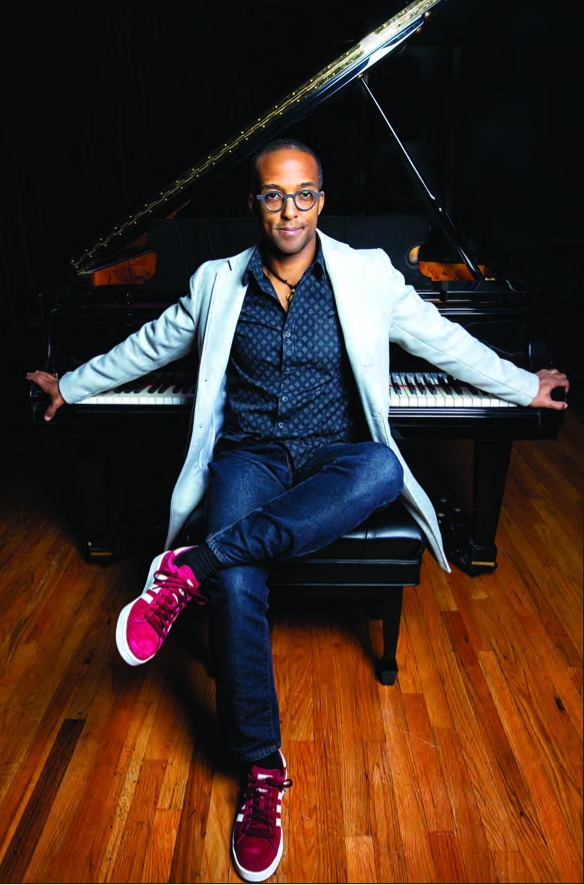
Composer and pianist Kevin Harris plays the Regattabar in Cambridge, Dec. 3.
Boston-based composer, pianist and educator Kevin Harris brings passionate knowledge and appreciation of art and science to his work. “Vitruvian Echo,” his latest album, which will be released in early 2026, is inspired by the famous Vitruvian Man drawing by Renaissance scientist and artist Leonardo da Vinci. Like Leonardo’s depiction, the intent of Harris’ music is balance of freedom and structure.
Harris’ reach is ambitious. He has a philosophical, abstract approach to music, which takes the compositions to a higher plane while remaining grounded in the harmonies, blues and gospel of his Kentucky upbringing.
This is Harris’ seventh recording. In addition to his own albums, he has collaborated with Terri Lyne Carrington, Jason Palmer, Avishai Cohen, Delfeayo Marsalis, Gregory Groover Jr., Yoron Israel and Steve Langone, to name a few. Harris, who is an associate professor at Berklee College of Music, expresses himself musically in symphonic compositions, arrangements for trios and as a solo artist.
The Kevin Harris Project, his trio, performs one show at Regattabar in Harvard Square at 7:30 p.m. on Dec. 3. Joining Harris will be Rufus Reid on bass and Neil Smith on drums.
The Banner spoke with Harris a couple of weeks ago.
Banner: What is “Vitruvian Echo?” Kevin Harris: The recording is not simply a portrait of tangible properties of what can be put on paper, but rather asks: How can we achieve balance as human beings? I’ve tried to choose artists that in the songs are the echoes of that balance between freedom and inclusivity, and rules, grounding and structure.
What’s in the da Vinci drawing that inspired you specifically?
It shows a man standing up, hands and legs spread out, and you can see the proportions, the equal distance. His reach is as wide as his height. He’s not wearing any clothes. The representation points out the proportions and how these balance with nature. Da Vinci, as a scientist and artist, was a master of balance and nature.
Who are the artists you reference on the album that are echoes of that philosophy?
Khalil Gibran is one. The song “The Lonely Strength” is associated with his poetry. In that poem, he wrote, “Do not live half a life, and do not die half a death.” Oftentimes when we endeavor to create, and to love what we do, to be an artist and stick to creative principles, we find that to be a lonely strength. And there’s also a song inspired by Edna St. Vincent Millay’s poem “Conscientious Objector,” in which she writes, “I shall die, but that is all that I shall do for Death.”
What do Rufus Reid and Neil Smith, who join you on the album, bring to the music?
I’ve played with Neil several times before. Rufus not so much, but I know him as a composer since we’re both on the board of the International Association of Jazz Composers and Arrangers. On this trio album, my compositional skills are inspired by the ability to compose for these musicians. As I write the bass line, there’s the way that Neil is a swinging pocket. Both musicians are in mind as I write this music.
What can the audience expect to hear at your upcoming show at Regattabar?
They will hear music that will have them tapping their toes, and melodies they can hear on their way out. Think of Wynton Kelly or Miles’ [Davis] recording, “Live at Black Hawk.”
What’s your take on Boston’s music scene?
What jazz was in the ’40s is not what it was in the ’70s or ’90s. It keeps evolving. Boston is a college town with educational priorities. Music is supported, and part of the culture. It has cultural importance here. That is due to the open-minded approach to art of what it can be for human beings and society: inclusive and inspiring. Boston has potential to be a trend-setter.
You’ve been quoted as saying that participation is “what keeps our souls alive.” Say more.
Coming from Kentucky to Boston and first going to Regattabar when I got here, thinking of my background in Black gospel, I was aware of the need to give permission to participate: to move and connect to the music. Let’s play music to keep people on the dance floor.
ON THE WEB
Learn more at kevinharrisproject.com