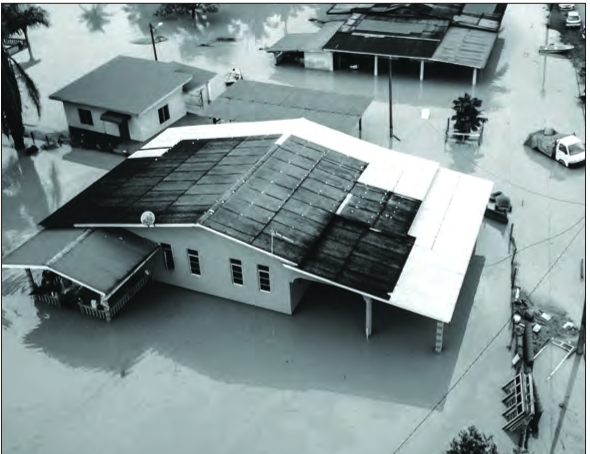
In recent years, homeowners’ insurance costs have skyrocketed in parts of the country facing the most acute climate risks, such as the hurricane-prone Southeast. While that’s put a serious dent in home values in those areas across the board, a new study has found the insurance crisis has hit particularly hard in ZIP Codes with higher percentages of Black and brown homeowners.
The study, published by the National Bureau of Economic Research, found that the ZIP Codes most affected by the climate change-driven insurance crisis stretch along the Gulf Coast, from western Florida to southern Texas — a region that is not only routinely beset by hurricanes but is also home to around half of all Black Americans.
Insurance premium increases “are capitalized into home values, reducing home price growth by over $40,000 in the most exposed ZIP codes,” according to the study. “The premium and home price effects are larger in areas facing rising climate risk.”
There are, of course, plenty of people who live in the Southeast who are not Black. But the
numbers are uniquely stacked against Black residents, in terms of actual
risk of major storms and the financial hit that they’re taking because
of that risk.
Black
households are taking a long-term hit to the wealth-generating machine
that is homeownership and are most likely paying more month to month as
home insurance premiums skyrocket for the same reason that they’re more
prone to being affected by hurricanes: because they’re Black.
Black
communities in the Southeast are nearly twice as likely to be hit by
hurricanes as other communities in the same part of the country. That’s
not only a dramatically higher risk even within states that are
routinely hit by hurricanes but also speaks to how redlining and other
racist housing practices have put Black people in harm’s way.
Not
all communities with more Black people and more storm risk are the most
exposed ZIP Codes in the new story on homeowners’ insurance and home
values. But it stands to reason that those communities are
disproportionately represented in parts of the Southeast where the
insurance crisis has pushed home values down by as much as $40,000.
Credit score squeeze
Black
households are taking a long-term hit to the wealth-generating machine
that is homeownership, and are likely paying more month to month as
home-insurance premiums skyrocket for the same reason that they’re more
prone to being affected by hurricanes: because they’re Black.
There are, unfortunately, many different reasons that Black communities end up with a higher insurance cost burden.
The
average credit score for a Black American is about 100 points lower
than the average credit score for a white American. Credit scores across
a Black community are more likely to have a lower overall average, too.
Home
insurers, meanwhile, base their rates in part on credit risk: the lower
a homeowner’s credit score, the higher the premium. One study found
that individuals with subprime credit pay around 30% more for home
insurance than individuals with high credit scores.
Taking a huge risk
In
a report on the home insurance crisis, The New York Times interviewed
Cristal Holmes, a homeowner in Bogalusa, La., a city of about 10,000
where roughly half the residents are Black. She told The Times her
mortgage is about $700 per month, but her homeowner’s insurance is $500 a
month.
Across the
country, 13% of homeowners are now uninsured. It’s a huge gamble,
especially for residents living in areas that are likely to experience
increasingly powerful hurricanes. But as solutions to the insurance
premium crisis go, going without is a luxury too: to get a mortgage on a
home, banks require that properties be insured. The only way to avoid
the rising cost of insurance is to own a home outright.
Willy
Blackmore is a freelance writer and editor covering food, culture, and
the environment. This article first appeared on Word in Black