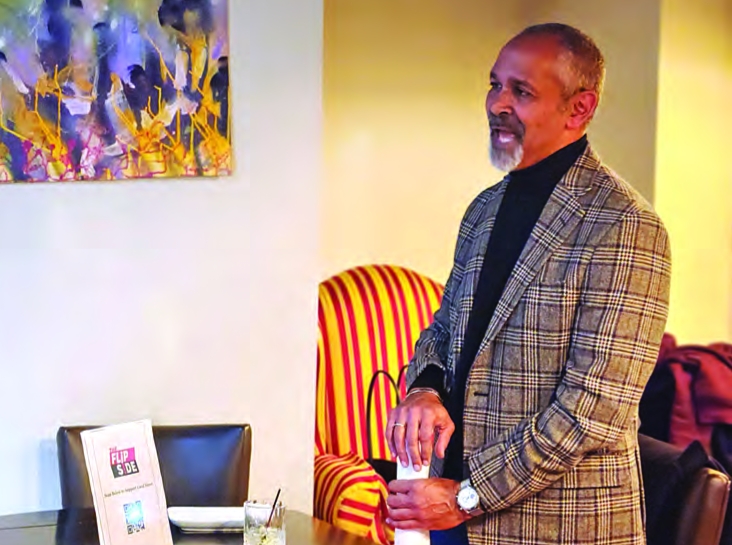
Yawu Miller, co-founder of The Flipside, speaks at a recent fundraiser for the news organization.On the evening of Nov. 19, about 20 people gathered at the District 7 Café in Roxbury to attend the first fundraiser for former Bay State Banner senior editor Yawu Miller’s latest venture, The Flipside.
The Flipside is a nonprofit digital news publication aiming to cover issues important to communities of color in the Greater Boston area. Subscriptions are free with a simple email signup. Donations are much encouraged.
Miller launched the publication in March of this year with his business partner Claudio Martinez; both participated in the American Journalism Project’s inaugural 18-month Local News Incubator. Participation in the Incubator also included a $400,000 grant to jumpstart The Flipside. Miller said that the Incubator helped the duo research the media landscape and acquire the training necessary to run a nonprofit news outlet.
Since its inception, The Flipside has produced over 60 articles. Miller, along with Boston University journalism student Nicole Abrams, cover a wide array of topics including: politics, education, housing, inequality, criminal justice and international news.
“My preference is to write about more things that spark my own interest, not to cover crime. I’m more oriented toward policy issues and questions about public policy,” said Miller. “I want to ask the why behind things that are happening more than just reporting on what’s happening.”
Recently, Miller reported on the state Democratic Party convention and the local writing nonprofit 826 Boston’s decision to maintain their DEI mission and reject federal funding. The latter article was also published in the Banner, whereas some Flipside stories are published in other local papers like the Dorchester Reporter. Contributing to local papers in this way is mutually beneficial; it gets The Flipside’s content in front of additional readers while supplementing local news outlets’ coverage of happenings around town.
During his speech at last week’s fundraiser, Miller mentioned the collaborative nature of Boston’s media landscape. Local newspaper publishers like André Stark of the Banner and former senator Linda Dorcena Forry of the Dorchester Reporter were in attendance.
“We can’t all cover everything that’s happening,” Miller said at the fundraiser, “but together we can cover all the gaps.”
News gaps are a nationwide issue. According to Northwestern’s Medill School of Journalism’s News Desert Report, high levels of newspaper closures and federal funding cuts to public radio are estimated to impact 50 million Americans, making local news limited or inaccessible. In
the past four years web traffic to 100 of the nation’s largest
newspapers dropped by 45 percent. The upside is that more than 300 local
news startups launched in the past five years, in almost every state.
“Over
the past two decades we’ve seen a dramatic reshaping in local news,”
said Medill State of Local News Project director Zach Metzger. “Unlike
in previous years, however, the majority of papers shutting down now are
smaller, family-owned enterprises. These are often the most trusted
active local news sources, and their loss creates new challenges for
local news access in many communities.”
In
addition to the lack of federal funding, newsrooms have been gutted by
hedge funds like Alden Global Capital. Alden has owned the Boston Herald
since 2018 since the paper filed for bankruptcy in 2017. Under its
ownership, the Herald has seen layoffs and increases in staff cuts.
Research
shows a drop in local news results in a drop in civic participation. A
dearth in investigative journalism and community reporting will make
holding institutions like governments and school systems accountable to
its citizens more difficult.
In
a report about the gutting of newspapers by hedge funds, Atlantic
writer McKay Coppins discusses research revealing that towns without
hyperlocal news may experience hikes in city budgets due to corruption,
which can increasingly occur without local watchdog news monitoring city
halls and state houses across the country.
Although
more philanthropies are funding local news, as Miller said in his
fundraiser speech, paid support from readers is still critical.
“You
may have read in recent years about the investments that major
philanthropies are making in local news across the country. But you
probably haven’t heard about how little that money makes it to the
people who write the news,” he said.
“A lot of it is going to
journalism schools and some of it is going to projects that help
journalism, but very little of it is actually making it to nonprofit
news organizations that are putting out the news,” Miller said. “While
we’re fortunate in our first year, we will increasingly rely on our
readers to help us grow and thrive.”
The
majority of the site’s revenue stems from grants provided by The
American Journalism Project, The Boston Foundation, Access Strategies
Fund and reader donations. As a nonprofit news outlet, Flipside does not
accept money from advertisers.
Kristen
Halbert, a nonprofit executive and volunteer who helped organize the
fundraiser, said in a speech at the event: “We are the home of Spotlight
and Pulitzer Prize-winning coverage, but we’re also the home of
significant amounts of inequity that do not
just happen with our incomes and housing, but also with who is covering
what, and to what degree the truth is being covered.”
Independent
journalist and founder of Bostopia News Evan George, who attended the
fundraiser, noted the importance of nonprofit journalism that meets the
moment.
“I’ve been a
big fan of Yawu’s for years,” he said. “He’s a reporter whose integrity
you can trust. I’m very excited to support the Flipside and get away
from corporate media that spins or frames articles in a certain way.
He’s someone who transcends that, so I’m happy to support him and the
work that he’s doing.”
For
now, Miller is pulling double duty, fundraising and writing the news.
By March, he would like to have more foundational support to hire staff
and compensate journalists for their labor. In five years, he’d like to
see stable revenue and readership growth.
“We’re
producing news that is of interest to communities of color. We’re also
following our interest, which I think is when I think journalism is at
its best,” said Miller.
“We get to ask lots of questions. We sometimes get answers to those questions. Sometimes we don’t.
But when we follow our interests and write about things that interest us, that’s when we do our best work.”
To read The Flipside, visit flipsidenews.net.