
M.
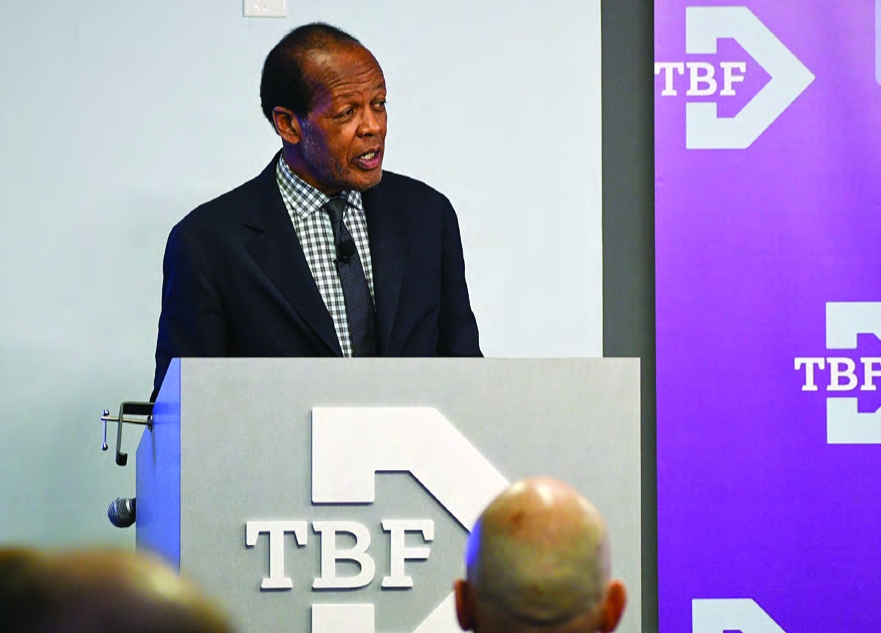
Lee Pelton, president and CEO of The Boston Foundation, welcomes
attendees to an event releasing the foundation’s latest housing report
card, Nov. 12. The report, an annual release from the group’s research
arm Boston Indicators, identified persistent challenges for renters and
prospective homeowners in the Greater Boston area, with limited supply
and other factors creating high costs for housing.
Ask any resident in the Greater Boston area and they’ll most likely tell you that rent is too high and homeownership is out of reach.
A new housing report card released by Boston Indicators, the research center at the Boston Foundation, put numbers to the struggles that many — especially residents of color — face in finding and maintaining housing in the region.
“The data and the report confirm what many residents already know from lived experience: Housing costs continue to rise faster than income; housing needs far exceed production,” said M. Lee Pelton, president and CEO of the Boston Foundation.
That gap, between who can and cannot afford to stay in Greater Boston, is not inevitable, he said at a Nov. 12 event to release the 24th annual edition of the report.
“They reflect choices, policy choices, investment choices and collective priorities, that we have the power to change,” Pelton said.
At the state level, various efforts have aimed to close some of those gaps. The controversial 2021 MBTA Communities Act pushed communities to reconsider zoning to potentially allow for more housing. And the Affordable Homes Act, a housing bond bill passed in August 2024, was followed by a state report that set an official target of 220,000 new homes between 2025 and 2035.
But for now, the report found that challenges around housing persist in the homeownership and rental markets. Many of those changes hit residents of color hardest.
According to the report, prices for entry-level homes — properties with approximately the lowest third of home values — along with associated costs have continued to rise, making the barriers for families looking to buy homes higher.
According to estimates from Boston Indicators, a family would need to make over $162,000 per year to afford a home in Greater Boston, which is an increase of over $64,000 since 2021.
The change has limited access for young adults in Greater Boston to buy homes. And residents of color are less likely to be able to afford a starter home.
The report found that an estimated 114,000 renters in the region could afford a home, based on their price estimates. About two-thirds of those renters are white, while Black renters make up about 7% and Latino renters make up about 11%.
Those changes are most likely due to rising home prices and higher mortgage rents, according to the report.
Fewer available homes and greater demand from higher-income households have shifted those prices, which may have shown some signs of leveling off but are still at high prices. The report found that home values are 88% higher than they were in January 2015.
And high prices are common across the region. In 36 municipalities, the median home price sits above $1 million and in three, median prices are above $2 million.
In only three cities and towns — Brockton, Halifax and Wareham — median home prices are under $500,000.
In the region’s rental market, the report found that high prices present challenges for residents.
About half of renting households are rent-burdened, meaning they pay 30% or more of their monthly income on rent, and about a quarter are severely rent-burdened, meaning they pay 50% or more.
The report said this metric may be somewhat overstated by non-standardized data collection, but that it still represents real affordability pressures for much of the region’s population.
As with home prices, renters of color are cost-burdened at higher levels.
Fifty-six percent of Black renters were cost-burdened at any level, according to the report, with 32% of Black renters severely cost-burdened. Among Latino renters, 52% were cost burdened, with 28% of renting households severely cost-burdened.
By comparison, 46% of white renting households were cost-burdened and 24% were severely cost-burdened.
That burden also fell more heavily on low-income households. Among the lowest 20% of renters, 77% were cost-burdened and 61% were severely cost burdened. Among the top 20% of renters, only 3% were cost burdened and none were severely burdened.
Across the region, rents are high.
The Greater Boston region ranked as the fifth most expensive rental market in the country, the report found. Those costs have risen over the past decade, with a short-lived dip during the pandemic.
The report identified a shortage of units as a core reason for price hikes, which leads to prospective renters having fewer options to choose from and creating conditions for greater discrimination by landlords. In 2024, just under 3% of rental units were vacant for rent.
“If landlords have much more leverage, they are able to be much choosier about who they pick,” said Luc Schuster, executive director of Boston Indicators and an author of the report. “This sets up really terrible conditions for renter households.”
Some early evidence suggests vacancy rates might be rising in some student-heavy neighborhoods of Boston, probably due to a drop in international student arrivals in response to shifts in immigration policies under the Trump administration, but the uniform data for this fall is not yet available.
The report tied those high prices from low supply to a need to build more housing.
An analysis of permits issued for new construction in the state found that they rose slightly in 2024 but are still significantly below historical levels. In 2024 permits for about 14,300 new units were issued.
In comparison, the state saw peaks of new units permitted at about 53,000 in the early 1970s and about 45,200 in the mid- 1980s. Even in the mid- to late 2010s, permitting numbers neared 20,000 per year.
A new metric released by the U.S. Census Bureau painted a different picture. Census address count data on recent housing showed a rise in annual net new units between 2020 and 2025.
But continued pricing challenges and limited supply suggest that that rise isn’t enough and lower permitting numbers suggest a “significant slowdown” in future production. Construction slowdowns and challenges to bring new housing from paper to completion also present a warning sign, according to the report card.
“I’d say it’s a pairing of a goodnews, bad-news story,” Schuster said. “The good news is that we built significant new housing in the last few years, making a bit of a dent in our housing shortage, but there are real warning signs around whether that will continue into the future.”
Impacts of the MBTA Communities Act
Each year, the housing report card digs deeper on a particular topic affecting the region’s housing landscape. This year, that special section looked at impacts of the MBTA Communities Act, a 2021 state law that requires cities and towns served by the MBTA, or those that neighbor them, to create at least one zoning district that automatically allows the construction of multifamily housing.
The law also said that, where possible, those districts should exist within half a mile of public transportation. The housing report card found that 62% of zoned units in plans under the law are within half a mile of a transit station.
While some communities have not yet come into compliance with the requirements under the law — in some cases with highly public fights against the regulations, like in Milton where a court challenge went all the way to the state’s Supreme Judicial Court — the bulk of the 177 communities that fall under the law’s reach have implemented new zoning policies under the law.
But the research in the housing report card found that even among communities that have implemented the required changes, the impacts of those new policies have been mixed.
Because the law left it to each municipality how to implement the requirements, how much housing to actually zone for — some stuck close to the mandated capacity while others more than doubled it — and where to put that housing varied.
For example, in 53 municipalities, none of the upzoned parcels were previously zoned for single-family homes. In only nine municipalities did parcels previously zoned for single-family homes make up 20% or more of the upzoned parcels.
Overall, 61% of all zoned capacity was allocated to commercial or industrial areas. Single-family areas made up less than 5% of all the MBTA Communities upzoned parcels.
Max Palmer, an associate professor of political science at Boston University and co-author of the special section of the report card, said he thought that the focus away from single-family parcels could further gentrification inequities in the housing market.
“To the degree that we’re excluding single-family neighborhoods, that definitely perpetuates the equity that we have seen,” Palmer said during a question-and-answer period of the event. “I think that’s one of the troubling things we find here: if you only target multifamily neighborhoods and then commercial and industrial areas [for upzoning], you’re not going to address any of the inequities.”
The report also found that how the community engagement process was handled shaped which voices were heard and what rezoning occurred.
In a case study, the Boston University researchers who put together the special section found that Needham, which has three commuter rail stops, initially created an ambitious rezoning plan that was ultimately shot down by a ballot referendum and replaced by a base compliance plan that met the bare minimum of the law’s requirements.
In Wellesley, the town’s plan faced limited opposition, largely because the zoning changes it proposed were able to count an existing proposed development and wouldn’t require other major changes or construction.
In contrast, Lexington produced an ambitious plan that initially would have zoned for as many as 12,000 new units, while the state requirements mandated only 1,231. The report attributes an inclusive and effective public outreach process, an endorsement from virtually all local officials and strong ground-level activism as factors in that outcome.
Later backlash led to an updated plan that had a capacity of 1,314 units.
At the event releasing the report card, Lt. Gov. Kim Driscoll pointed out that the MBTA law was signed by former Gov. Charlie Baker, not current Gov. Maura Healey, but that the Healey- Driscoll administration is in strong support of the law as a way of bringing more housing to the state, especially in the communities that get the most benefit from the MBTA system.
“We know it’s created opportunities to have conversations about housing in a number of places,” Driscoll said. “Some have embraced that more than others, but the fact that we’re talking about housing, that we’re asking people in communities to think about who is living in their community, who isn’t and how are they going to provide for their future housing needs, is really, really important.”