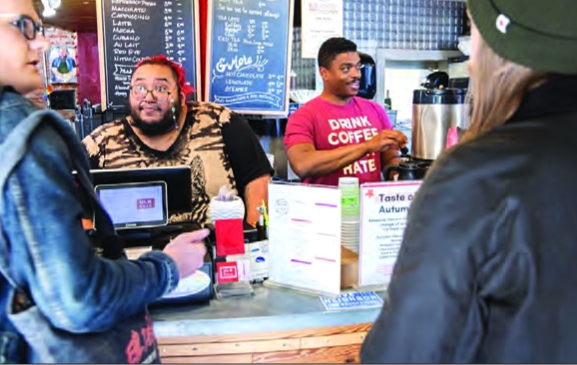
Marvin Mathelier (back right), co-owner of Ula Cafe, counsels veterans to lean on other vets for mentorship.Lisa Ducharme, an Air Force veteran and daughter of a veteran, has seen moments when veterans were almost universally revered by the American public and respected by the federal government.
The current moment, she said, feels different.
“We all go through this love-hate relationship with America — especially as veterans,” said Ducharme, executive director of the Massachusetts Veterans Chamber of Commerce. “We are at a moment where the people are mad at the government, therefore they’re mad at the veterans.”
A decade ago, there was near-universal pride among Massachusetts business leaders who were also veterans. Today that pride is complicated by a changed political environment for many veterans, according to interviews with several in the local business community.
The number of businesses that identify as veteran-owned has declined in recent years, mirroring a broader decline in the number of U.S. veterans overall. America’s total number of veterans is expected to decrease by 7 million by 2048, a 36% drop in 27 years, according to research from the U.S. Department of Veterans Affairs National Center for Veterans Analysis & Statistics.
In Massachusetts, the decline over the past 25 years is even steeper, with 42% fewer veterans today than in 2000.
The same trends are in place for veteran-owned businesses, according to multiple experts, although there are no organizations that quantify such businesses in Massachusetts.
Ducharme say that the main reason is that the population is aging. Over half of the veterans in Massachusetts are over 65, and mostly retired, she said.
But Ducharme says another factor is more businesses that simply don’t want to publicly identify as veteran-owned due to a changing attitude reminiscent of the Vietnam War. Rising anger towards the federal government amid political division can be directed at local veteran business owners, she said.
“People are mad at the National Guard in some places right now, as they do what the president told them to do,” says Ducharme. “If you have a veteran-owned business in one of those areas, you pay attention to what is going on.”
Bob Notch, head of the Massachusetts Office of the Veteran Advocate, says most veterans are very proud of their service, but some believe their status works against them in job interviews, despite little evidence to support that belief.
“Really, the only time I have seen people hesitant to be visible is if they perceive the system is working against them if they identify as a veteran,” said Notch.
Hesitation about whether to mention veteran status is the first thing many students looking for work ask Andy McCarty, cofounder of the Dolce Center for the Advancement of Veterans and Servicemembers at Northeastern University.
“The first question is always, ‘Should I?’” said McCarty. “There is a big fear of being misunderstood.”
A reluctance to use benefits
Resources are available for veterans at both state and federal levels, but finding the correct tools is particularly challenging, says Notch.
The OVA advocates for veterans to get the benefits and services they are entitled to, but some business owners who went through military service are reluctant to identify and use those benefits because they feel they don’t deserve special services, according to Notch.
Peter Garran, CEO of BIMstream, and architecture and engineering firm based in Plymouth, said he hasn’t taken advantage of many veteran resources because they feel out of reach. Something as simple as obtaining SBA certification for being a veteran-owned business can be daunting.
“I earned these resources by serving, but I haven’t taken advantage of them,” said Garran.
“It’s the government, so nothing is instantaneous.”
Marvin Mathelier, a Marine Corps veteran who co-owns Ula Cafe in Jamaica Plain, said there’s also a big knowledge gap between veterans and civilians.
“We need, as a society, a better bridge between civilians and veterans,” says the business owner.
“That is why we are not always hitting the target when it comes to supporting our veterans.”
However, he encourages veterans to rely on each other when resources fail. In addition to his work at the cafe, Mathelier is a nonprofit leader and was a candidate for Boston city councilor at-large in this week’s election. He also has past experience working in the Executive Office of Veterans’ Services.
“The military service has the biggest alumni network in the country,” said Mathelier. “If a new veteran is able to come out of the military and leverage that, they can tackle any challenge at the federal, city or any level.”
Mathelier wants to ensure that everyone, especially people in uniform, feel welcome in his business.
“As a military member, police officer or first responder, you are serving your community and we talked to our staff to tell them that there must be a mindset shift,” said Mathelier. “At the end of the day, we want to be inclusive of everyone and anyone.”
McCarty advises young veterans at Northeastern University to be transparent and honest throughout the employment journey. He hopes that they combat their fears by leaning into their community and use programs like the Dolce Center’s new peer mentorship program, or attend events such as its military family and veteran-focused networking circuit
‘A lonesome journey’
While Mathelier and McCarty counsel veterans to lean on other vets for mentorship, veterans Debbie and David Creek, who met in the Army, found it hard to find support as a small business owner. The couple opened Le Macaron, a French bakery franchise, in Somerville around five years ago, and say it was challenging to find any veteran resources as they tried to get their business off the ground.
“It was a lonesome journey,” said Debbie Creek. “I don’t think there are resources out there that support us as veterans. Our support really comes from our clients and loyal customer base.”
But despite the hardships, Ducharme contends that veterans are among the best entrepreneurs because of their dedication to the mission. She looks at celebrating the state’s Veterans and Spouse Small Business Week as a way of championing local leaders.
“The military actually taught us to be entrepreneurs, it taught us to think differently,” says Ducharme. “You used to get a whole bunch of support if you were a veteran business,” she said. “Now is the time for veterans to really get the support we need from the American people, community, state and federal government.”
This story first appeared in the Boston Business Journal