
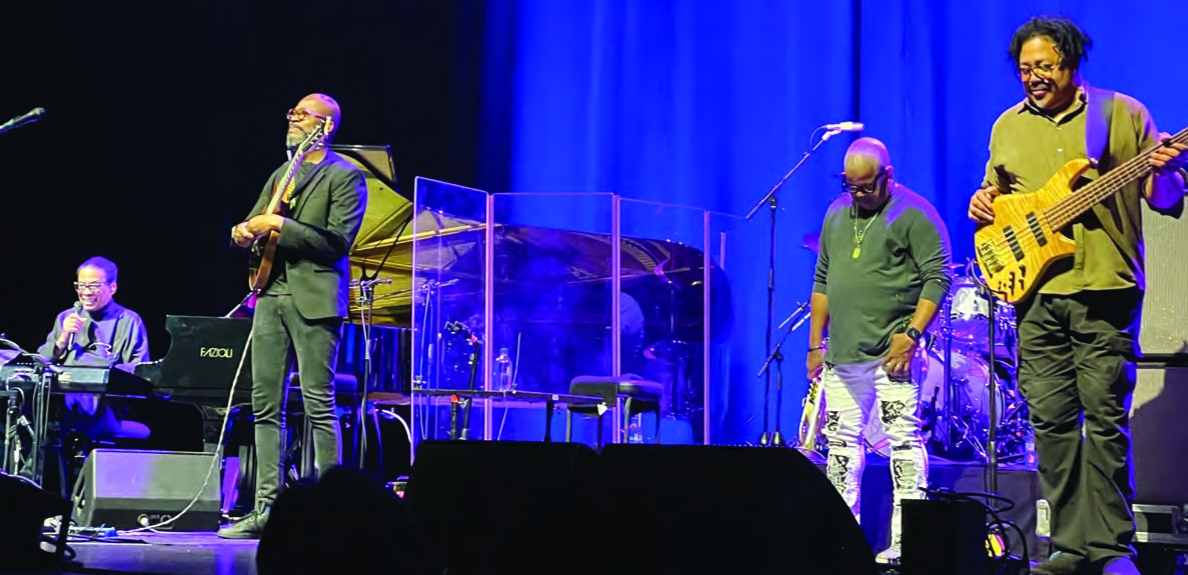
The Awesome Band in a 2024 concert.
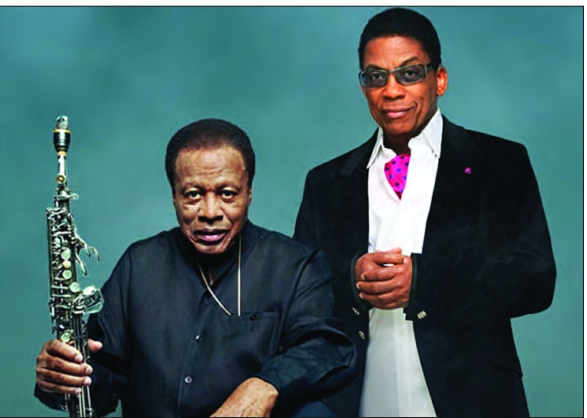
Herbie Hancock is pictured with saxophonist Wayne Shorter of Weather Report
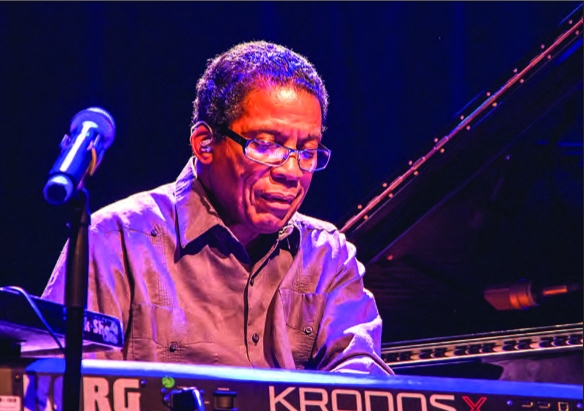
Herbie Hancock has won 14 Grammy Awards and an Academy Award.
I attended a concert that reminded all who were there what contemporary artistry looks, feels and means: Herbie Hancock.
Jazz artistry is probably single-handedly one of the most “creative agency” forms of art. It just stands, represents and functions this way. Its very meaning is to create an experience for listeners and an expression for the artist, that is, by intention, reaching the highest level.
That’s its significance, and its high-value mark.
Some performances leave you with no words left to describe what you just witnessed. Excellence doesn’t allow you to waste time or tongue with words that can’t match it in a single description. Awesome, though, is a great word. We know it means magnificence, phenomenal, extremely impressive, daunting or inspiring great admiration. The Herbie Hancock concert tour landed in Boston at the Wang Theater on Oct. 30 and we experienced something extraordinary.
Herbie Hancock’s Awesome Band included Hancock, guitarist and vocalist Lionel Loueke, Terrance Blanchard on trumpet, James Genus on bass and drummer Jaylen Petinaud.
The band was incredible. Hancock lives among us in the seventh decade of his public life in artistry. He is the most outstanding contemporary example of a living musician, cutting across every style of music since his early performances in the 1960s, the years of this writer’s birth, and is still relevant and engaged today.
That means jazz, rock, funk, reggae, hip-hop, urban contemporary, neo-soul, global Afro-pop, and recording a Maurice Ravel piano concerto. Hancock’s professional life has always been at the forefront of world culture, technology, business, and music.
Like all the greats, he continues to fuse all his creativity in the document we call “a recording,” as he is currently in the studio at work on a new album. Most of us who follow his music recall the classic 1964 Miles Davis Quintet, which pioneered groundbreaking sounds and approaches in jazz.
No other band, besides Weather Report, Return to Forever or Earth, Wind & Fire, engaged our interests as young musicians. I think a younger generation today may be familiar with at least “Rockit,” the hip-hop, MTV television and breakdancing song.
Hancock is the first artist introduced in Stuart Baker’s 2014 book “Black Fire! New Spirits! Images of a Revolution: Jazz in the USA, 1960-75.” The luminaries that follow him include Nina Simone, Ornette Coleman, Alice Coltrane, Yusef Lateef and Sun Ra, as well as Mary Lou Williams, The Last Poets, John Coltrane, Wayne Shorter, Chicago’s Association for the Advancement of Creative Musicians, Miles Davis, Max Roach and Art Blakey and The Jazz Messengers. He’s leading quite a cast of trailblazing 20th-century artists.
Baker notes, “(Herbie) was born in Chicago in 1940. Keyboardist and composer Herbie Hancock has managed to segue, Zelig-like, into each evolving era of Black music, often composing an era’s defining musical example. Classically trained, his success lies partly in rendering complex music easily accessible, without sacrificing quality or creativity.”
“He joined Miles Davis’ second great quintet in 1963 and also cut a string of classic albums for Blue Note, including ‘Maiden Voyage’ (1965) and ‘The Prisoner’ (1969), the hugely successful ‘Headhunters’ (Columbia 1973) ‘Thrust’ (Columbia 1974), ‘Secrets’ (Columbia 1976) and the astonishing live recording ‘Flood’ (CBS/Sony 1975).
“In the early 80s, ‘Rockit’ was, for many people, their first taste of nascent hip-hop and became the first black music video to play on the then-new MTV. He continually performs and records today, effortlessly switching between genres. Ever the innovator, his most recent solo show saw him utilizing several iPads.”
Hancock’s accomplishments are unprecedented for a “jazz musician” in modern times. No one has been more celebrated, except Quincy Jones. An Academy Award for his “’Round Midnight” film score; 14 Grammy Awards, including Album Of The Year”; two Grammy Awards for the globally collaborative CD “The Imagine Project”; and he served as creative chair for Jazz for the Los Angeles Philharmonic Association and as institute chairman of the Herbie Hancock Institute of Jazz.
In 2011, he was named a UNESCO goodwill ambassador. Two years later, Hancock received a Kennedy Center Honor.
His memoir, “Herbie Hancock: Possibilities,” was published in 2014 and in 2016, he received the Grammy Lifetime Achievement Award. Hancock was a recipient of the prestigious Polar Music Prize in 2025, accepting it in a speech where he thanked his mentors, his family and his bandmates while emphasizing the role of music in creating a more peaceful world.
The Awesome Band played an arresting mix of Hancock’s groundbreaking 1970s works, including “Cantaloupe Island,” “Actual Proof” and “Chameleon.” The group then connected 1980s hits like “Rockit” with very inventive medleys, back to back.
The Awesome Band had ample room to play as a full band, featuring impressive solos. My colleague and friend, the amazing modernist guitarist Loueke, was singing and playing at one moment with digital loop effects, “counterpointing directions” in different feels, that sounded like five different voices at once. Awesome!
One of the highlights this night for me that was euphoric was Hancock as “Master Griot, Popular Music High Priest,” reflecting his Nichiren Buddhism. He often speaks of being a musician, not “what I do,” but first on, “What I am, as a human being.” He feels that this approach gave him a broader perspective on his creation, a more functional, rather than tool-based, purpose, but one that aims to connect more deeply with his audience’s need for peace.
Sitting at the synthesizer, moving back and forth from his grand piano, he used a vocoder device for both soloing and delivering messages. That night, he delivered a poignant and powerful speech about world unity.
Sung in a robot-like voice, he pretended to be an AI bot, asking people not to be afraid of technology that could just as well be programmed for their good.
“Some people are good and some are bad,” Hancock said. “The truth is everybody is good and bad, aren’t we? Everybody is important, unique and irreplaceable, and we need everybody because nobody is like you; we need you. We need to care more about ethics, to be kinder to each other, to treat everybody with respect, because everybody is important and we need each other, and we always will. Forever.”
Now that is too cool! Generosity of Spirit.
The below share here is about his humanity. What kind of major artist of his stature does that? Awesome Herbie.
An open letter from Herbie Hancock and Wayne Shorter:
To the Next Generation of Artists,
We find ourselves in turbulent and unpredictable times….we live in a time of great confusion and pain. As an artist, creator and dreamer of this world, we ask you not to be discouraged by what you see but to use your own lives, and by extension your art, as vehicles for the construction of peace.… The answer to peace is simple; it begins with you. Each of us has a unique mission. We are all pieces in a giant, fluid puzzle, where the smallest of actions by one puzzle piece profoundly affects each of the others. You matter, your actions matter, your art matters.
… What this world needs is a humanistic awakening of the desire to raise one’s life condition to a place where our actions are rooted in altruism and compassion. … Focus your energy on becoming the best human you can be. Focus on developing empathy and compassion. ….The world needs new pathways. Strive to create new actions both musically and with the pathway of your life. …Everything is connected. Everything builds. We need to be connecting with one another, learning about one another, and experiencing life with one another. We can never have peace if we cannot understand the pain in each other’s hearts. The more we interact, the more we will come to realize that our humanity transcends all differences. … Living (your lives) with creative integrity can bring forth benefits never imagined.”
—Herbie Hancock, Wayne Shorter
That’s an awesome message, meaning and call to action(s) in our world today. Herbie Hancock becomes a “primary clarion call” for the value of impactful, transformative and meaningful, purposeful intent, lifting, inspiring