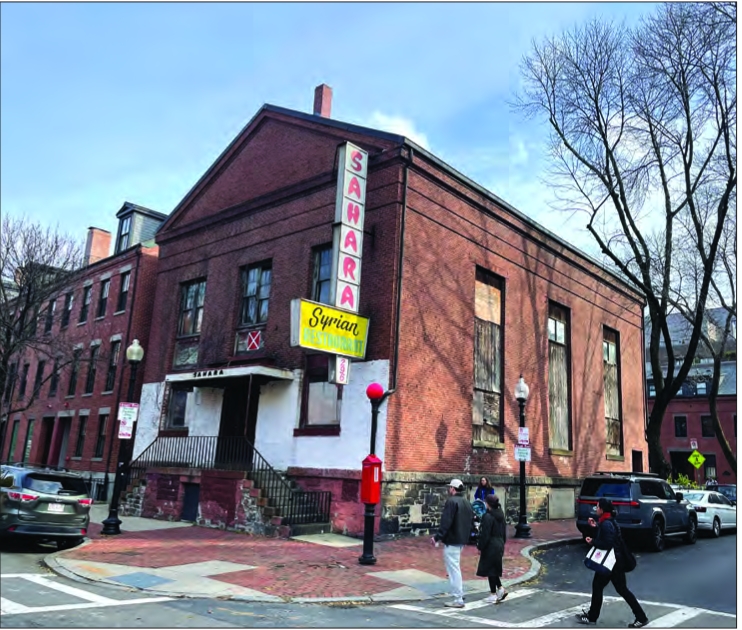
The Sahara Syrian Restaurant on Shawmut Avenue — closed more than 50 years — is one of a few remaining traces of a once-thriving Arab-American community in Boston. Pao Arts Center hosts ‘Arab Massachusetts: Building Community in the Commonwealth’
A hundred years back, the area around Chinatown had a distinctly Middle Eastern flavor. At the same time Chinese Americans began settling in the area between Essex Street and the right of way now occupied by Interstate 90, so too did immigrants from what was then the Syria province of the Ottoman Empire, which included Lebanon, Syria, Palestine and Jordan.
By the 1930s, there were churches, stores, social clubs and even an Arabic language newspaper serving the small but thriving community that grew to 15,000 in Boston, spreading past its roots in Chinatown into the South End. Arabs worked in factories, opened businesses and settled in cities and towns throughout Massachusetts.
“The stereotype was that Arabs came here as peddlers and entrepreneurs,” said Diana Abouali, executive director of the Arab American National Museum in Dearborn, Michigan. “But there were a lot who worked as laborers in the shipping yards in Quincy and in the mills in Lawrence. There was a lot of participation in the labor movements and in labor activism.”
The museum has captured much of that history in an exhibition that will open in the Pao Arts Center in Chinatown before moving over the course of the next year to Quincy, Lowell and Worcester.
The Boston exhibition, “Arab Massachusetts: Building Community in the Commonwealth,” will feature panels with photographs and text describing the genesis and growth of the Syrian community in Chinatown as well as display cases with artifacts from former residents that tell the story of the community. Among those objects is a Chinese vase given to an Arab family as a wedding gift.
“We thought that object was a nice physical reminder of the relationship between the two communities,” said Kyle Winter-Stoner, research and content manager for the Arab American National Museum.
By the 1940s, the community was a thriving part of a multi-ethnic neighborhood. The late Mel King, who lived on Seneca Street in the New York streets section of the South End, described his experience growing up there alongside Albanians, Greeks, Lithuanians Jews and Arabs in the 1940s in his book “Chain of Change.”
“Across the tracks there were Syrians and Lebanese,” he wrote. “Although our buildings were pretty well sorted out by color and ethnic background, the street belonged to all of us.”
By 1954, as construction of the Southeast Expressway and Interstate 90 began, land takings in Chinatown and the South End squeezed the Arab and Chinese communities. By then, many in the Arab community had climbed into the middle class and began moving to West Roxbury, Dedham and Norwood. By 1970, Boston’s Arab community was a fading memory.
But traces of the community remained — businesses such as the Sahara Syrian Restaurant, the Lebanese American-owned Red Fez restaurant and squares named after Arab Americans killed in World Wars I and II.
When researcher Lydia Harrington began looking at Little Syria as a doctoral student at Boston University, there was little in the way of published material on the community.
“There was a lot of archival materials, but there was much available to people outside the community,” she said. “The part of Little Syria that was in South Cove is generally invisible now. You have to see photographs and maps to understand what was there.”
Along with Harvard doctoral student Chloe Bordewich, Harrington in 2020 started the Boston Little Syria Project to document the community. The Arab American National Museum drew on their work for its upcoming exhibition.
The museum has also drawn its work documenting Arab American communities in other U.S. cities, such as Dearborn’s South End neighborhood and the Little Syria community in New York City.
“After doing the New York City exhibit we turned to Boston because it was one of the largest communities in the 20th century,” said Abouali, who graduated from Wellesley College and obtained a PhD in Middle Eastern Studies from Harvard.
The exhibition at Pao Arts Center opens Nov. 19. On Nov. 22, the arts center will host a Little Syria Walking Tour from 2 to 4 p.m. A community day will be held Saturday, Dec. 6.
The Quincy exhibition, to be hosted by the Quincy Historical Society, will run from March 16, 2026 through May 29, 2027. An exhibition will run at Lawrence Heritage State Park from Aug. 1 through Sept. 12. The Museum of Worcester will host the final exhibition from Sept. 26 through Feb. 14, 2027.
“Traveling exhibits are integral to our mission at AANM as they allow us to amplify Arab voices and histories across the nation,” Abouali said. “In a time of rising xenophobia in this country, it is more urgent than ever to preserve these stories and to share them in hopes to dispel stereotypes and expand the narrative of this nation.”
This story originally appeared on flipsidenews.net.