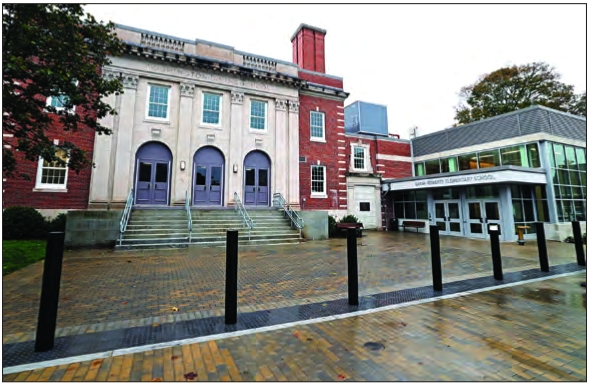
The new Sarah Roberts Elementary School in RoslindaleMore than one hundred years before the Brown v. Board of Education Supreme Court decision found school segregation to be unconstitutional, the issue was first challenged by a five-year-old girl in Boston by the name of Sarah Roberts.
Now, the trailblazer is being recognized for her heroic efforts with the opening of the new Sarah Roberts Elementary School in Roslindale.
Living in the West End of Boston in the 1840s, Roberts was required to attend the Abiel Smith School, an all-Black public elementary school. The city required all Black elementary schoolers to attend Smith, located on Joy Street on the north side of Beacon Hill where a sizable Black community lived. However, not only was that school far away from her home, Sarah had to pass by five “whites only” schools to get to Joy Street.
Her father, Benjamin Roberts, a printer, was angered by this and applied to the Boston Primary School Committee to request she be allowed to attend the closest institution. After four requests were denied, the committee claimed she could only attend the school for Black children, despite its distance.
In 1848, Sarah’s father made the bold decision to enroll her in the Otis School, the closest all-white elementary school to their home. Being fair skinned, she stayed there unnoticed for two weeks. However, when they attempted to enroll her brother, 9-year-old Benjamin Jr., he was denied. Sarah was then expelled and a police officer forcibly removed her from the school premises.
Roberts sued on behalf of his daughter and was represented by Robert Morris, one of the first Black men to become a practicing lawyer in Massachusetts. With Charles Sumner [an antislavery activist who went on to become a U.S. senator] as his co-counselor, the Roberts case was fought on the basis of an 1845 statute asserting that children “unlawfully excluded from public school shall recover damages.”
Despite their efforts, the court ruled in favor of the Boston School Committee in 1848; upon appealing to the Massachusetts Supreme Judicial Court, in 1850 they lost again. At the time, Chief Justice Lemuel Shaw ruled against Roberts, stating that Boston had the right to segregate schools according to race.
This ruling set a precedent that many other states later used to justify school segregation. But what seemed like a loss on paper sparked an onset of conversations on the topic. Just five years later in 1855, Massachusetts was the first to pass state legislation outlawing segregation in public schools.
On Oct. 8, Sarah Roberts’ legacy was honored with a ribbon-cutting ceremony at the school. The institution opened at the start of the 2025-2026 school year, welcoming about 700 new students from pre-K through grade six.
Claire Galloway-Jones is a descendant of Sarah Roberts. Benjamin Sr. was her third great-grandfather, making Sarah her third great-aunt. Jones explained that she grew up knowing she was related to Sarah Roberts and said that the historical significance of the case was something “shared within our family all of my life.”
“My third great-grandfather, he was really fighting for access to the American dream, and that was something that was really important to him, that he felt that he…was warranted that access,” she stated.
Galloway-Jones went on to say that she wasn’t initially informed about the school being named after her great-aunt, and was “totally unaware” that it was up for a vote.
It was in February while at an event when a colleague brought it up. Galloway-Jones explained that she had lost her mother, from whom she learned so many stories of her great-aunt, and that finding out caused a complex swirl of emotions.
“And you know, my mother would always say, my grandmother would say, ‘You come from good stock,’” she said.
Galloway-Jones then explained that right after she found out about the tribute, she connected with the school district, which was more than excited to hear that there were living descendants of Sarah Roberts.
“It was more than just a building project. And I do think they realized that very early on, that it wasn’t just a building project for us,” she said.
Galloway-Jones pointed out that she was a “METCO kid,” the Metropolitan Council for Educational Opportunity school integration program that brings city students to schools in the suburbs. She said programs like METCO gave her family a choice in schooling, something that Sarah Roberts didn’t have.
“You know that has allowed our families to have choices. And so, it always resonates with me that my [third great-] grandfather was looking to have choices,” Galloway-Jones said. “So, you know, we always call him Papa Benjamin. So, Papa Benjamin was looking to have a choice, and he wanted to be able to choose to go to a school that was close to his home. We all like neighborhood schools, and that was something that he wasn’t able to do. And I think that’s had a profound impact on me.”
She also said she felt as though the Roberts’ story hasn’t received the proper recognition that it should have in American history. While it long predated the moment when segregation in schools was fully abolished, it set a foundation allowing people like Thurgood Marshall to look back and refer to the Roberts v. Boston case when arguing Brown v. Board of Education before the U.S. Supreme Court.
Despite the recognition being overdue, Galloway-Jones expressed her excitement for Sarah’s name to finally be brought to the forefront, highlighting the importance of work done in the name of education and social justice.
“I say this all the time. I’m not really about knowledge transfer. It’s about systemic transformation,” Jones said.
Galloway-Jones is proud of her family’s roots and their contributions to American history. She said that as America gets closer to its 250th anniversary, she sees it as an opportunity to shed light on important but often overlooked moments in history.
For her, the Sarah Roberts School is a step in the right direction as it has already brought together a diverse pool of students who will be able to learn from the actions of the Roberts family and their importance in history.
“We really have to approach this centering and building equitable systems that you know every decision is really filtered through the lens of student success and community impact,” she said. “So, as I think about students, I want them to have an understanding that they’re standing on the shoulders, shoulders of really strong people who fought for equality.”