
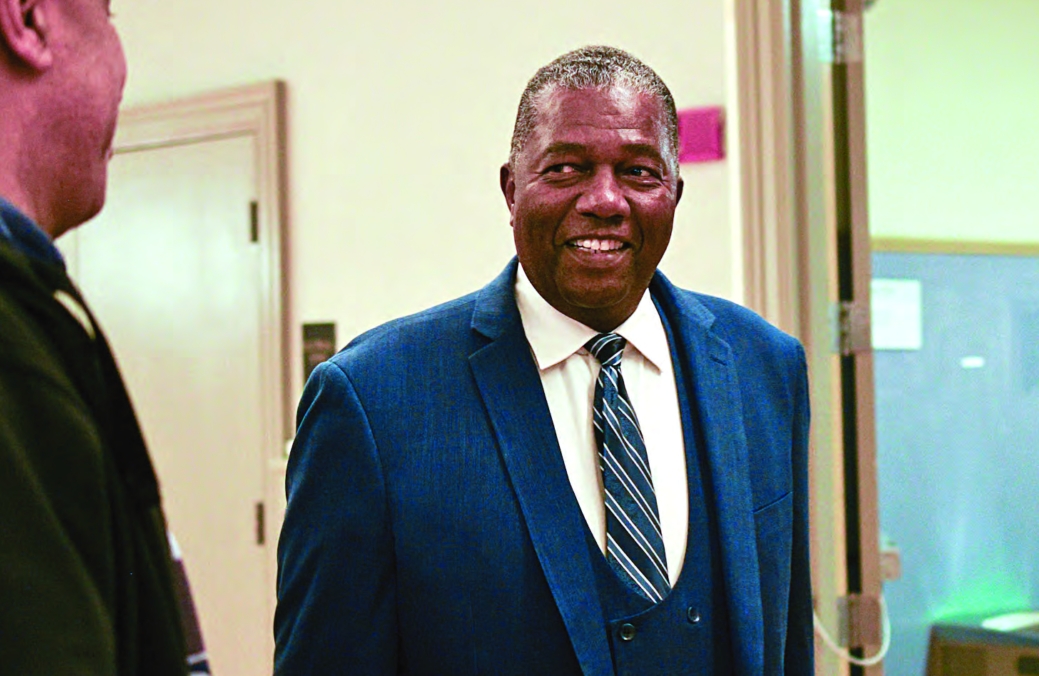
District 7 City Councilor-elect Miniard Culpepper talks with supporters at his election watch party at Hibernian Hall, Nov. 4. Culpepper won his bid to represent the district — which includes parts of Roxbury, Dorchester, the South End and Fenway — by 600 votes over his opponent Said Ahmed, according to unofficial results from the city of Boston.
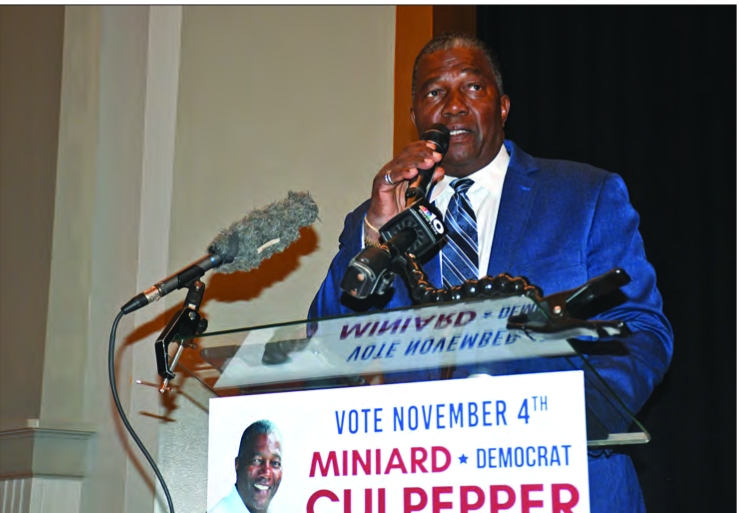
Miniard Culpepper gives a victory speech at his election watch party at Hibernian Hall, Nov. 4. The minister, attorney and now District 7 councilor-elect won the election by an about-600-vote margin for the district that includes parts of Roxbury, Dorchester, the South End and Fenway.
Four incumbent at-large city councilors are re-elected
The race to fill District 7’s open City Council seat, which started with a packed field of 11 candidates, ended Tuesday night when Miniard Culpepper declared victory in a speech to dozens of his assembled supporters.
During his election night watch party at Nubian Square’s Hibernian Hall, Culpepper called the win a tribute to the efforts of his supporters.
“This hasn’t really been a political campaign; it’s been a community campaign,” Culpepper said. “Folks came together across the board — from the South End, to Roxbury, to Fenway, to Dorchester — folks came together across this district.”
Culpepper, an attorney and senior pastor of Pleasant Hill Baptist Church, scored 53% of the vote, with 3,874 votes, according to unofficial results released by the City of Boston. Culpepper’s opponent, Said Ahmed, trailed by about 8 percentage points, with 45% of the vote and 3,275 votes.
Throughout the race topics like housing access, support for small businesses, public safety and addressing the dual crises of substance abuse and homelessness at Mass and Cass took center stage.
When he addressed his crowd of friends, family and volunteers at his victory party, Culpepper said “the battle starts now” to take steps to turn subsidized development into homeownership opportunities, to address Mass and Cass and to bring strategic development and economic growth to District 7.
Culpepper ran on a platform that included steps like supporting the use of Section 8 vouchers for mortgage payments; creating Empowerment Zones, a federal designation that opens economically distressed areas to receive grants or tax incentives to foster economic growth in areas like Nubian Square and Grove Hall; and establishing a care campus with harm reduction services and other recovery resources to support individuals struggling with substance abuse.
For many in District 7, another key concern as they considered whom to elect to the City Council seat was the concept of serving as an “independent voice,” district leaders who would serve the interests of the district, not outside influences or other city leadership.
That element of the race posed a hurdle for support for some who raised concerns about earlier statements by both Culpepper and Ahmed in support of the city’s plan to redevelop Franklin Park’s White Stadium through a public-private partnership. Some community members worried that stance was an indication that they might serve as a rubber stamp for Mayor Michelle Wu’s agenda. (In more recent events, both candidates said they believed there should be more community involvement in those plans.)
During an interview with reporters following his victory speech, Culpepper said he has a strong relationship with Wu, having worked together on U.S. Sen. Elizabeth Warren’s 2012 campaign, and said he believes he and the mayor “agree on a lot more than we disagree.”
But he also promised to reflect the voice of residents of the district, not the Wu administration.
“I’m not a guaranteed vote for anyone except for the voters of District 7,” Culpepper said in response to a question about whether he would be a “guaranteed vote” for the Wu administration. “That’s the guaranteed vote I want, and they guaranteed me with their vote tonight that I should go to City Council to be an independent voice for District 7.”
When pressed, he said he was ready to have hard conversations with Wu about topics like the city’s proposed bus lane and transportation overhaul on Blue Hill Avenue, which has faced strong community pushback. He said he is “100% against” the project.
A field of 11 candidates
The District 7 race was spurred, and in many ways defined, by the resignation of City Councilor Tania Fernandes Anderson, who was arrested in December and pled guilty to one count of wire fraud and one count of theft concerning a program receiving federal funds. Fernandes Anderson reported to prison in mid-October, where she will serve a one-month sentence followed by three years of supervised release and will have to pay $13,000 in restitution.
Her resignation left an open seat on the council, the only one in this year’s election, which attracted a field of 11 candidates in September’s preliminary election.
At the end of the preliminary election, Ahmed came out on top but only by a narrow margin, scoring 15.8% of the district’s vote. Culpepper, 58 votes behind, scored 15.1% of the vote.
In that election, the top five candidates differed by a total of 113 votes.
Once the field narrowed, Culpepper started to score a host of high-profile endorsements. By the time of the general election, he had landed the support of elected officials at the state level, including Sens. Liz Miranda and Lydia Edwards and Suffolk County District Attorney Kevin Hayden, as well as Massachusetts elected officials at the federal level, including U.S. Rep. Ayanna Pressley and Sens. Ed Markey and Elizabeth Warren.
He also received endorsements from the Boston Globe and Boston Herald and organizations including the Boston Teachers Union.
Daniela Baez, a 22-year-old Roxbury resident, said she saw this election as a moment for change in District 7.
“From what I’ve seen and what I’ve been through — because I’ve lived here my whole life — we want a lot of positive impact, a lot of change for our people,” she said.
Culpepper said that in speaking with residents, he heard people say they were ready to have someone filling the seat, which has been empty since July.
“When I look at every corner of the district that I went to, I heard folks say, ‘I want representation,’” Culpepper said. “I heard folks say, ‘We need help.’ I heard folks say, ‘Mass and Cass and housing.’”
Allison Anderson, civic engagement coordinator at the Madison Park Development Corporation, said the election marks a moment where voters once again get a voice on the council.
“This election is going to be the time where this district actually has a person that’s going to be our voice, that represents Roxbury,” Anderson said. “We haven’t had a person in this seat for quite some time, so a lot of people have a lot of questions.”
She pointed to local challenges like the closure of grocery stores and pharmacies, as well as other factors at the federal level such as cuts to SNAP and a potential freeze of those food assistance benefits.
“There’s a lot of things that are happening in this community that we need someone who’s going to have the willpower to stand up for the community and get the things that need to be done, done,” Anderson said. “This election is super important, especially for D7.”
A year after voters across the country elected President Donald Trump back into the office, and on the backdrop of a dramatic federal landscape that his election has wrought, Rev. Willie Bodrick, senior pastor at Twelfth Baptist Church, said the importance of voting is especially stark.
“Every election matters,” Bodrick said. “We know that now, with an even greater sense of understanding.”
For some, Ahmed was the right person to fill that empty seat. Baez said that after researching the candidates, she liked the pitch Ahmed made as a longtime resident of the district.
“I feel like he had background, or history, or just growing up here,” she said. “That’s something that stands out to me. He has an understanding of living here: the struggles, the positives, all of those different things.”
Ahmed moved to Roxbury when he arrived in the country as a Somali refugee, at 12 years old (Culpepper, too, grew up in District 7).
She said she was also inspired by Ahmed’s history as a runner and a coach, working with kids in the community.
Ultimately, Culpepper’s steady voice and experience — his victory comes after decades working in the campaigns and offices of state and federal elected officials — won out.
Samuel Hurtado, who endorsed Culpepper after running against him in the preliminary election, said he felt if he wasn’t elected to the District 7 seat, Culpepper was the best option.
For Hurtado, much of that choice fell on Culpepper’s experience with the U.S. Department of Housing and Urban Development, which throughout the campaign he touted as an indicator that he could bring positive change to the housing affordability landscape in District 7.
“I definitely trust that Miniard Culpepper had the experience and the character to do well, to protect District 7 from going to private corporate investors and maintain the families in the district,” Hurtado said.
Culpepper also scored endorsements from former opponents Said Abdikarim and Wawa Bell.
For others still, the choice between Culpepper and Ahmed brought less enthusiasm.
Leonard Nelson, a 66-year-old Roxbury voter, said he’s “always optimistic about any election” but has doubts about whether the candidates are as committed to the community and its needs as they should be.
He said he knows both candidates, but neither very well, and is not sure the current crop of candidates have District 7’s best interests at heart.
Ahead of the general election, both candidates faced a tough crowd during a forum with the District 7 Advisory Council, a group of community leaders that had been organized by Fernandes Anderson to help guide the district’s seat tack on the council.
At that event, members of the advisory council made clear, through questions and some commentary, a level of distrust for both Culpepper and Ahmed.
Speaking with reporters after claiming victory, Culpepper said he intended to keep the advisory council but that he’d “probably modify it in some ways.”
Although the District 7 seat has been open for four months, Culpepper is currently not slated to be seated until January. In the meantime, he said he plans to meet with community members to prepare for next year so that he will be “off and running” to represent a district that he believes has a big impact on the rest of Boston.
“I think this district is the heartbeat of the city,” Culpepper said. “How this district goes, I think, will determine how this city goes.”
Tuesday’s election also saw the reelection of Wu to the city’s top seat. She faced no competitors in the city’s first uncontested mayoral race since the late Mayor Tom Menino ran unopposed in 1997, after former opponent Josh Kraft dropped out of the race after he trailed Wu by nearly 50 points in the preliminary.
Third-place candidate Domingos DaRosa didn’t score enough votes in the preliminary to advance to the general election in Kraft’s place.
The four incumbent at-large city councilors — Ruthzee Louijeune, Erin Murphy, Julia Mejia and Henry Santana —were reelected as well, according to unofficial results published by the city.