
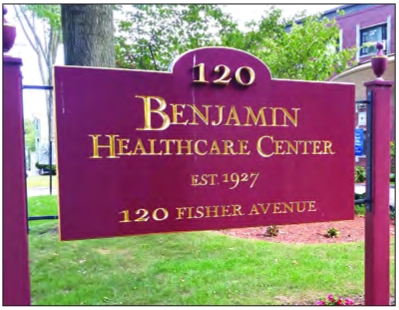
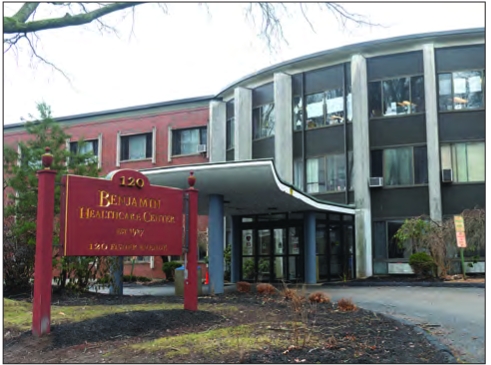
The Edgar P. Benjamin Healthcare Center on Mission Hill, shown March 6.
Community members aired concerns about the pending sale of the Edgar P. Benjamin Healthcare Center to Allaire Health Services at a Department of Public Health public hearing on Nov. 6.
The New Jersey-based, for-profit, long-term care operator was recommended to take over operations of the facility by Joseph Feaster, the facility’s court-appointed receiver, in July.
Community members at the public hearing, which was held over a telephone conference call that lasted about an hour, were generally hesitant or opposed to the sale, which they said they worry could negatively impact residents or the facility. They also expressed concern about limited communication about the pending sale.
Staff from and attorneys for the court-appointed receivership have described the proposed sale of the Edgar Benjamin to Allaire as a chance to save the facility, which has been facing financial difficulties for years.
The deal includes a $6.5 million payment for the facility and its operations, as well as a post-acquisition investment of between $2 million and $4 million for general renovations and improvements at the Mission Hill facility.
The center faced a potential closure in early 2024 when then administrator Tony Francis sought to shutter the facility by the summer under allegedly insurmountable financial challenges.
Months later, a court-ordered receivership pushed Francis out of his leadership position at the facility after staff went unpaid repeatedly, and amid allegations that Francis was mismanaging the center’s finances.
But others said a sale to Allaire risks a valuable long-term care resource. The Edgar Benjamin has been in operation for almost a hundred years — it opened its doors in 1927 — and in that time has primarily served the area’s Black and brown elderly residents.
Community members said they worried that a takeover by Allaire, an out-of-state company, would mean the end of engagement with local businesses and vendors, as well as a loss of the cultural presence the facility has had.
“There is a loss of the cultural awareness,” said Dr. Kenya Hanspard, the center’s medical director, at the public hearing.
“[Edgar] Benjamin did this for a reason, because there was a time where people of color could not go and rehab from their illness because of segregation.”
Kyle Kramer, Allaire’s chief strategy officer, said the company is used to coming into facilities with a cultural legacy and working to protect and maintain, but also elevate it.
He said the company has taken over facilities with strong religious connections — like Catholic, Lutheran or Baptist care facilities — and in predominantly Spanish-speaking communities.
Paul Lanzikos, a cofounder and coordinator of Dignity Alliance Massachusetts, an organization that advocates for long-term care facilities, said that to foster more community connection, in addition to residents’ and relatives’ councils — groups allowed for and protected under state and federal law to advocate for conditions at the facility — he would like to see a community advisory board that could give input on the facility and its operations.
At the hearing, community members proposed concepts like keeping the land under ownership of a local nonprofit entity so that if the sale goes through, Allaire can’t just decide to redevelop it in a matter of years.
Others raised concerns about Allaire’s status as a for-profit company.
“I’d like to know what checks and balances will be implemented and how transparent is this transition in regards to the policies that will be implemented moving forward,” said one speaker, whose father is a resident at the Edgar Benjamin. The speaker also expressed concerns that profit incentives could lead to reduced care.
Another person on the call, whose aunt resides at the Edgar Benjamin, said she chose the facility because of its nonprofit status.
“I’ve had bad experiences with for-profit facilities, and that’s one of the many reasons we chose to place my aunt at the Benjamin, because it was a nonprofit,” she said.
Kramer said he “certainly understands” those concerns, especially in light of the state’s history with Steward Health Care, which left the state in a messy process last year with bankruptcy proceedings that closed two hospitals, including Carney Hospital in Dorchester.
“Obviously we want to run the buildings that we own as efficiently and effectively as we can because healthcare is a business,” he said. “But in conducting that business, we’re very, very focused on maintaining the culture that exists within building services necessary to support the population and the relationships within the community that elevate the overall presence of the facility and the services that are provided therein.”
Also of concern for some was that the sale to Allaire felt like a “foregone conclusion” and that any commentary or feedback provided at the hearing held little weight.
“This is the first time some of us are hearing about it, and it sounds like it’s a foregone conclusion, which is maddening,” said one community member, whose aunt lives at the Edgar Benjamin.
For Richard Phipps, president of the Mattapan Community Development Corporation, that sentiment made the intent of the public hearing fall flat.
“Public comment makes no difference if you’ve already decided,” Phipps said.
Last summer the Mattapan CDC submitted a competing bid against Allaire that was not selected by the receivership.
At the start of November, an administrator affiliated with Allaire took over operations of the Edgar Benjamin.
Lanzikos said he saw the timing of that appointment “interesting.” The position had been empty since former administrator Delicia Mark left earlier this year after months of butting heads with staff from the receivership.
Feaster said that as receiver, state officials had been pressing him to fill the administrator position and that he would “take a good administrator from wherever I can get them.”
Kramer said that having an Allaire staff member at the Edgar Benjamin is an attempt to start building bridges with residents and staff if the deal goes through.
“The advance presence of someone from Team Allaire is really just that: it’s the getting-to-know-you phase,” Kramer said. “It’s building a connection and supporting relationship developments that when things ultimately do go through — and we’re optimistic that they will — that we’ve got a head start on all of those things.”
Officially, the sale is not a done deal. According to Feaster, if the transfer is not approved, the matter will go back to the court where he will either seek a new owner-operator or determine that the Benjamin must be closed.
Others at the hearing expressed concerns about how the pending sale was — or, by their account — wasn’t communicated to family members of residents at the facility, with one relative calling this “absolutely unacceptable.”
Feaster said the receivership previously held a meeting for residents and family members about the sale and that an email was sent out. That meeting, he said, took place earlier this fall.
“We’ve been transparent about our process,” Feaster said.
Questions but no answers
The format of the public hearing, too, presented some frustration for community members. Participants were given time to provide comments or ask questions, but the event was not an information session; any questions asked were not answered, but rather will be used by DPH to inform its determination.
At one point, a community member who joined the conference call late tried to ask a question, only to have to pivot when she was told that questions wouldn’t be answered.
Phipps said he was disappointed in the structure and said he saw it as “quite a sham.”
But, while Lanzikos, too, has concerns about the format and said he’d like to see it changed, he also said the structure of the event was consistent with how DPH runs this sort of hearing and met the letter of the law.
Community members faced the same disconnect and frustration in early 2024 when DPH held a similarly structured meeting as part of the process it follows when an operator seeks to close a facility, like the center’s administration was attempting to do at the time.
Bid process objections
The public hearing was requested by the Mattapan CDC and Hanspard, who separately had attempted to intervene in the court-monitored sale of the facility in early October.
In their court filing, Hanspard and the Mattapan CDC alleged that the bid process was mismanaged and suggested that Allaire was a poor choice to take over the facility. Their motion asked to restart the bid process.
That request to intervene was denied by Suffolk County Superior Court Judge Anthony Campo, who said in his ruling that “time is of the essence to improve this situation” and that restarting the process could be harmful to residents and the facility.
They followed their request with bids to own and operate the Mission Hill nursing home. The Mattapan CDC, Hanspard and Total Care, a Boston homecare company, all submitted bids and were offered by Feaster to submit a joint proposal.
Phipps said that the three together were told over the phone that if they created a joint proposal, they would be selected to own and operate the Edgar Benjamin.
Feaster has said he didn’t communicate that any bidders were out of the running until he selected Allaire’s bid as his final recommendation to the court in July.
While the coalition of the three prospective bidders has since come apart in some ways, Phipps said he still believes Mattapan CDC has the resources necessary to pull off a “stunning recovery for the Benjamin facility.”
Feaster has said that he felt none of the three local bidders were equipped to take over the facility on their own and that Allaire struck him as the best choice.
For months, the court has pushed the process forward, urging the receivership, representatives for the Department of Public Health, the attorney general’s office and most recently Allaire, to keep the process moving in an attempt to bring a measure of stability to the lives of residents at the Edgar Benjamin.
Now the Department of Public Health will consider the feedback from community members and make a determination regarding whether to approve Allaire’s bid to take over operations.
If the facility is sold to Allaire, details of the transfer must also be approved by the Public Charities Division of the attorney general’s office.