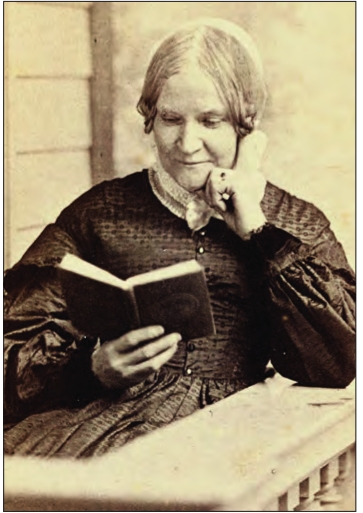
Portrait of Lydia Maria Child ca. 1866-1869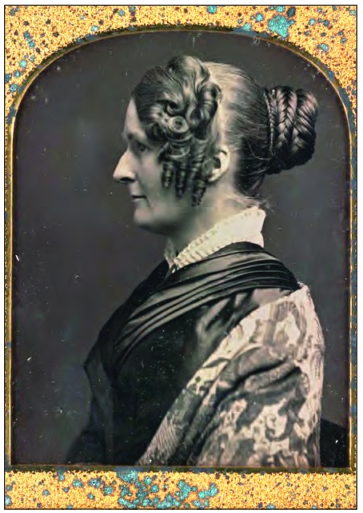
Portrait of Maria Weston Chapman, Daguerreotype ca. 1846
A Plays in Place production performed at BPL
In 1833 Boston abolitionist Lydia Maria Child wrote a book that upended her career. The book, “An Appeal in Favor of That Class of Americans Called Africans,” was the first American publication that called for the immediate end of slavery. The push for the abolition of slavery was a radical act in Child’s day. It would be an additional 32 years until the 13th Amendment abolishing slavery was passed.
Child was not the only prominent Boston abolitionist in her time. She had an occasionally fraught relationship with another local abolitionist, Maria Weston Chapman, who was arguably more radical. Chapman was a forceful and influential member in the Boston Female Anti-Slavery Society, an organization that drew national attention to the abolitionist cause. Their strained relationship is explored in the upcoming staged reading “A Revelation of Character” at the Central Library in Copley Square’s Rabb Hall on Nov. 12, 13 and 15 presented by the Associates of the Boston Public Library’s Pierce Performance Series in partnership with Plays in Place.
“A Revelation of Character” was written by Patrick Gabridge and is directed by Lisa Rafferty. The piece is a Plays in Place production, an organization that stages site-specific plays and readings at historic sites and museums. Gabridge wrote “A Revelation of Character” using the Boston Public Library’s archival special collections, which include the women’s archived letters, diary entries and contemporary newspaper articles to get a better understanding of the humanity of the protagonists and to bring their words to life.
The reading consists of three actresses portraying Lydia Maria Child, Maria Weston Chapman and Chapman’s younger sister, Deborah Weston. The protagonists are dressed in period clothing made by costumer Kat Lawrence as they read Gabridge’s script from music stands. On a phone call Rafferty said Deborah Weston’s character is used as an intermediary between the two “frenemies of the American Revolution.” Weston acts as a release valve in the script and brings a level of humor and wit that’s interspersed between the more serious moments of the play and its themes.
During a phone call Gabridge explained the risk these women take by standing up for antislavery when they had much to lose. In the 1830s and ’40s women were prohibited from voting, and these two abolitionists were facing familial and financial woes like infant mortality and career and reputational blows. Today it might be hard to fathom how unpopular the abolitionist movement was.
Gabridge said, “When she [Child] publishes ‘An Appeal in Favor of That Class of Americans Called Africans’ her career is tanked. I mean she’s canceled. Her books are taken off the shelves. Her magazine that she publishes for children is gutted. She knew that could happen and she’s surprised, but this was also somebody you could see the full level of commitment.”
When Child finally quits the abolitionist movement, Chapman writes a scathing critique that Child’s resignation is a “revelation of character.” It is a criticism that Gabridge thinks is unfair.
Gabridge wonders if we ask too much of our heroes. He ponders when it’s appropriate to ask our
heroes to pass the baton to younger generations to fight the good fight.
There will always be causes to rally for and moral failings to fight
against. Is it too much to ask for human perfection when fighting
against imperfect systems?
Rafferty
said, “I hope the audience afterward says, ‘Well, wait a minute. These
women had nothing. They had no rights in society. They had no standing
and it didn’t stop them.’”
Gabridge
said of Chapman, “There’s this quote attributed to Maria Weston Chapman
when they’re under attack by a proslavery mob at their headquarters.
They’re after [William Lloyd] Garrison but they’re attacking these
people and she says, ‘If this is the last bulwark of freedom, we might
as well die here as anywhere.’” Gabridge continued, “If you’re someone
who can say stuff like that and mean it, I’m interested in you.”
ON THE WEB
Learn more at bibliocommons.com/events/68c95a0bfe1db36a65404a2d and playsinplace.com


