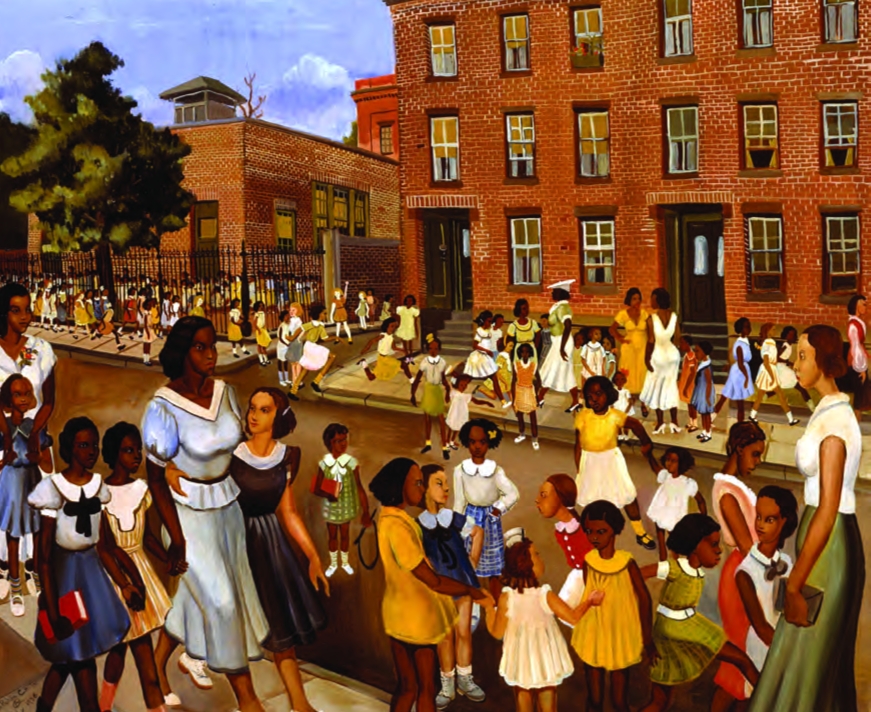
(Clockwise
from top left) “A course in music appreciation” 1940, watercolor with
black ink and white highlights over graphite, Boston Athenaeum. Gift of
Allan Rohan Crite, February 1971. Courtesy of the Allan Rohan Crite
Research Institute and Library | “Harriet and Leon” 1941. Oil on canvas.
Boston Athenaeum, Gift of the artist, 1971. Courtesy of the Allan Rohan
Crite Research Institute and Library | Allan Rohan Crite on Columbus
Avenue in Boston’s South End, 18 April 1981. Photography courtesy of
Aukram Burton, RamImages.com
| “School’s Out” 1936. Oil on canvas. Smithsonian American Art Museum,
Transfer from General Services Administration. Courtesy of the Allan
Rohan Crite Research Institute and Library. 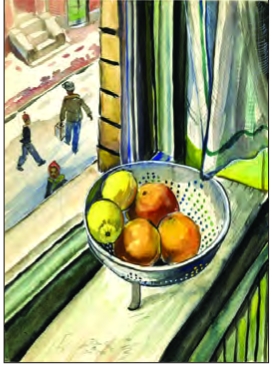
“Fruit
and snow: from my window at 2 Dilworth St.” (1940) Watercolor with ink
and white highlights over graphite. Boston Athenaeum. Gift of Allan
Rohan Crite, February 1971. Courtesy of the Allan Rohan Crite Research
Institute and Library
‘Allan Rohan Crite: Griot of Boston’
The Athenaeum’s exhibition “Allan Rohan Crite: Griot of Boston” was curated by Christina Michelon, formerly of the Boston Athenaeum and now curator of prints and drawings at the Museum of Fine Arts, Boston. Presenting works from its extensive Crite collection, the exhibition unfolds in the Athenaeum’s Norma Jean Calderwood Gallery and Leventhal Room.
The gallery installation opens with a 1977 statement by Crite in which he describes himself as a griot, a storyteller in the West African tradition. “That’s what I’ve been doing all of my life in all my drawings. I’m a storyteller.” Next to it is his oil painting “The News” (1945), which shows four men on the corner of Columbus Avenue and Northampton Street reading newspapers that report the death of President Franklin Delano Roosevelt on April 12, 1945. The white folds of the newspapers center the urgent and absorbed figures of the men, who include a soldier.
An intimate, eye-level visual memoir unfolds on the gallery’s walls and in display cases, which present 84 images and objects, including oil sand watercolors, archival papers, drawings, letters, pages of books and works on paper.
Captivating watercolors render street scenes with
more fluid lines and a lighter palette than in Crite’s oil paintings. In
the lyrical “Fruit and snow: from my window at 2 Dilworth St.” (1940),
the lines of the window frame and sidewalks below compliment the curves
of the sieve and fruits.
Inducing a long gaze, the image shows the power of art: The house is destroyed; but this image stays.
“A
course in music appreciation” (1940), with its animated, tender
depiction of a motley group on a bench enjoying a portable record
player, venerates community life.
In the 1950s, Crite adopted offset lithography and installed a press in his home, where he churned
out liturgical drawings for weekly church bulletin covers as well as
pamphlets advocating recognition of First Peoples and communities of
color and other causes he cared about. On display is a printing plate he
would draw on to immediately produce multiples.
Self-published
documents are on display as well as beautiful ink drawings from “Three
Spirituals from Earth to Heaven” (1948), published by Harvard University
Press with a forward by the great tenor Roland Hayes.
In
“Our Lady of Harvard Square” (ca. 1955), the Madonna hovers over its
warren of small streets and in “Our Lady of the Migrant Workers/Nuestra
Senora de los Braceros” (1961) she joins the laborers.
Concluding
the gallery exhibition is Crite’s “Settling the World’s Problems”
(1933), which shows a group of men and their medley of expressive hands
as they gab on a bench in Madison Park, lost in the 1960s to Roxbury
urban renewal.
In the
Leventhal Room, eight oil paintings by Crite from 1935 to 1941 are on
display. One is a fine example of portraiture, “Mrs. Martin’s Misses”
(1941). The three sisters were neighbors of the Crite family and fellow
parishioners. With masterful use of color, line, light and shadow, Crite
conveys his subjects’ features and the texture of their skin and
clothing.
On
display nearby is an illustrated timeline of Crite’s life and an
installation by Roxbury-based artist Ekua Holmes, whom Crite mentored.
She displays collages she made when planning “A Place to Grow,” her
joyful mural in the Athenaeum Children’s Library that shows Black
children at play in Boston settings.
Admission
to the Athenaeum exhibition is free to Gardner Museum visitors and
members. Those who visit the Athenaeum first will receive $2 off
admission to the Gardner Museum.
ON THE WEB
Learn more at bostonathenaeum.org


