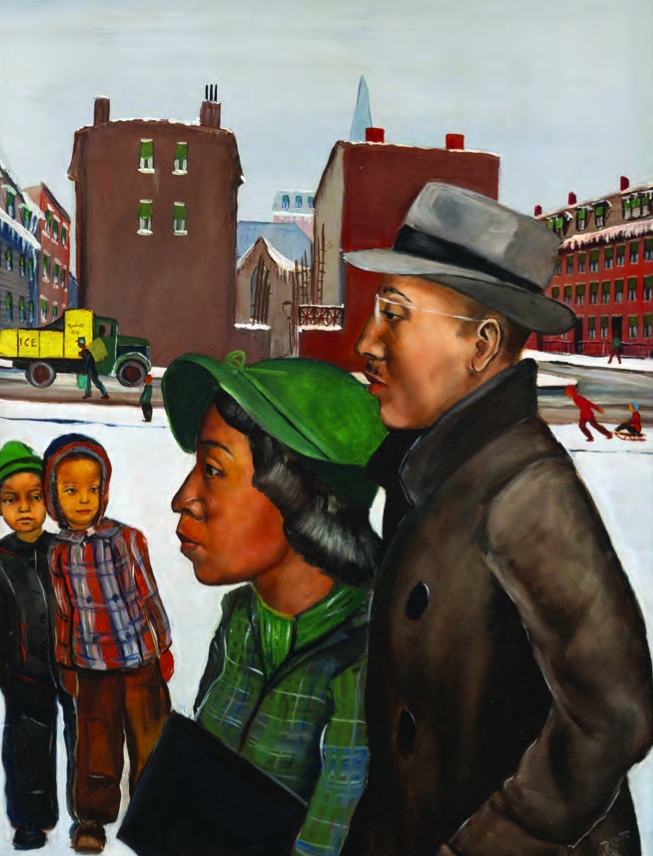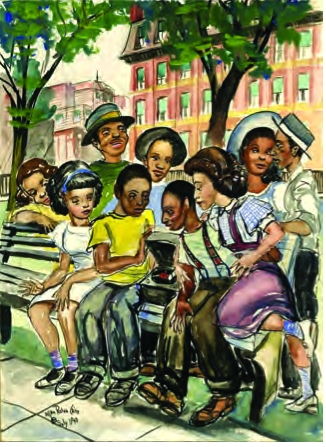
The impact of Allan Rohan Crite (1910–2007) as an artist and a community leader is the subject of exhibitions at two historic Boston cultural institutions that he cherished: the Boston Athenaeum and the Isabella Stewart Gardner Museum.
The Gardner Museum, a lifelong place of inspiration for Crite, presents Allan Rohan Crite:
Urban Glory through Jan. 19; and at the Boston Athenaeum, Allan Rohan Crite: Griot of Boston is on view through Jan. 24.
Crite
was a member of the Boston Athenæum and donated many of his works to
this library, museum and cultural center on Beacon Hill, which houses
one of the largest institutional collections of his art and archives.
As
part of their concurrent celebration of Crite and his legacy, the
Gardner and the Athenaeum have co-published the first catalog of Crite’s
work, “Allan Rohan Crite: Neighborhood Liturgy,” edited by Diana
Greenwald and Christina Michelon, curators, respectively of the Gardner
and Athenaeum exhibitions. The catalog is the first extensively
researched, fully illustrated, career-spanning book about Crite and
includes scholarly essays and recollections of the artist from his
friends and colleagues.
Crite is well known for his paintings depicting daily life in the Black community of Boston’s Lower Roxbury and South End
neighborhoods during the 1930s and 1940s. As massive rebuilding
projects displaced his family and demolished entire neighborhoods, with
art, and later through advocacy, he practiced his own kind of urban
renewal.
Seen today, his works, like the tales of griots in West Africa, sustain community by telling its stories.
Crite’s
parents, Annamae and Oscar, raised him to participate in their parish
and neighborhood as well the surrounding city. Annamae nurtured her
son’s talents, taking him to art lessons in the South End at the
Children’s Art Centre and visits to the Museum of Fine Arts, Boston as
well as to the Gardner.
In
1971, when his family’s longtime home at 2 Dilworth Street in Lower
Roxbury was torn down for a Boston redevelopment project, Crite and his
widowed mother moved to 410 Columbus Ave. in the South End. A plaque on
the row house recognizes Crite as a “Master Visual Artist, Painter,
Printmaker, Author, Lecturer, Historian and Good Neighbor.” Planning is
underway for a nearby commemorative park.