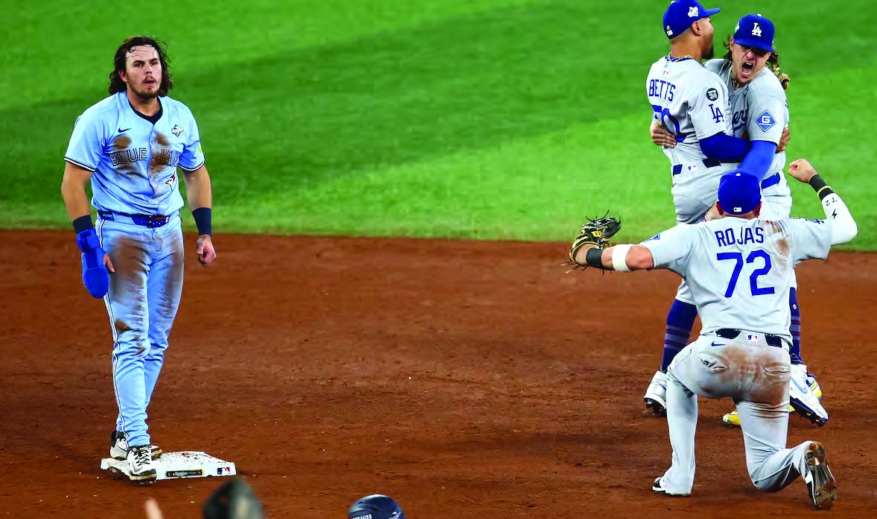
Toronto Blue Jays outfielder Addison Barger gets doubled up on the last play of the World Series. 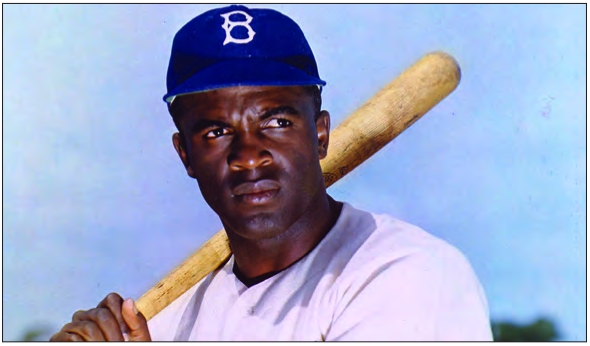
Jackie Robinson helped the Dodgers win their first World Series Title.
This year’s World Series Championship — number nine in Dodger franchise history —was a seven-game triumph over a tough and gritty Toronto Blue Jays team. The Jays were returning to the series after a 32-year absence. Vladimir Guerrero Jr., the son of Hall of Famer Vladimir Guerrero Sr., valiantly led them.
The Blue Jays pounded the Dodgers 11-4 in Game 1, leading to the valiant effort of series MVP Yoshinobu Yamamoto in Games 2, 6 and 7. The most exhausting game of the series was Game 3, an 18-inning affair that came to a close on a climactic walk-off home run by Freddie Freeman (who else), who became the only player in Major League Baseball history to decide two World Series Games with walk-off home runs. His history-making blast gave the Dodgers two games to one lead in the best of seven series.
However, credit the Toronto Blue Jays, who picked themselves up off the proverbial deck, with solid pitching, strong defense and clutch hitting to win games 4 and 5 before a stunned Dodgers home audience, taking a commanding 3-2 lead back to Toronto. Enter Yamamoto, who took control for six innings to record the win that would push the series to a seventh and deciding game, with so much history at stake.
The Dodgers were attempting to become the first National League team in 50 years to repeat as World Series champions since the Cincinnati Reds during the 1975 and 1976 seasons; a fact that seemed to be lost by many network broadcasters who continued to speak of the New York Yankees team that “three-peated” from 1998-2000 — a period of 25 years while waiting to the late stages of this 2025 World Series to address the “Half-Century Gap” of repeat National League World Series champions.
“Game 7,” in modern-day sports parlance, is one of the monumental events of baseball, basketball and hockey. Such was the case as the visiting and defending World Series champion Dodgers, who took the field against the home team, the Toronto Blue Jays, before a delirious sellout crowd at Rogers Stadium. This became more than just a World Series game; it was a battle between America and Canada — a thought that may seem too jingoistic today but reflects the present-day climate of sports.
Shohei Ohtani (Dodgers) and Max Scherzer (Blue Jays) were the starting pitchers for the respective teams in this winner-take-all game, the first Game 7 in World Series competition since 2019, featuring the Washington Nationals against the Houston Astros. The Jays jumped out to a 3-0 lead in the third inning when Bo Bichette blasted a three-run homer off Ohtani, knocking him out of the game (after 51 pitches) in the process. It was an uphill climb for the visiting Dodgers from that point to the conclusion.
Trailing 4-2 after seven innings, the Dodgers were given a lifeline by an eighth inning solo home run by Max Muncy, his third home run of this postseason and 16th, the most in franchise history. This set the stage for reserve infielder Miguel Rojas, who was inserted into the Dodgers’ lineup for games 6 and 7 due to his solid defensive work, which paid big dividends in both games. But it was his bat, along with his glove, that wrote his name into Dodgers lore. With one out, in the top of the ninth inning, Rojas (who had not hit a home run since Sept. 19), batting in the ninth position, struck a “lightning blow” for the ages with a home run on a 3-2 pitch from Jays closer Jeff Hoffman, to tie the game at 4-4.
The
Jays loaded the bases in the bottom of the ninth. Enter the great
“defense” by Rojas, who speared a sharp grounder, and while falling off
balance, Rojas: “I had to play back on the ball because of the hard
bounce off the infield surface.” He threw home for a force-out at the
plate to prevent the winning run from scoring, with catcher Will Smith
getting his foot on the plate just a fraction of a second before a
sliding Isiah Kiner-Falefa. And if that wasn’t enough to stop a
heartbeat, Ernie Clement (the hitting star of the series, compiling a
record 30 hits) drove a deep drive to left centerfield, which looked
like a sure-fire World Series game-winning hit. But it was not to be as
centerfielder Andy Pages, (a late-inning defensive replacement who was
1-for-16 at the plate for the series) made one of the alltime great
catches in World Series History — a leaping, one-handed catch before
crashing into teammate Kiké Hernández on the warning track — literally
saving the game and sending it to extra innings. The Blue Jays had
multiple chances to score throughout this series but failed to come up
with the “big hit” numerous times.
Following
a scoreless 10th inning, Dodgers catcher Will Smith (who set a record
by catching every inning of this World Series) hit the game-winning home
run off Shane Bieber to give the Dodgers a 5-4 lead. Back came the Blue
Jays in the bottom of the 11th inning. Guerrero led off the ninth by
doubling down the left field corner. He moved to third on a sacrifice
bunt. Addison Barger walked, putting runners at first and third.
Yamamoto broke the bat of catcher Alejandro Kirk, who grounded to Mookie
Betts, who stepped on second base and threw to first to complete the
double play to end the 2025 World Series. Yoshinobu Yamamoto (series
MVP), who pitched two-plus innings of gutsy relief, became the winning
pitcher of a very climactic seventh game of the 2025 World Series — only
the third Game 7 of 121 World Series to be decided in extra innings
behind the 1924 Washington Senators over the N.Y Giants in 12 innings —
longest in history and the 1997 contest with the Miami Marlins beating
the Cleveland Indians in 10 innings.
An
objective final analysis: the Blue Jays (the best team in baseball with
runners in scoring position as well as the best team in “productive
outs” this season) outhit, played superior defense and generally
outplayed the Dodgers, who recorded one of the lowest batting averages
of any World Series Champion. But it was the “Championship DNA” and
“come back” ability of this Los Angeles Dodgers team (54th
come-frombehind win this season, tied for the lead in Major League
Baseball) that made it one for the ages.
The first National League team to repeat as World Series champions in five decades since the Cincinnati Reds of 1975 and 1976.
Watching
the “Victory Parade” to celebrate this Los Angeles Dodgers World Series
championship team reminds me of the year 1955, the first of the
Dodgers’ nine World Series championships. They were the Dodgers of
Brooklyn, N.Y., back then — a team nicknamed “The Boys of Summer.”
What
made that team so special was the fact that they had finally beaten the
New York Yankees, their longtime tormentors. What made the moment even
more special was the fact that these were the “Dodgers of Jackie
Robinson,” the most iconic figure in the history of modern-day baseball.
Robinson, who lives in our memory as “The Man Who Broke Major League
Baseball’s Infamous Color Line” in 1947, was a mythical hero to Black
people. For his outstanding contributions to the Dodgers organization
(on and off the field) and the game of Major League Baseball, Robinson’s
famous “Number 42” is “permanently retired” by every Major League
Baseball team today. He was, and still is to this day, the reason that
so many Black people are, and will always be “Dodgers fans.”
My
first memory of the “magnitude” of what would become “The Dodger
Legacy” occurred the day that Johnny Podres pitched the Brooklyn Dodgers
to a 2-0 victory over the Yankees, before a sellout crowd and millions
of television viewers across America. I can still vividly remember my
father and mother screaming with joyful tears cascading down their
cheeks. My father was not a man to show his emotions, but I’ll remember
his tears for the rest of my life.
The
next Dodgers World Series title came in 1959 as the Los Angeles Dodgers
beat the Chicago White Sox with reliever/closer Larry Sherry (series
MVP) saving all four Dodger victories. A common thread among the 1955
and 1959 Dodgers teams was a left-handed pitcher from Lafayette High in
Brooklyn named Sandy Koufax, who was signed right out of high school and
would reach legendary heights in the 1960s.
After
recovering from early wildness, Koufax would become one of the greatest
pitchers of the early and mid-’60s, pitching the Dodgers to a four-game
sweep of the Yankees in 1963 and a seventh game World Series victory
over the Minnesota Twins (1965). Koufax struck out a (then) record 15
Yankees in Game 1 and 10 in Game 4 in what many consider the finest
display of pressure-pitching in the history of postseason baseball. He
became an even greater sports figure when he announced his refusal to
pitch on Yom Kippur, the holiest day on the Jewish calendar, in 1965.
Jackie Robinson became one of the first to speak out in support of
Koufax’s decision. Sandy Koufax’s stand drew
international headlines. He was lauded by people all over the world as
he became more than a talented athlete — he became recognized as a “Man
of Courage.”
The
future Hall of Fame hurler would return to pitch Game 7 of the ‘65 World
Series — on two days’ rest — blanking the Twins 2-0 while striking 10
and throwing over 100 pitches (mostly fastballs, to which he later
stated: “I had no feel for my curveball, so I followed my catcher’s
(John Roseboro) advice when he told me, ‘Sandy, just blow ‘em away with
your fastball.’” Koufax: “And I followed his advice to the letter.”
Sandy
Koufax would retire from baseball due to arm trouble at the end of the
1966 season, following his Dodgers team’s being swept four games to none
by the Baltimore Orioles, featuring Frank and Brooks Robinson.
The
franchise would return to glory in the strike-shortened 1981 season,
the year of rookie pitching sensation Fernando Valenzuela. LA dropped
the first two games of the ’81 series to the Yankees, who had already
beaten the Dodgers in the ’77 and ’78 World Series, thanks to the
heroics of Reginald Martinez “Reggie” Jackson.
Valenzuela
threw 154 pitches in Game 3 of the series to turn things back in the
Dodgers’ favor. His courageous performance was the inspirational and
critical factor in the Dodgers winning the next three games to become
one of the few teams in baseball history to come back from a 0-2 deficit
and win a World Series in six games. Valenzuela died before last year’s
World Series. The team stenciled his number 34 on the mound during its
run to the 2024 World Series Championship over the Yanks, and wore a
sleeve patch this year to honor his memory.
“It was fitting that we honored Fernando that way,” said Orel Hershiser,
who pitched the Dodgers to their sixth World Series title in 1988.
It
took 32 more years before the Dodgers would win title number seven over
the Tampa Bay Rays in 2020. Shortstop Corey Seager (NLCS and World
Series MVP) and Mookie Betts played starring roles in that one.
Freddy
Freeman etched his name into World Series and Dodgers lore last year.
His game-winning walk-off grand slam home run in game 1 of the series
catapulted the Dodgers to a five-game victory over the Yankees.
The
Dodgers would rally from a 5-0 deficit to win the deciding game, with
Freeman (Series MVP) playing the starring role in the World Series. The
team celebrated its eighth title with a massive victory parade,
culminating in a spectacular “Hollywood entrance” for manager Dave
Roberts and the champions. Addressing a sellout audience at Dodger
Stadium, Roberts didn’t just savor the win; he immediately looked ahead.
He seized the moment, challenging the team and the fans with a bold
statement: “Let’s try for a ‘3-Peat.’ The opportunity is before us, so
why not go for it?” His declaration instantly shifted the focus from the
recent triumph to the daunting, yet exhilarating, goal of winning three
consecutive championships. Congratulations to a special group of men
and a special organization. Jackie Robinson would be proud.


