
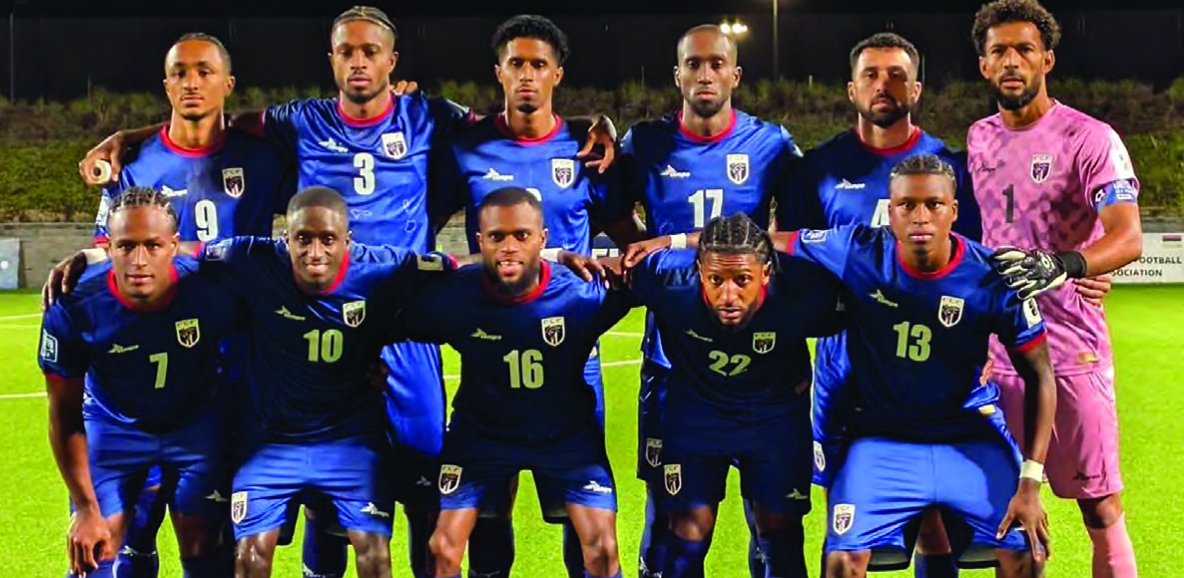
Cape Verde National Men’s Team
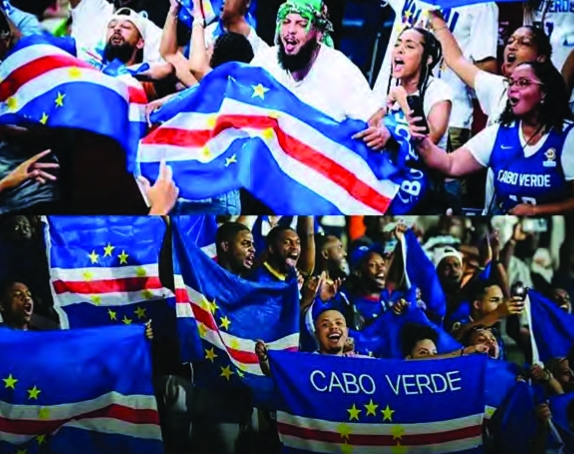
Cape Verdean fans are eager to see their team make history by appearing in the 2026 FIFA World Cup.
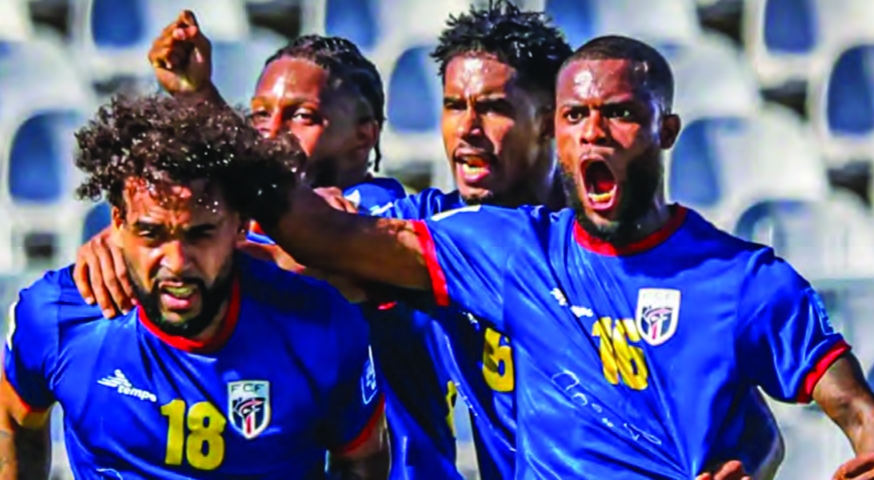
The Cape Verdean team finished at the top of their African Group D to earn a trip to North America.
If good things come in small packages, then Cabo Verde’s recent FIFA World Cup soccer qualification has been a pint-sized gift the world can’t stop talking about.
The Rhode Island-size country’s first-time participation will make it the second-smallest population ever to play in the quadrennial event to be hosted jointly next summer by the United States, Mexico and Canada.
Iceland, in Russia 2018, was the smallest country (400,000) by population to make it. Its Scandinavian roots and European economic advantages eased its approach to world football.
Cabo Verde, devoid of mineral wealth or commodities, overcame its modest means and minute population of roughly 600,000 through ingenuity and cultural wealth. Even when adding another million-plus from its foreign bases, the population remains paltry compared to the vastness of the countries it defeated to get there.
“I always had the dream of seeing Cape Verde in the World Cup,’’ said Jair Ribeiro, a former member of the New England Revolution and Cabo Verdean national teams. “I just didn’t know when it would be. So, it has come about much earlier than I thought it would.”
To arrive at this juncture by defeating Cameroon, Libya and Angola, Cabo Verde used a longterm vision and harnessed players from Portugal, the Netherlands, France and even Ireland. Combined with its homegrown talents, it has rounded into a plucky and charismatic team.
During the last dozen years or so the Blue Sharks, as they are known, have won over the African continent and fans from across the world impressed by their courageous performances against countries orders of magnitude larger in population, land mass, riches and soccer lore.
Ribeiro said Cabo Verde’s achievement serves as an inspirational story for any group looking to overcome seemingly insurmountable odds.
“A dream is not limited by you being large or small, rich or poor,” he said. “Everybody can dream. It starts there. Then you must have that vision and it’s something that guides you.”
The common factor in this soccer sojourn, Ribeiro said, has been Mario Semedo, the longtime Cabo Verde Football Federation president, that took the team from the regional West African Amilcar Cabral tournament of many decades past to the lofty African Cup of Nations (AFCON) of which Cabo Verde first qualified for in 2013.
The most recent event held in Ivory Coast in January 2024, which became an unforgettable AFCON, was viewed by an estimated total of two billion people.
Cabo Verde bowed out in the quarterfinals on penalties to South Africa after a scoreless, but exhilarating, 120 minutes.
“We’ve been there now four times now and we played good football in each tournament,” Ribeiro said. “Then we started thinking of the World Cup. It was the next step in the journey. I hope this can serve as a testament to other countries or entities, in any endeavor, that everything is possible. A dream followed by a vision and a plan that is stringently followed makes everything possible.
I’ve never believed in a short-term vision. It always should be a longterm plan.”
The big moment in this FIFA qualifying phase came Sept. 8 in the Cabo Verdean capital of Praia. It was the eighth game of the 10-game group phase and Cabo Verde, before a packed stadium, defeated traditional power Cameroon 1-0 on a Dailon Livramento solo goal. That win solidified the Blue Sharks and they would only need one win in its final two games to guarantee their qualification.
Cameroon, an eight-time World Cup participant, still have a chance to back into the World Cup. They play in a four-team single elimination of the best second-place finishers that include Nigeria, Gabon and Democratic Republic of the Congo. The winner then plays an intercontinental matchup for the tournament’s final spot. Nine African countries have already gained qualification.
Cabo Verde’s run of games didn’t go unnoticed locally as “watch parties” around the region were all the rage. Tony Barros, co-owner of Dorchester’s Restaurant Cesaria, said his locale had its doors open.
“We actually had a watch party on the big screen,” Barros said. “The (Boston) Globe was here. Major League Soccer was here. It was electrifying. We had one for the previous game against Libya. That game was a nail-biter. The crowd was crazy. We were suffering in the beginning. When we started coming back the place was blowing up and no one in here would sit down. People were standing on the chairs.”
Game 9 in Libya, in which Cabo Verde remained resolute despite being outplayed for much of the contest, ended 3-3. The final game, a 3-0 win over Eswatini, formerly Swaziland, sealed qualification.
Barros said the Boston community has been abuzz with the news.
His restaurant, named after the late Cabo Verdean singer Cesaria Evora, an extraordinary vocalist who became world renowned while in her 50s, is another step in the journey of a hitherto little-known archipelago putting itself on the world map.
“We have great players but to have all of these players from the diaspora come together and represent the country was a pleasant occurrence,” he said. “It speaks to the heart of how much we want our country to be represented in every area. In sports, culture, we are so proud of our small country and everyone who has a talent wants to put it out there.”
For decades, if not centuries, Cabo Verde’s remoteness and colonial connection to Portugal seemed to suggest a more European than African nation. Independence in 1975 changed things, bringing it closer to the African continent while retaining its uniqueness.
Soccer and music suddenly brought it to the attention of its fellow Africans in a more romantic way.
“I will say that wherever we go we are a group that people can relate to,” Ribeiro said. “We are educated, friendly and well-adjusted.
We’ve got a bit of Brazil in us in that respect. People sympathize with us because of the way we play and in our fighting spirit. That’s what people have seen when they see us for the first time. We are a beautiful people. I’m referring as much to inner beauty and I think we have shown that when we’ve played in the AFCON.”
Now it’s onto a bigger stage with stiffer competition including the top European, South American and Asian teams. It won’t be easy but it will be lucrative as each first-round team will receive $13 million for playing three guaranteed games. Going from group stage into the knockout rounds will be an enormous challenge.
“Hopefully, we’ll get Cape Verde playing some games in Foxboro,” Barros said. “We are definitely going to have a watch party when they announce the (final draw) in December 6th. Hopefully, we’ll get a few games here with the team. Even if we don’t, we are going to show the games and take advantage of that and get people out in the spirit of the World Cup.”