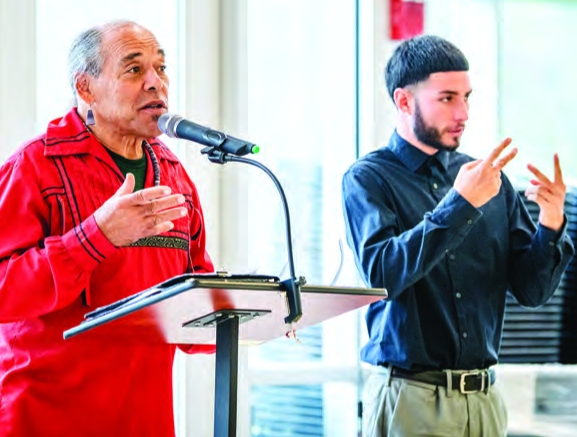
Chief of Mashpee Tribe of Wampanoags Earl Mills Jr., (left), addresses attendees as a translator signs for the hearing impaired. 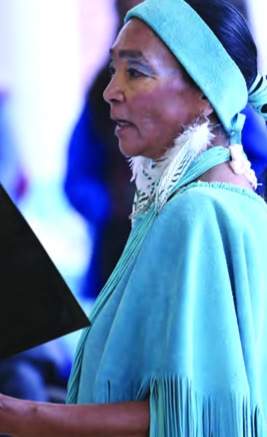
Keynote speaker, Kathryn Akuahah Wheaton, Nipmuc
More than 1,000 people gathered at Newton North High School on Oct. 13 for the city’s fifth annual Indigenous Peoples Day Ceremonial Celebration, which has replaced Columbus Day since 2021.
The event, hosted by Indigenous Peoples Day Newton, was moved indoors because of rain but still featured live music, traditional dancing and a ceremonial fire that stayed lit throughout the day.
This year’s theme, “Honoring Our Drums — The Heartbeat of Mother Earth and Our Nations,” recognized the drum as a symbol of connection and endurance across Indigenous cultures. The celebration brought together tribal leaders, artists and residents from around New England, the Caribbean and Latin America, reflecting Newton’s growing role as one of Massachusetts’ most visible hosts of Indigenous Peoples Day events.
Tribes represented at the celebration included the Wampanoag of Gay Head (Aquinnah), Mashpee Wampanoag, Nipmuc Nation, Herring Pond Wampanoag, Narragansett Indian Tribe, Passamaquoddy Tribe, Taíno Nations, Huaylas Ancash Quechua, Nahuatl Mexica Nation, Mi’kmaq and Shinnecock Indian Nation.
Among the dignitaries were Chairwoman Cheryl Andrews-Maltais of the Aquinnah Wampanoag, Chairwoman Melissa Ferretti Harding of the Herring Pond Wampanoag, Chairman Brian Weeden of the Mashpee Wampanoag, Chief Dean Stanton of the Narragansett Indian Tribe and Chief Earl Mills Jr., who served as emcee.
Organizers said that despite the weather and a last-minute venue change, turnout was strong. They described the day as a
celebration of living Indigenous cultures, centered on education, youth
participation and intertribal unity.
The
high school hosted a full afternoon of performances and presentations.
The Host Drum High Rollerz opened the program with a social song,
followed by the Tokalli Macehualli (Mexikah Prayer Dancers), who
performed ceremonial movements rooted in Mexican Indigenous traditions.
Other
highlights included Pauochau Waupi’s Drum and Dance Exhibition, the
Taíno Drum Presentation featuring guest drummer Akapay Supay, the
Pumawari Tusuy Dancers representing Quechua communities from Peru and
the SanArte Cultura Bomba/Plena Presentation from Borikén (Puerto Rico).
Youth
performers Annokquus Brown and Wunnup-Pash Brown joined the High
Rollerz during a social dance, followed by Asa Peters’ Water Drum
Presentation and a closing set by Sito 5 Lizard Music. Each performance
underscored the event’s theme — the drum as both a musical and spiritual
unifier.
“The
drum carries the heart, the soul, the spirit of the people,” said
Kathryn Akuahah Wheaton, a Nipmuc speaker who delivered the keynote
address. “It connects us all through rhythm and meaning.”
In her remarks, Wheaton discussed the Nipmuc Nation’s efforts to establish a permanent
cultural and educational site in Massachusetts — a project she said
would help preserve language, art and traditional knowledge for future
generations. Her message reflected a wider goal shared by participants:
ensuring that Indigenous culture remains active and visible in everyday
civic life.
Organizers
said Newton’s annual celebration continues to grow as more residents,
students and community groups take part. They emphasized that the day is
not only about ceremony but also about education and inclusion,
offering a space where Native and non-Native people can learn from one
another.
According to
2020 U.S. Census data cited by the National Association of Social
Workers Massachusetts chapter, more than 90,000 people in Massachusetts
self-identify as Native American or Alaska Native, either alone or in
combination with another ethnicity. The state’s Indigenous population
includes descendants of the Massachusett,
Wampanoag, Mahican, Nauset, Nipmuc, Pennacook and Pocomtuc tribes —
communities whose contributions remain deeply tied to the region’s
cultural and historical identity.
Newton
was among the first cities in Massachusetts to formally recognize
Indigenous Peoples Day, joining a national movement that acknowledges
the histories and ongoing presence of Native peoples. Since 2021, the
local celebration has evolved from a small gathering into a major
cultural event drawing hundreds each year.
According
to organizers, the group behind Indigenous Peoples Day Newton works
year-round on programs that promote Indigenous representation in arts
and education. While the winter months are quieter due to the lack of a
permanent indoor space, several collaborations are already planned for
2026.
The Newton Free
Library is preparing educational programs for early next year, the New
Art Center plans to host a master beader workshop and an intertribal
youth ski trip is scheduled for February. By late spring, organizers
expect to partner with the Newton Conservators on an outdoor event
focusing on environmental and cultural education.
Organizers
said these initiatives are part of their broader effort to keep the
momentum of Indigenous Peoples Day going beyond October. Each project,
they noted, aims to strengthen community ties while highlighting
Indigenous voices across Massachusetts.
As
the celebration concluded and the sound of drums faded, attendees
lingered by the glowing ceremonial fire — a reminder, organizers said,
that Indigenous traditions remain not just historical but living,
continuing to grow with each passing year.