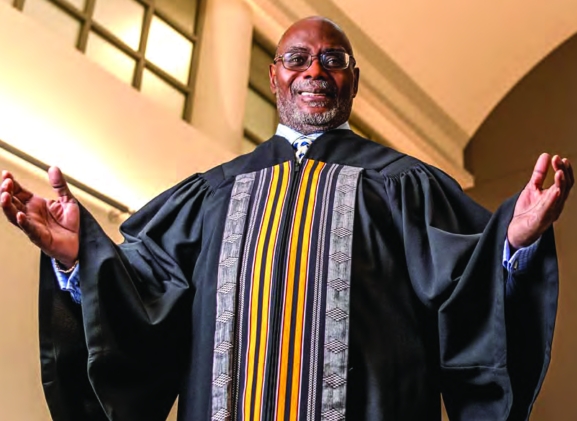
Judge Leslie Harris left an enduring mark on the legal and local community. 
Judge Leslie Harris served on the bench of the Suffolk Juvenile Court from 1994 to 2014.
He has told you, O mortal, what is good; and what does the Lord require of you but to do justice and to love kindness, and to walk humbly with your God?
Micah 6:8 NRSV Three ministers and a judge arrived at this Scripture independently, believing it best summed up the life and work of Judge Leslie E. Harris. They offered separate remarks on that topic during his memorial service on Oct. 29 at Roxbury Community College.
Judge Harris transitioned to his heavenly reward from his Roxbury home on Oct. 15. He was 77.
The theme throughout the tributes paid to him was that he did indeed humbly deliver kind, compassionate justice for 20 years in Boston Juvenile Court as one who clearly knew God.
I was privileged to attend the Vigil Program for Judge Harris at a full Eliot Congregational, his home church, in Roxbury on Tuesday evening Oct. 28. I was with him over the last 40 years as we worked our way through the educational and legal communities of Boston into semi-retirement.
Before attending Boston College
Law School, Judge Harris had been the Melrose METCO coordinator, a
probation officer and taught elementary and secondary school. He
personified the persistence and perseverance required in defying the
odds against a Black person in America graduating from law school,
passing the bar, practicing law and then successfully navigating the
Massachusetts Judicial Nominating Commission application process in
order to be appointed to a judgeship.
My
most important tie to Judge Harris is the one that binds many Black
lawyers and judges in Massachusetts: The Roxbury Defenders Committee. It
speaks to who we are. Once a Roxbury Defender, always a Roxbury
Defender. I was RDC administrator from 1972 to 1974 prior to law school
and a board member after graduating.
Judge
Harris began there as a lawyer. In 1989 he represented Alan Swanson and
other defendants wrongfully arrested after the false accusations by
Charles Stuart that a black man had shot and killed his pregnant wife in
Mission Hill, following a prenatal visit to Brigham and Women’s
Hospital.
Roxbury
Defenders existed in 1989 as it does today as part of the Committee for
Public Counsel Services. However, when it began in 1971 it was
independent, having been formed by a board of community activists that
included Percy Wilson, Chuck Turner, Lenny Durant Sr. and Fredia Garcia.
They were concerned that the then Massachusetts Defenders Committee was
not adequately representing people of color in the Roxbury District
Court.
After being a Roxbury Defender, attorney Harris went to the Juvenile Division of the Suffolk District Attorney’s Office.
As some of us were taught, he practiced the prosecutorial discretion
philosophy that it was one’s duty to show mercy and keep young people
out of the system. He was stern but respectful.
That
was the philosophy he brought to the Juvenile Court bench in 1994. I
was in private practice and teaching juvenile law at Massachusetts
School of Law in Andover at that time. He encouraged me to begin
practicing in Boston Juvenile Court.
I became a member of the Children and Family Law Trial Panel.
We were charged with the responsibility of representing families in termination of parental rights cases.
Thanks
to Judge Harris, for most of his 20 years on the bench I was able to
counsel hundreds of clients appearing before him and the other justices
of his and the Probate Court as we helped people through the most
difficult situations imaginable.
Judge
Harris was always helping people, according to family and friends who
spoke at Eliot Church of the community where they all grew up, in and
around Chicago’s Ida B. Wells housing development. He moved to Boston 55
years ago, after graduating from Northwestern University, to obtain a
master’s degree in African American Studies from Boston University. One
woman described the night he raced into a burning building in their
Chicago neighborhood to save several people.
Boston
attorney Anthony Ellison, a mentee of Judge Harris as well as a former
law student of mine, and brother of Minnesota Attorney General Keith
Ellison, related the many times he appeared before Judge Harris
representing juvenile offenders. He remembered him as holding youth
accountable but at the same time leaving them with a sense of respect.
Judge
Harris was also fondly remembered for helping to found the Boston
College Law School Black Alumni Network. He is credited with mentoring
four generations of law students. He and his wife, Beverly, welcomed
hundreds of law students into their home over the years.
The ministers at the RCC service eulogized Judge
Harris for his godly compassion from the bench. His fellow Black judges,
Roderick Ireland and Milton Wright, both former Roxbury Defenders, also
spoke and knew him best.
Ireland
was the first deputy director of the Defenders and attorney Wallace
“Wally” Sherwood was the director when they were founded in 1970. They
hired me. Ireland became a juvenile judge, rising to the top and
retiring in 2014 as the first Black chief justice of the Massachusetts
Supreme Judicial Court.
Sherwood
went on to become a distinguished professor of criminal justice at
Northeastern. He left this life in 2016 after a courageous battle with
Parkinson’s disease.
At
RCC, Ireland reminded those assembled that he was a fellow congregant
of Harris at Eliot Church and praised him as a “proverbial giant.” He
said he last saw him at a Roxbury Defenders event a few days before his
death. Ireland marveled at Judge Harris’ impact on Juvenile Court legal
and social issues. He quoted the above Scripture from Micah during his
remarks.
Judge Wright,
also a member of Eliot Church, sang “Old Man River” at the service, as
he told me Judge Harris had requested. Wright also continues this year
to direct and sing in Boston’s “Black Nativity.”
At
RCC, Wright recounted being the supervising attorney at Roxbury
Defenders Committee for 13 years, including a time when Judge Harris was
a staff attorney. He recalled Judge Harris sometime afterwards
referring to him as “My boss,” to which he replied, “I was never your
boss, Leslie, because you always did what you wanted.”
Wright
provided the most humorous story of the memorial events. He told of The
Defenders successfully representing a skinhead who was so grateful he
said he was going to try to grow an afro.
Wright
and Ireland did not wear their judicial robes during the nearly
three-and-a-half-hour RCC service, but approximately 40 of their sitting
or retired judicial colleagues did. They formed a solemn column as they
followed the casket of Judge Harris from the RCC Media Center.
The
robed judges were visibly moved. Some of them had worked in Boston
Juvenile Court with Judge Harris as clerks or lawyers, including current
judges Janine Rivers, Peter Coyne, Helen Brown Bryant, Thomasina
Johnson and David Griffin. His fellow Boston Juvenile Court judge, the
retired Terry Craven was also present, along with Boston College Law
alumnus retired Housing Court Judge Wilbur Edwards.
They
were led out by the daughter of former US Attorney for Massachusetts
Wayne Budd, Kimberly Budd, the first Black female chief justice of the
Massachusetts Supreme Judicial Court.
All in all, a dignified and fitting tribute to a beloved Black Massachusetts jurist.