
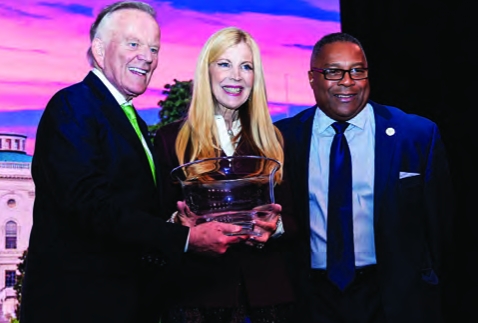
Jim
Brett, president and CEO of the New England Council, is pictured with
2025 Centennial Award honoree Sandy Edgerly and Robert Lewis Jr. of the
Boys and Girls Clubs of Boston.
The oldest regional business association in the country, the New England Council, is celebrating its 100th anniversary.
Jim Brett, the council’s president and CEO, said the 100-year mark is testament to the success of the organization and its methods. The association represents all six New England states.
“It’s quite an honor and it really demonstrates the effectiveness of who we are, to be able to be a voice for all six New England states in Washington for the last 100 years,” Brett said.
The council fills a role of making connections for businesses in New England, Brett said, calling the group a “convener.”
Council members said they value that wide reach and skill at bringing voices together.
In an email, Jonathan Jefferson, president of Roxbury Community College, said the school, which is a member of the council, has “benefited from the New England Council’s convening power and policy discussions.”
“Both RCC and NEC are mission-driven; NEC connects members with key policymakers who drive growth in our economy. RCC’s seat at the table for policy conversations has directly supported our students and community,” Jefferson said.
He touted regular communications with the region’s 21 U.S. representatives, 12 U.S. senators and six governors.
That wide reach, he said, makes the council “very unique.”
And in that task, Brett said he’s focused on making sure the connections are across the region and nonpartisan.
“We’re not leaning left, not leaning right,” Brett said. “We tell you as it is, and that’s why we’re effective in getting people on both sides to speak to us.”
Despite the region’s reputation as being a left-leaning part of the country — in the 2024 presidential election, all six New England states voted for Democratic presidential candidate Kamala Harris — four White House officials joined members of the New England Council’s board at its annual meeting in May.
“Some of our members of the board who were coming for the first time said, ‘I can’t believe that we have that kind of access to the White House, knowing who we are and being in a blue state, blue region, of New England,’” Brett said.
Being able to make those connections, he said, is about maintaining a reputation.
“In my 30 years of getting to know members of Congress, getting to know members of the administration, my philosophy has always been treat everybody — everybody — the same, because you never know where he or she ends up,” he said. “Sure enough, it’s paid dividends”
For the New England Council, the next couple of years will mean some expansion of programming.
This year, as part of its centennial celebrations, the group launched a fellowship program where it selected six nonprofits — one in each New England state — and provided them with $5,000 to hire a fellow to serve as an extra pair of hands over the summer.
In Massachusetts, that program allowed St. Mary’s Center for Women and Children, a shelter and support organization for women and families, to hire a summer staffer. Across the rest of New England, the program supported efforts around food access, cancer care, legal services for refugees and immigrants and housing access.
Brett said that in the next few years the New England Council is aiming to expand that program. Next year, he said, it intends to add another position in each state.
He said the organization is also keeping an eye on issues like energy projects, due to persistent demand and high prices; changes in how the federal government manages its military bases in the region; and potential shifts in population and federal representation with the next decennial redistricting in 2030.
Underlying all of that, however, is the goal to keep the organization and its success moving forward.
“It’s been a very successful formula; we just want to continue it,” Brett said. “Now, more than ever, business leaders need the council because the council is the one that can convene Democrats and Republicans.”