
Announce efforts to close some gaps presented by freeze
A pair of court rulings in two federal New England courts may bring respite — at least temporarily — for residents facing the threat of a freeze to their food assistance benefits.
The rulings came as communities and residents in Boston, New England and across the country battened down the hatches following an announcement from the Trump administration that recipients of the Supplemental Nutrition Assistance Program, or SNAP, wouldn’t receive their November benefits amid the ongoing government shutdown.
On Nov. 1, funding for the food assistance program officially ran out as the Trump administration said it couldn’t or wouldn’t use a contingency fund through the United States Department of Agriculture, which oversees SNAP, to keep benefits going.
In a Rhode Island court on Oct. 31, Judge John McConnell Jr. ruled that withholding SNAP funding was unlawful and said that Congress provided $5 billion in emergency funding to close gaps like this. He instructed the Trump administration to use the funds as soon as possible.
The same afternoon, Judge Indira Talwani in Boston ruled that the Trump administration could choose to tap additional funds from customs revenue to further fund the program, which the administration opted not to do.
The rulings came at the end of a week of officials and advocates preparing for major impacts as the SNAP freeze threatened to drastically impact how residents across Boston and Massachusetts access food.
Across Massachusetts, more than 1 million residents receive food assistance through the SNAP program. In Boston alone, more than 140,000 residents are expected to be impacted by the SNAP freeze.
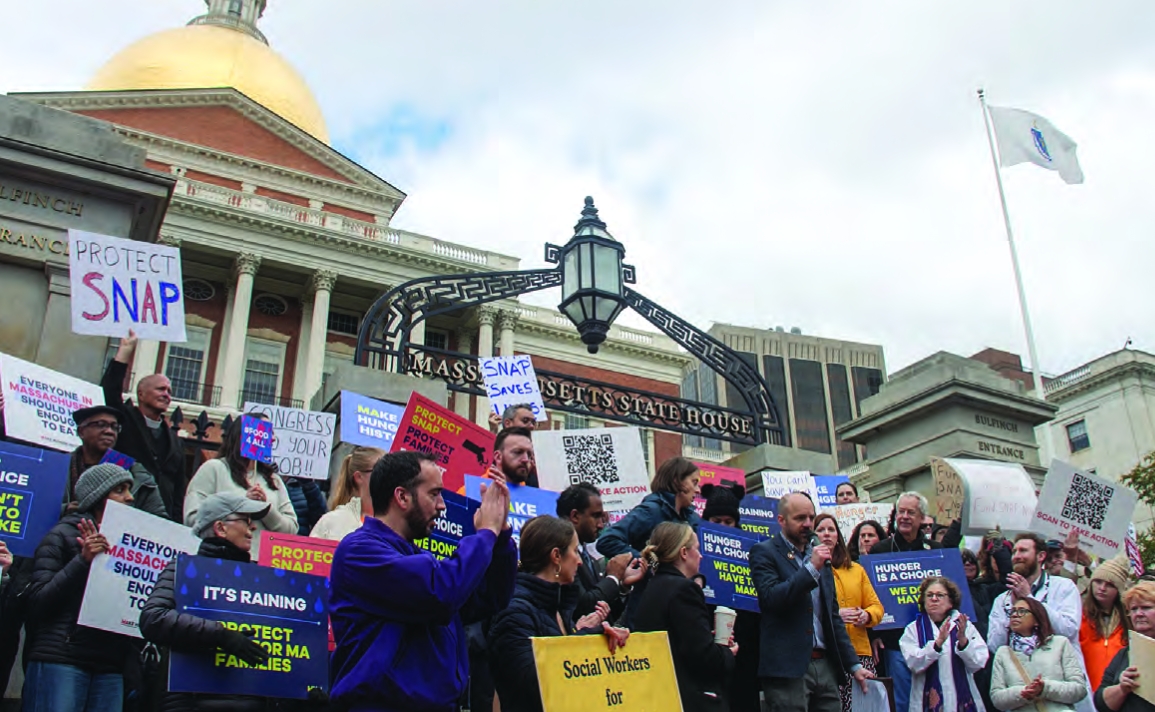
The potential impacts took center stage at an Oct. 28 rally on the State House steps.
“These aren’t numbers,” said Erin McAleer, president and CEO of Project Bread, a food assistance nonprofit, at the rally. “They’re our neighbors, our co-workers, our family members.”
Iris Montufar, a Chelsea resident who spoke at the rally, said that SNAP has been a vital support for her household, ensuring access to nutritious food for her and her children. She said it’s not just a government program, but a “lifeline.”
“The rising cost of living has already made it difficult to make ends meet,” she said. “SNAP has bridged the gap.”
In the week leading up to the SNAP freeze, advocates at the rally also touted the economic impact of the SNAP program.
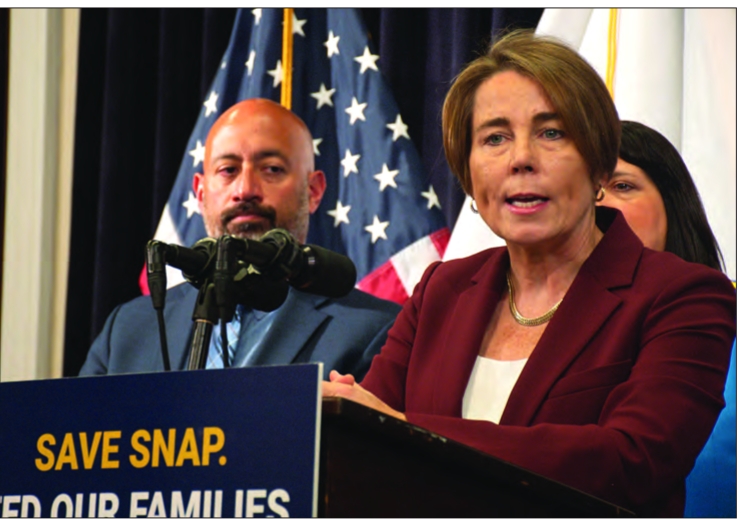
At a State House press conference on Oct. 30, the Healey administration cited a statistic that every dollar spent through the SNAP program generates $1.54 in economic activity.
For David Wadley, owner of Pepperell-based Kimball Fruit Farm, SNAP dollars make up between 5% and 20% of daily sales, depending which farmers market they attend. On average, he said it’s an estimated 10% to 15% of sales.
For farmers like Wadley, the timing is particularly challenging for operations. Much of the produce that he would have expected to sell to customers using, at least in part, SNAP dollars was planted months ago and is all stuff the farm had to pay for in advance, he said.
Advocates and opponents of the Trump administration were quick to label the pause in SNAP funding a choice by federal leadership.
“Let’s be clear: This isn’t an inevitable consequence of a government shutdown,” McAleer said. “It’s a political choice, and it is completely preventable.”
At Healey’s press conference, in providing information about a state-level response to the freeze, a map with the number of SNAP recipients in each county was captioned with the phrase “Donald Trump is freezing SNAP benefits” with the last three words capitalized in bright, bold yellow.
Healey said that this is “a terrible situation, it is an awful situation, and it is also a needless situation.”
At a city press conference about the response, Boston — in partnership with nonprofits and other local municipalities — planned to make, Mayor Wu said that “the president of the United States is using hunger as a political tool.”
When benefits were frozen Nov. 1, it marked the first time that SNAP was frozen during a government shutdown. In previous shutdowns, including during Trump’s first term, the federal government has continued to fund the food assistance program.
The Trump administration claimed that there were legal obstacles and technical hurdles that prevented getting the SNAP money out.
That argument held little water with the federal judges, who indicated they saw no reason the federal government couldn’t pull from its own resources.
On Monday, the Trump administration, in response to the court rulings, announced it would use the USDA’s contingency funds, but that it would not use alternative funding sources to supplement that sum.
The USDA’s funds are not enough to cover the whole month, and as of Monday, the Trump administration had not informed states how much SNAP funding they will get and when it will be made available, according to Massachusetts state officials.
State and city officials push back
Ahead of the court ruling, nonprofits in collaboration with the state and the city were surging to close gaps, to the extent that they can.
At the State House press conference Healey was joined by representatives from Project Bread, United Way of Massachusetts Bay and the Greater Boston Food Bank to announce statewide efforts to close some of the gaps presented by the SNAP freeze.
During the press conference, Healey announced an extra investment of $4 million to the Massachusetts Emergency Food Assistance Program, a state initiative that supports food banks across the state, for the month of November, doubling its normal monthly contribution.
Catherine D’Amato, president and CEO of the Greater Boston Food Bank, said at the Oct. 30 press conference that the new Massachusetts Emergency Food Assistance Program is already being put to work. She said that the Greater Boston Food Bank is putting 75 more pallets of food into the field per day.
Also, in partnership with the state, the United Way of Massachusetts Bay launched a United Response Fund in late October. At the Oct. 30 press conference, Marty Martinez, president and CEO of the United Way of Massachusetts Bay, said the fund had raised over $1 million in donations in its first week. He announced that on Oct. 31, the United Way of Massachusetts Bay planned to put out $50,000 in funding to small organizations focused on food access.
At a city press conference, Wu announced a $1 million commitment in partnership with The Boston Foundation — funded half by the city and half by the foundation — to launch a resource to help residents pay for groceries and other basic needs.
Boston City Council President Ruthzee Louijeune also said the council is pursuing a legislative push in the city to explore support for nonprofit grocery stores in Boston.
During that press conference, the space behind and beside Wu was packed by Boston city councilors and leaders of various city offices; leaders of a host of nonprofits working to connect residents with resources; and municipal leaders from a handful of Boston’s neighbors.
Wu said it was a moment that called “for all of us — government, nonprofits, individuals, philanthropy and business — to come together for our community.”
It’s a sentiment that residents across the city seem to share. David Shapiro, president and CEO of the YMCA of Greater Boston, said at the press conference that his organization has gotten as many calls from people looking to help as from people in need of resources.
On the Greater Boston Food Bank’s website, according to their volunteering page, group volunteering opportunities are booked through the end of the year, as are Saturday shifts for individuals — the only time block offered outside of regular working hours.
Throughout the city’s event, the message looked to maintain a tone of hope and resilience. Yes, elected officials and nonprofit leaders said, the challenges faced in the absence of federal funds are daunting if not insurmountable, but local leaders are ready to do what they can at a community level to limit the harm they said is coming.
“This is not going to fill the whole gap, but it is something that we can do that will mitigate the harm,” said Yi-An Huang, Cambridge’s city manager, of that city’s municipal investment in the Cambridge Community Foundation to support food access efforts.
Federal legislators float solutions
For a federal government at loggerheads, the issue has led to an array of proposed solutions from various camps.
On Oct. 24, Rep. Ayanna Pressley, along with almost all Democratic members of the U.S. House of Representatives, sent a letter to Brooke Rawlins, secretary of the USDA, highlighting the impacts the freeze could have on Americans across the country and urging her use the contingency funds to keep food assistance benefits flowing.
A similar letter, sent Oct. 22 by Democratic senators, made a comparable request of the USDA, encouraging the department to use the contingency funds and to transfer funds from other nutrition programs into SNAP.
Meanwhile, a legislative push from Republican Sen. Josh Hawley, announced Oct. 22, would fund SNAP during the government shutdown.
In an opinion piece published in the New York Times, Hawley wrote, “Republicans blame Democrats, and Democrats blame Republicans, but all these people have food to spare. One suspects that if senators couldn’t buy groceries, the government would never close down again.”
As of Nov. 3, that bill has bipartisan support from 29 senators.
A separate legislative proposal from Democratic Sen. Ben Ray Luján from New Mexico, would also fund SNAP, as well as the Special Supplemental Nutrition Program for Women, Infants, and Children, or WIC, program.
As of Oct. 29, that legislation had been blocked in the Senate.
As leaders across state and city government take actions to close the gap, officials and nonprofit leaders urged residents to provide help if they can and seek help if they need it.
“For anyone who has the means to help, I encourage you to do so,” Healey said. “For those who are heading into this weekend with tremendous anxiety, know that we will do everything that we can to help you and your families.”
At the state’s press conference, McAleer from Project Bread used her remarks to remind residents struggling to put food on the table that they are not alone.
“No one in Massachusetts should face this crisis alone,” she said. “Reaching out to ask for help is a sign of strength.”
RESOURCES
GET HELP:
- City of Boston: boston.gov/snap
- Boston Public Schools: 617-635-8873
- Massachusetts: mass.gov/snapfreeze
- Project Bread: 1-800-654-8333, projectbread.org/get-help
- Greater Boston Food Bank: gbfb.org/need-food
DONATE AND VOLUNTEER:
- United Way: unitedwaymassbay.org/united-response
- Greater Boston Food Bank: gbfb.org/ways-to-give