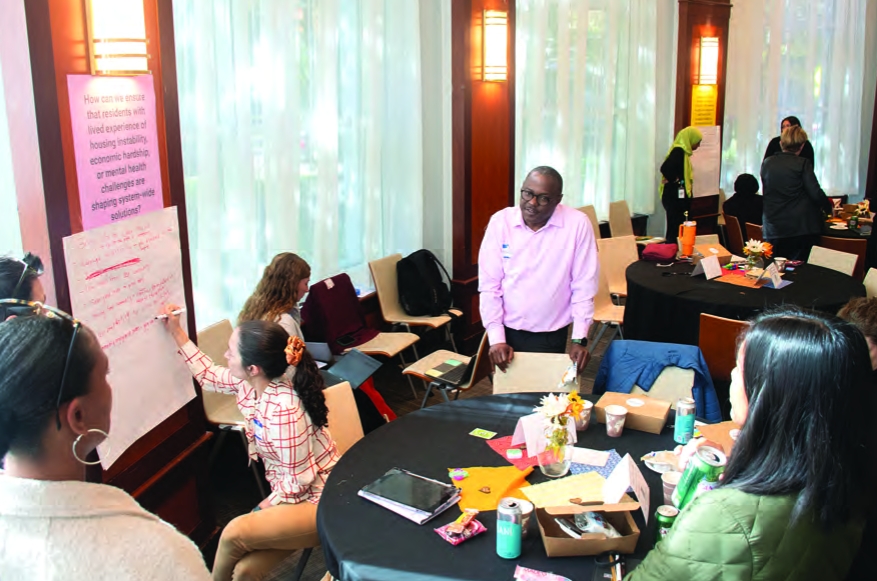
Attendees brainstorming solutions at the Boston Public Health Commission summit, Oct. 21. The event focused attention on how social determinants — factors outside of hospitals and clinics — impact mental health.
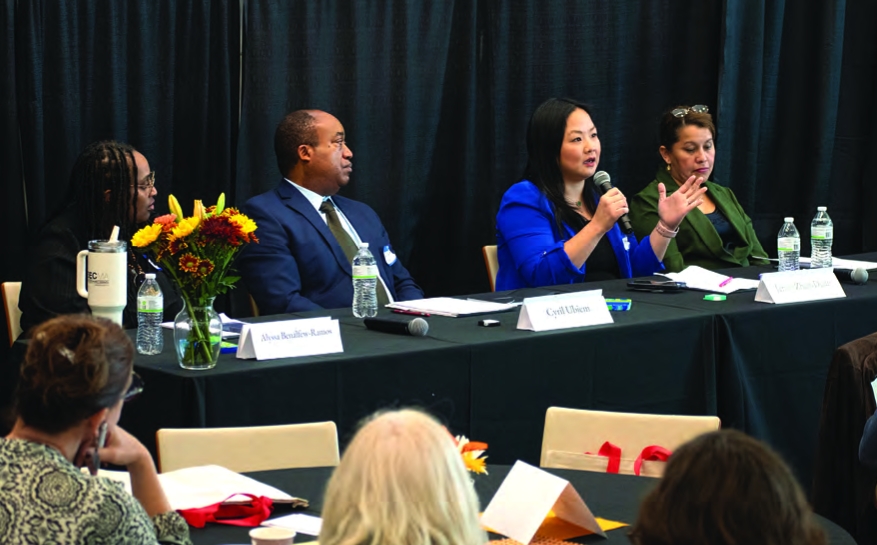
Black Economic Council of Massachusetts Chief of Policy Alyssa Benalfew-Ramos, Harvard Street Neighborhood Health Center Senior Vice President of Programs and Services Cyril Ubiem, Harvard Assistant Professor of Psychology Jenny Zhen-Duan and Charlestown resident Magaly Galvis sit on a panel about the impacts of economic insecurity on mental health during the summit, Oct. 21.
When the Boston Public Health Commission hosted its mental health summit at Northeastern University on Oct. 21, the event drew mental health researchers and clinicians. It also brought together housing officials, economic development advocates and community members focused on decreasing inequity across the board.
Central to the premise of the Public Health Commission’s summit, which was hosted in partnership with the university’s Institute for Health Equity and Social Justice Research, was the idea that mental health struggles don’t exist in a vacuum.
The event aimed to reframe mental health as being shaped by broader social and structural conditions, called “social determinants of health” — factors outside of hospitals and clinics that can shape good or bad health outcomes.
“It is true that, often, when I engage with patients, undoubtedly, if someone’s calling me for a resource it is often not actually a resource related to a clinical appointment,” said Dr. Kevin Simon, Boston’s chief behavioral health officer, during remarks opening the summit.
The distribution of mental health challenges — or those underlying determinants — are not equitably distributed.
“While poor mental health and mental illness impact all communities, communities with fewer resources and who experience more discrimination and exclusion face greater barriers to mental well-being,” said Alisa Lincoln, a Northeastern professor of health sciences and sociology and director of the Institute for Health Equity and Social Justice Research.
Throughout the morning, experts and advocates answered questions about the impacts of economic insecurity and housing instability on mental health — with the advisory board citing those two factors as two of the “most powerful social determinants of health.”
An afternoon session gave attendees the opportunity to brainstorm their ideas of how to address the social determinants of mental health and how to track what success in that work might look like.
Throughout the summit, a constant theme was that efforts to improve mental health are varied — and not necessarily easily identifiable as mental health efforts.
“There’s so many things we can do to address people’s mental health and when you start talking about it, people don’t think you’re talking about mental health because you’re talking about housing and wages and resources,” said Alyssa Benalfew-Ramos, chief of policy at the Black Economic Council of Massachusetts, during the panel on economic instability. “These are the conversations I like to have and link them back to mental health, because if folks have stability, folks can focus on trying to get well or being well.”
During the panel on housing stability, Stephanie Ettinger de Cuba, an applied health services researcher at Boston University, pointed to a 2024 study that looked at the intersection of evictions and psychological distress among pregnant African American women in Detroit. The research found that psychological distress increased among African American women in neighborhoods with higher eviction rates, even if they didn’t experience an eviction themselves.
“You can’t think forward in your life if you’re constantly scrabbling for the moment,” Ettinger de Cuba said.
In practice, the need to address social determinants to improve mental health is noticeable, Zhen-Duan said during the panel about economic insecurity. Through her clinical experience working with low-income patients, she said often she found that the most effective use of time was helping patients find access to services so they could get enough food or access to medical care.
“The reality is that as clinicians, as researchers, we have to match the service we provide with what people are needing at the moment,” she said.
Providing those services might be a matter of meeting patients where they’re at and linking care around social determinants of health or around mental health to existing visits, like trips to primary care providers.
Speakers also highlighted how conversations about mental health could fit into work to address housing access or wealth gaps. Sheila Dillon, Boston’s chief of housing, pointed to the city’s efforts to address evictions by providing at-risk families with back rent or pro bono legal services, but said rarely do they ask how the residents are doing.
“What we never do is we never have our colleagues at public health or the nonprofits say, ‘Hey, you’ve been through an awful lot. Are you okay?’” said Dillon, who moderated the panel on housing stability. “It would be a very, very decent step to make sure the family is okay, because they’ve been through a very traumatic event.”
Panelists at the event said they had concerns that a changing landscape under the federal administration of President Donald Trump could worsen some of those determinants.
Dillon said the city has concerns that the federal government will implement new restrictions when it provides annual continuum of care funding that the city seeks, potentially limiting the amount of permanent supportive housing Boston can invest in.
That shift, if it pans out, will likely lead to more people living on the streets, she said.
Panelists at the summit highlighted permanent supportive housing as an important measure to address mental health gaps, as well as the overlapping crisis around substance abuse.
A recent report from Boston Indicators, the research arm of the Boston Foundation, predicted that new federal policies under the budget reconciliation law passed in July, which was known through much of its legislative journey as the “One Big Beautiful Bill,” will increase the racial wealth gap and negatively impact low- and middle-income households.
That legislation included changes to Medicaid and the Supplemental Nutrition Assistance Program (SNAP) that are likely to limit access for millions of residents, as well as shifts to federal tax policy and new or altered policies around student loans and policies impacting families with children.
The Trump administration has also notably limited or attempted to pull grant funding to a host of efforts across the country, many of which are focused on equity efforts.
Benalfew-Ramos said that as the federal government cuts dollars, it will be important to find diverse sources of money for projects, seeking a mix of local, state, federal and philanthropic sources and “braiding these funds together.”
The conversations around mental health fit into the commission’s broader vision of addressing social determinants of health.
In July 2024, the city announced a new population health initiative called the Live Long and Well Agenda.
That effort is aimed at decreasing life expectancy gaps across the city by targeting the most prominent causes of premature death, according to city data: cardiometabolic diseases, preventable cancers and unintentional drug overdoses.
To address those targets, the city plans to go upstream to social determinants of health. The health commission’s first big push came in the form of a $10 million investment from the Atrius Health Equity Foundation, funding projects from community-led coalitions working to build wealth and economic security across the city.
Work around the social determinants of mental health could take a similar tack, Grossman said.
“From here on out, we’ll be as aligned as we can live long and well, because social determinants of health are part of the Live Long and Well agenda,” Grossman said.
Treating social determinants as the cause of inequity — rather than just responding to the disparate health impacts they lead to — has long been a priority for Dr. Bisola Ojikutu, the city’s public health commissioner.
Grossman said the event at Northeastern was the start of a broader effort to address the upstream causes of mental health struggles in Boston.
Following the summit, she said the health commission’s Center for Behavioral Health and Wellness, in continued collaboration with Northeastern’s Institute for Health Equity and Social Justice Research, plans to put together a coalition at the intersection of a range of subject areas to try to break down silos and make mental health topics more widespread.
“We’re really hoping that there’ll be people from all aspects of life and research and community-based organizations and leaders that can come together and create a committee or a group that will help move things forward, so that we don’t just think about it, but really move action forward from here on out,” Grossman said.
That group, she said, will probably develop a “full analysis” of the landscape to understand what efforts are out there.
That work might then lead to policy proposals — starting at the city level, though potentially advocating for state-level change — to address some of the social determinants of mental health, as well as developing new and deeper ways to communicate with communities.
“We don’t want to reinvent the wheel; we want to bring things together,” Grossman said. “I think, hopefully, [it will bring] a deeper understanding of what’s there and what we can come together on across the silos.”