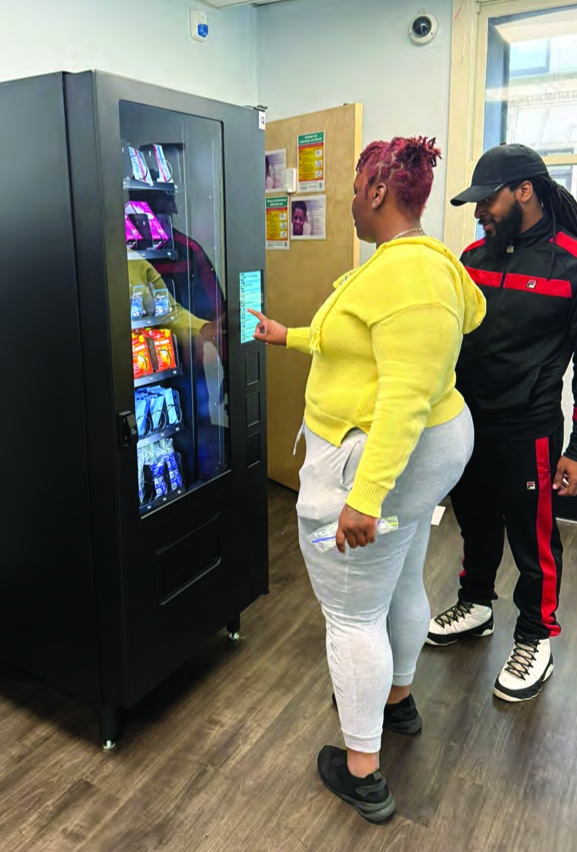
A visitor uses Bridge Over Troubled Waters’ new public-health vending machine at the nonprofit’s West Street drop-in center. The machine provides free Narcan, test strips, socks, snacks and other essentials for youth.Youth homelessness in Boston is rising faster than the temperatures are falling.
Bridge Over Troubled Waters, the city’s leading nonprofit for unhoused young people, has seen a 26% jump in youth seeking help this year, with nearly 2,400 teenagers and young adults looking for safety before winter sets in.
To meet the need, Bridge has launched Boston’s first youth-focused public health vending machine, stocked with Narcan and other supplies that could mean the difference between safety and tragedy.
The initiative, part of a broader campaign during National Homeless Youth Awareness Month [observed every November], underscores a crisis that often goes unseen. Most homeless youth in Boston aren’t sleeping on park benches — they’re in classrooms, working night shifts, or couch-surfing from one friend’s dorm to another, doing whatever it takes to make it through the night.
Inside Bridge’s drop-in center on West Street in downtown Boston, the new customized vending machine stands beside a cellphone charging station. Along with snacks and soda, it holds Narcan, fentanyl and xylazine test strips, hand warmers, snacks, socks and basic wound-care kits. Bridge leaders call it a “public health vending machine,” one of five in Boston but the only one built specifically for youth.
“We didn’t want a machine that screamed, ‘I use,’” said President and CEO Elisabeth Jackson. “If a young person isn’t ready to talk about recovery, they can just say they came for socks.”
Each user registers once and can access any of the city’s machines. Bridge tracks anonymous data to learn what items disappear fastest and where demand is highest. The information helps staff restock supplies and direct outreach teams to neighborhoods where youth are most in need.
Bridge has served nearly 2,400 young people this year, a 26% rise from 2024. Jackson credits an expanded outreach staff and partnerships with colleges and community events for the increase.
“Last month alone we welcomed 92 new youth,” she said. “We’re meeting them where they are — at health fairs, on campuses, wherever they feel safe.”
For Bridge, homelessness doesn’t always look like what the public imagines. “People picture someone pushing a cart or sleeping on a bench,” Jackson said.
“But youth homelessness looks different. They might be in class next to you.”
One in 13 youth experiences homelessness, and national data shows that 1 in 10 young adults ages 18 to 25 and 1 in 30 teenagers ages 13 to 17 experiences at least one night of homelessness. Most are students or part-time workers struggling to stay in school while keeping a roof — any roof — over their heads.
Bridge’s approach is grounded in harm reduction and empathy. Staffers celebrate progress rather than perfection. Jackson described how even small victories matter. “If someone was drinking six beers a day and now they’re down to one, that’s a win,” she said. “Next week might be hard again, but they know we believe they can get back to one. That’s what learning looks like.”
The agency’s trauma-informed programs extend beyond survival basics. A new “Zen garden” offers a quiet, sensory-friendly space where young people can plant herbs, relax and de-stress. Inside, fidget toys, low-light rooms and calming scents help overstimulated youth reset before counseling sessions or communal dinners.
“Bridge is the university of life skills,” Jackson said. “Our staff are the professors.”
This month, Bridge is sharing those hidden stories through #WhatISayWhatIMean, a campaign created by its youth. Posters across MBTA trains and Boston sidewalks pair simple phrases with deeper meanings. “One poster says, ‘It’s just my favorite hoodie,’” Jackson said. “For many of our kids, that’s the only hoodie they own!!”
The campaign, now in its fifth year, encourages Bostonians to recognize that many young people are “hidden in plain sight.” A student skipping dinner may not be dieting; they may simply not have the money. “I want everyone to understand you might know someone who’s homeless,” Jackson said. “Ask questions. Make them feel safe.”
Bridge is also backing state legislation to raise the age for certain offenses and to make identification cards free for youth experiencing homelessness, two barriers that can prevent them from finding jobs or housing. “It’s not okay to have 18-year-olds with nowhere to live,” Jackson said.
The organization’s work will be honored this November when Elisabeth Jackson receives the Shattuck Award for distinguished service to the City of Boston. Yet, she insists, the real recognition belongs to the young people who keep showing up. “They’re the reason we do this,” she said. “They teach us what strength looks like.”
Throughout November, local businesses are teaming up with Bridge to raise awareness and funds. The Salem-based popcorn store Popped! will donate 50% of all online purchases made with the code NHYAM through Nov. 30. On Nov. 4, Shake Shack will contribute 25% of every order that mentions “Donation Day” at checkout or uses the code DONATE in its app, website or kiosks. On Nov. 8, Rag & Bone will donate 15% of all sales and Alice + Olivia will give 10% of proceeds while offering shoppers an additional 10% off.
As winter draws near, Jackson hopes the city keeps paying attention. “These kids aren’t statistics,” she said. “They’re our students, our co-workers, our neighbors. If we make it easy for them to reach out for help, we might just save a life.”