
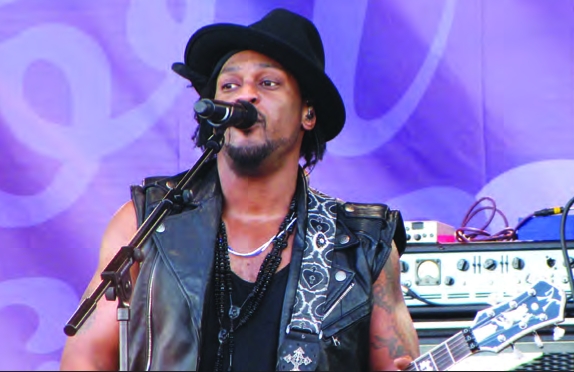
Michael Eugene Archer, better known as D’Angelo, died of cancer Oct. 14.
When D’Angelo died, my “art heart” cried. Loudly!
Great musicians die too young.
D’Angelo was the continuation of that long kind of genius and a grassroots griot in progressive Black music. It shook and saddened me to read that the Grammy Award-winning R&B singer had passed at the young age of 51.
Little Richard, Jimmy Hendrix, Donny Hathaway, Prince, D’Angelo. It’s a straight line with some other influences mixed in. There are different causes of death, but the result is still sour-bitter, tragic to families, the public sphere and our cultural losses.
Mozart, Bix Beiderbecke, Billie Holiday, Charlie Parker, Jimmy Hendrix, Amy Winehouse, Kurt Cobain, Michael Jackson, Freddie Mercury, Jim Morrison, Janis Joplin, Whitney Houston.
It’s a gospel story. It’s a jazz story. It’s a rock and roll and soul story and it’s a tragic American tradition with a long arc of “young rock stars” who die too young. The value of artistry is that its work is to transfer to the observer the ideas of the worth of human thought, feelings, representations and possibilities.
He was born Michael Eugene Archer in Richmond, Va. D’Angelo was the son of a Pentecostal preacher, who grew up in his family church where his musical talent was discovered early on, nurtured and developed throughout his teenage years and into adulthood.
What I knew about him as a PK — that’s what we call a “preacher’s kid” — informed everything I know as a musician about the power of spiritually forged Black music makers. As D’Angelo told GQ magazine in 2014, “I learned at an early age that what we were doing in the choir was just as important as the preacher. It was a ministry in itself. We could stir the pot, you know? … The stage is our pulpit, and you can use all of that energy and that music and the lights and the colors and the sound. But you know, you’ve got to be careful.”
When you think about the advocacy of art, music as a public ministry, then you have a very powerful platform and the notion of music’s working purpose at its “people lift capacity” level.
This aspect of his public ministry of work that translates his talent into “people preach reach,” that’s huge!
The passing of D’Angelo broke my art heart.
When I think about the abuses of this industry, the tear of religion, the destruction and distractions from drugs, the loneliness of what it is to be given gifts — really real gifts — and the struggle on the human heart and mind to hold it all together, in this one sane mind, one fragile body and soul — this is our glorious and sad terrain of the popular priests of public arts, our contemporary griots.
I am sad because this level of artistry is irreplaceable!
Artists perhaps need walls around their hearts, so as not to become vulnerable to life’s difficulties, discomfort and disappointments.
Because when people listen to the music, it lifts every time. So, we need great artists to hold us up! When they die, we lose a true people foundation.
As his RCA Records family wrote, “He was a peerless visionary who effortlessly blended the classic sounds of soul, funk, gospel, R&B, and jazz with a hip hop sensibility. … D’Angelo’s songwriting, musicianship and unmistakable vocal styling has endured and will continue to inspire generations of artists to come.”