
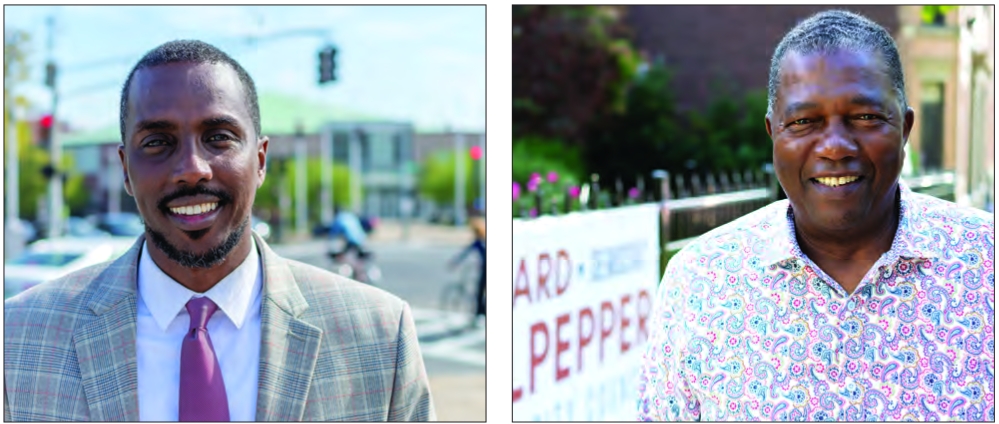
District 7 City Council candidates Said Ahmed (left) and Miniard Culpepper, photographed Sept. 16. Both candidates faced a tough and skeptical crowd at a District 7 Advisory Council candidates forum, Oct. 8.
District 7 City Council candidates Said Ahmed and Miniard Culpepper faced a tough audience Oct. 15 at a virtual forum organized by the District 7 Advisory Council.
Members of the council grilled the two candidates on topics that included the city’s controversial plans to rebuild White Stadium, changes in key MBTA bus routes, efforts to renovate Madison Park Technical Vocational High School and Mass and Cass, the area of the city that is often recognized as an epicenter of dueling homelessness and substance abuse crises.
Culpepper and Ahmed progressed out of a field of 11 candidates in the Sept. 9 preliminary in a race to replace Tania Fernandes Anderson after she resigned from her City Council seat after pleading guilty to federal theft and wire fraud charges.
For some, the race is shaping up to be a choice between two poor options. Several members of the District 7 Advisory Council — a group of civic leaders that Fernandes Anderson had organized during her tenure to provide input and insight into operations of the district — said the choice between Culpepper and Ahmed has left them troubled or hopeless.
Throughout the forum, members of the D7 Advisory Council, as well as community members in attendance, seemed dissatisfied with responses from the two candidates, repeatedly asking for more information or specifics about proposed policies.
One segment of the forum, with questions focused on development, largely boiled down to a pop quiz on elements of the city’s process and plans.
When neither candidate was able to answer a question from Lavette Coney, president of the Mount Pleasant, Forest and Vine Neighborhood Association and a member of the council, regarding who Kairos Shen is — the city’s chief of planning — she said, “Ok, so, we’re in trouble then.”
Ahmed was also not able to answer Coney’s next question about the city’s Squares + Streets initiative, an effort to shift zoning rules to allow for the construction of more housing around public transit.
District 7 Advisory Council members seemed to find Culpepper’s response — that it is a city plan where “the streets become part of the squares for development of what’s to take place in the city in the future” — lacking.
In an interview ahead of the forum, Rodney Singleton, a member of the Advisory Council, said he worried that the choice between the candidates is a choice between two options, neither of whom will properly serve the district.
“There are a lot of really, really hard problems that we’re having to deal with,” he said. “I think both these candidates are ill-prepared.”
When Election Day comes around, Singleton said he likely plans to walk into the booth and write in a different candidate’s name instead. In balancing between the two, he said he couldn’t determine a lesser of two evils — a first, he said, in his voting experience as a Bostonian.
“The choice is just awful,” he said.
Singleton said he considers Ahmed “a nice enough guy” but worries that his inexperience would mean he wouldn’t be able to hit the ground running.
On the other hand, he said he has concerns that Culpepper will only be a rubber stamp for Mayor Michelle Wu’s policies and agenda.
Within the race, the idea of an “independent voice” has gained weight.
As an example, Singleton pointed to Culpepper’s early support for the city’s plan to renovate White Stadium through a public-private partnership with Boston Legacy FC, a new professional women’s soccer team.
Under the city’s plan, Boston Legacy FC would pay for more than half the cost of construction and all the costs to operate the stadium, which would serve both as a BPS facility and a professional sports venue.
The community, however, is concerned about issues like transportation and noise, and the consensus is that the city hasn’t properly considered local voices in shaping the deal. A failed lawsuit earlier this year sought to halt the process.
“I think early on he demonstrated this idea that he would likely be aligned with Wu because despite all of the pushback — and I think there was reasonably good pushback against a lot of the mayor’s White Stadium plans — he is for it, and sort of blindly for it,” Singleton said.
Singleton said White Stadium is “probably the biggest piece” that makes him think Culpepper won’t serve as check to the mayor.
According to reporting by the Dorchester Reporter, at a March meeting regarding White Stadium, Culpepper spoke in support of the plan. It was a sentiment he repeated at a City Council candidate forum in May (at the same forum, Ahmed also said he supported the plan).
In a candidate questionnaire produced by Progressive Massachusetts, Culpepper said he believed the redevelopment of White Stadium could be positive for the community, but that he had “significant concerns” with the process.
At the Advisory Council’s forum, however, he took a different tack, focusing on the community’s continued opposition to the proposal.
“I will fight to my last breath to make sure that White Stadium is a stadium that is used and continues to be controlled by the Boston Public Schools system for the Boston Public Schools system,” Culpepper said.
The independence of the Boston City Council has been a point of discussion in recent years. In the 2023 elections, Wu endorsed district Councilors Sharon Durkan and Enrique Pepen and At-large Councilor Henry Santana, all of whom were victorious.
The following year, when the City Council voted on the mayor’s budget, all three of those candidates reversed their positions on the budget to ultimately fall in line with Wu.
For others in District 7, that same concern of independence has been a mark in support for Culpepper.
Said Abdikarim, who came in fifth in the preliminary election, endorsed Culpepper after the candidate reached out asking for his support. He said that when he spoke with Culpepper regarding the potential endorsement, one topic of conversation was the idea of being an independent voice. Culpepper’s responses, he said, convinced him that he would be.
“Sometimes you have to be the dark horse to get the job done,” Abdikarim said. “Obviously, you are elected — if you get the opportunity to serve — by the people of District 7, so once you get into that position, you have to be in the community holding town halls, holding community forums.”
And others have said that as the district faces ongoing challenges and swings back from the negative impression left by Fernandes Anderson’s departure, Culpepper is the candidate who can best fill the empty seat.
Joyce Ferriabough Bolling, a political strategist, said she thinks Culpepper is the “right person at the right time.”
“We absolutely need strong leadership, experienced leadership, who can actually get things done,” she said, pointing to Culpepper’s legacy of fighting for community issues.
Culpepper has also pulled in a handful of high-profile endorsements, including Suffolk County District Attorney Kevin Hayden and state Sen. Lydia Edwards, who previously served as councilor for District 1. On Oct. 15, the Boston Globe announced its endorsement of Culpepper.
Like Abdikarim, Samuel Hurtado, who came in fourth in the preliminary election, also put his support behind Culpepper.
Ahmed told the Banner that he is getting ready to announce some endorsements of his own but was not ready to publicly comment on who has endorsed his campaign.
When it came to discussions around policy at the Advisory Council’s forum, both candidates staked similar positions. Both called for more community input around the demolition and revitalization of White Stadium; both spoke in opposition of the similarly controversial city plans to restructure Blue Hill Avenue to add a center bus lane. And both candidates agreed that some challenges facing the district could be solved by better enforcement of laws already on the books — such as double parking on busy streets like Blue Hill Avenue.
In other arenas, they leaned in different directions. When it came to addressing issues at Massachusetts Avenue and Melnea Cass Boulevard, Ahmed called for a decentralization of services in an attempt to disperse the concentration from the area. He also voiced opposition for supervised injection sites.
Culpepper, in contrast, proposed a care campus, like the one that existed on Long Island in Boston Harbor before the bridge there was closed in 2014. He also said he supports supervised injection sites as part of that care campus.
District 7 voters will cast their votes for city councilor in the general election on Nov. 4. Voters must register to vote by Oct. 25. Early voting will run Oct. 25-31.