
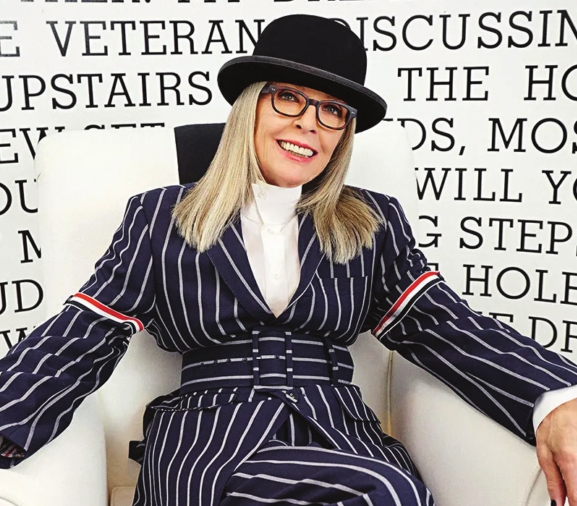
Academy Award-winning actor Diane Keaton died Oct. 11 at the age of 79. 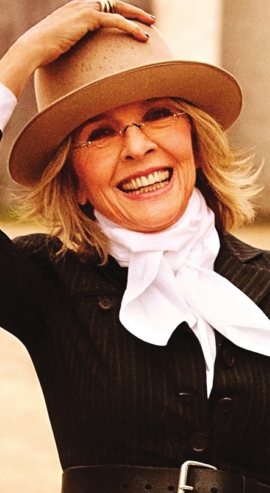
Beloved actor Diane Keaton has died at the age of 79 in California. The announcement of her passing shocked the Hollywood community and generations of film lovers who had followed her extraordinary career.
Few of her closest friends seemed aware that she was ill. Longtime friend Carole Bayer Sager told “People” magazine that Keaton had become “very thin” in the weeks before her death. “I saw her two or three weeks ago,” the singer-songwriter recalled. “She had lost so much weight.”
Other friends said her health had “declined very suddenly” and that her family chose to keep her condition private. Earlier this year, Keaton surprised many by listing her beloved Los Angeles “dream home,” a five-bedroom, seven-bath estate for $29 million, despite having said she intended to live there permanently.
Born Diane Hall on January 5, 1946, in Los Angeles, she was the daughter of Dorothy Deanne (née Keaton), a homemaker and amateur photographer; and John Newton Ignatius “Jack” Hall, a real estate broker and civil engineer. Keaton graduated from Santa Ana High School in 1963, where she performed in singing and acting clubs and starred as Blanche DuBois in a production of “A Streetcar Named Desire.”
She briefly attended Santa Ana College and Orange Coast College before leaving for New York to pursue acting. Upon joining the Actors’ Equity Association, she adopted her mother’s maiden name, Keaton, since “Diane Hall” was already registered.
In New York, she studied the Meisner technique at the Neighborhood Playhouse and performed a nightclub singing act later reflected in her films “Annie Hall” (1977), “Radio Days” (1987) and “And So It Goes” (2014). Known for her intense preparation, Jack Nicholson once remarked that she was the only actor he knew who memorized entire scripts before filming.
Keaton rose to fame in the 1970s and became one of the defining actresses of the New Hollywood generation. Her breakthrough role as Kay Adams in “The Godfather” (1972) and its two sequels made her a household name.
But it was “Annie Hall” (1977), her fourth collaboration with Woody Allen, that earned her the Academy Award for Best Actress and solidified her as both muse and master of the modern romantic comedy.
Over five decades, she built a body of work that was as daring as it was diverse. From “Reds” (1981) to “Marvin’s Room” (1996) and “Something’s Gotta Give” (2003), her performances earned multiple Oscar nominations. Other beloved films include “Looking for Mr. Goodbar” (1977), “Baby Boom” (1987), “Father of the Bride” (1991) and its sequel, “The First Wives Club” (1996), “The Family Stone” (2005), and “Book Club” (2018).
When Meryl Streep honored Keaton with the American Film Institute Life Achievement Award, she described her as having “the stream of consciousness of a hummingbird.” It was the perfect tribute to an actress whose mind seemed always in flight curious, quick, alive and deeply authentic.
A longtime feminist, Keaton lived by example rather than declaration. Her individuality embodied in that signature hat, that androgynous suit and that knowing smile made her a symbol of creative freedom. From the neurotic wit of “Annie Hall” to the quiet strength of “The Godfather’s” Kay Adams, she portrayed women who were intelligent, vulnerable and unapologetically real.
Beyond acting, Keaton nurtured a lifelong passion for architecture and design. In the 1980s, she purchased and restored the Samuel-Novarro House in Los Feliz, a 1928 masterpiece designed by Lloyd Wright, son of Frank Lloyd Wright. Working with architect Josh Schweitzer, she revived the property’s Art Deco glory, blending historic preservation with modern warmth. The project reflected her love for architecture, a passion that later inspired her to write books on home restoration and California design.
When my family relocated to California, we became Keaton’s neighbors. On my daily walks, I often passed by her home. Most days the gate was closed, but sometimes it stood open, and she would be in the yard. She was always warm, friendly and unassuming, just “Diane from around the corner.”
It dawned on me after her passing that I have never heard anyone say a bad word about her. Though she never married, Keaton became a mother in her 50s, adopting daughter Dexter and son Duke, whom she raised as a single parent. In a 2008 interview with “Ladies’ Home Journal,” she described motherhood as “an urge I couldn’t resist,” adding that it “was something I’d been thinking about for a very long time.”
A devoted animal lover, Keaton served on the board of Social Compassion in Legislation and championed rescue animal adoption throughout her life. Her last post on the social media app was shared on Oct. 11, the day she passed, in honor of National Pet Day. As part of a collaboration with Hudson Grace, a home and lifestyle brand, Keaton shared a photo of herself with her beloved Golden Retriever, Reggie. “Proof our pets have great taste too! Happy National Pet Day from HG & @diane_keaton” the caption of the post read.
Keaton, an avid dog lover, revealed she welcomed Reggie into her life in 2020. Keaton had long faced health challenges, including a skin cancer diagnosis at 21, which she attributed to family history.
Diane Keaton didn’t just play characters, she authored them. She turned neurosis into poetry and awkwardness into grace. In doing so, she left behind more than performances; she left a legacy that taught generations of women that strength can be eccentric, beauty can be imperfect and originality can be the truest form of honesty. Diane Keaton will be missed but what a body of work she has left for us.