
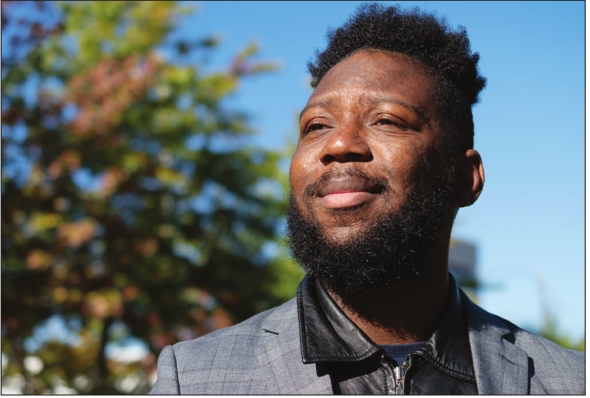
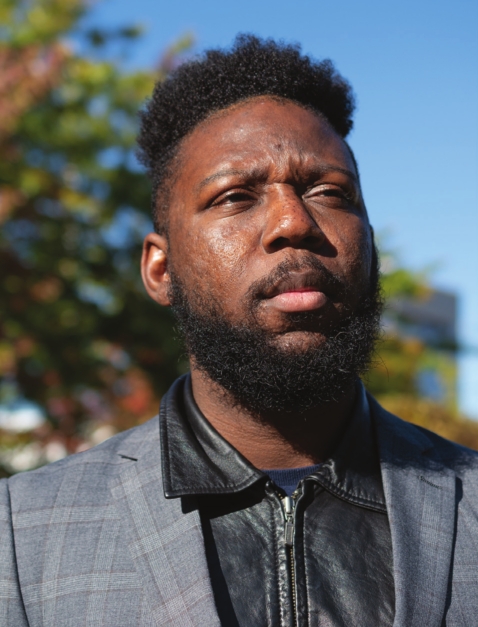
If elected, Willie Burnley Jr. would be Somerville’s first Black mayor.
Somerville mayoral candidate Willie Burnley Jr. says his story is one that is familiar to many residents of the city he is hoping to lead.
A California native, Burnley moved to Massachusetts to get a degree in writing from Emerson College. He moved across the river to Somerville in pursuit of the promise of cheaper rents — a sour irony when he was displaced back to California after his landlord raised his rent by hundreds of dollars.
That chapter of his life is one he has framed as central to his campaign, and a reason that voters should trust him to lead the city — touting his lived experience of being priced out and being the only mayoral candidate who is a renter.
“We need a mayor who brings the fierceness of experience to this problem and is going to work urgently to build a city that is more affordable and more accessible for everybody,” Burnley said.
If elected, Burnley will be the city’s first Black mayor and first mayor of color, as well as the city’s first queer and polyamorous person to hold the seat.
Burnley said his identity as a Black man has impacted how he thinks he’s perceived in the mayoral race. He feels candidates of color, as well as women, need to prove their competence in a way that their counterparts don’t.
His run for the city’s top seat follows four years as an at-large member of the Somerville City Council, during which he has passed, by his count, 13 pieces of legislation.
“Despite my four years in office, there’s certainly this sense of ‘Does this guy get it?’” Burnley said.
But he said he hopes that identity will mean something for residents — particularly students — in the city. In the last school year, less than 40% of public school students in the district were white (about 9% were Black, while 40% of the student body was Latino).
“None of them have had a mayor who reflects their background,” Burnley said.
Burnley will face off against fellow At-large Councilor Jake Wilson in the November general election after both scored higher vote tallies than incumbent mayor Katjana Ballantyne in the September preliminary.
If elected, Burnley said his top priorities would include addressing housing issues, education and improving general city services.
In aiming to address those, he said he views the city at a crossroads.
“Somerville, historically, has been a place that is economically and culturally diverse, where people across the income spectrum can find a home and build community,” he said. “But we’re barreling toward becoming a city where only the wealthy will be able to have housing stability.”
To address the city’s housing challenges Burnley said he’d like to create a new Office of Social Housing. The body would be a sort of successor to the Office of Housing Stability that was launched in 2018 by former Somerville Mayor Joseph Curtatone.
If created, it would work to buy and develop permanently affordable housing on municipal land. That housing would be owned by the city but most likely be operated by a third party.
Under his proposed model, the city would be able to set the pricing. Without needing to make a profit, the city would be able to put any money that comes in from the housing back toward maintenance or the construction of new housing, while still offering lower rents.
He said he views the office as a way to shift the model of housing in the city to better serve the community.
“Frankly, I don’t believe that the same market that is pricing out my neighbors right now is going to provide the results on its own in order to end the crisis that it created,” Burnley said.
Burnley has also committed to a 10% increase in funding for the city’s schools next year, if he wins the office. The increase was an ask from the teachers union and the Somerville Special Education Parent Advisory Council.
He said that it’s an important step to level out student outcomes in the city, and said he believes the funds exist; it’s just a matter of whether the city is willing to make spending them a priority.
“The question is really how we’re willing to prioritize education to the point to allocate that funding and to allocate it equitably,” Burnley said.
The commitment has drawn concern from Wilson, Burnley’s opponent, who warned against making big budgetary promises amid a shifting financial situation, according to reporting by “The Boston Globe.”
Burnley said he’d also prioritize a responsive city government, where residents feel like they can be heard, but also that proactively communicates with residents.
And he said he would implement a hotly debated non-binding ballot question that, if it passes in the November election, asks Somerville voters if they believe the mayor and elected leaders should divest from business with companies that engage in business that “sustains Israel’s apartheid, genocide, and illegal occupation of Palestine.”
“I believe in the democratic process, and I want to honor it by actually following through with the demands of our community,” Burnley said.
Burnley’s run is marked by policies that fall further to the left — though he is not unique, in a city that has a reputation for its liberal and progressive leanings — and he has the endorsements to match, such as support from the Boston Democratic Socialists of America and Somerville for Palestine.
His bid for the city’s top seat comes as other candidates across the northeast are finding or appear poised to find success on more-progressive-than-traditional platforms.
Across the river in Boston, incumbent Mayor Michelle Wu scored such an imposing lead in the city’s preliminary election — finishing with over 70% of the votes — that her opponent Josh Kraft dropped out of November’s general election.
In New York’s June Democratic primary, mayoral candidate Zohran Mamdani beat out former Gov. Andrew Cuomo to win the party’s nomination, in an upset that made national headlines.
Burnley said that’s a mark of communities recognizing that “the status quo is not working,” both in terms of municipal functions and in the face of a federal government that he said has “brought authoritarianism to our communities.”
“We have to understand that doing business as usual, trying to operate as if this were a few years ago — or several years ago at this point — will, fundamentally, not allow us to build the organizing capacity, the sense necessary to protect our community and protect our neighbors,” Burnley said.
But the more progressive candidates have also faced criticism that their boldest policy proposals are ones that are out of reach, often due to roadblocks at the state level government.
For example, when Wu ran for mayor in 2021, she made efforts like bringing back rent control or making the MBTA fare-free prominent parts of her campaign. Both require sign-off from officials at the State House or changes in statewide law neither have yet to pan out, though she pushed for a home rule petition to bring back rent control which was banned in 1994 and in 2022, the Wu administration launched a pilot program making three MBTA bus routes free, building on a program started under former acting Mayor Kim Janey.
Burnley said his bolder proposals, such as launching his Office of Social Housing or his 10% increase to the schools’ budget, are within the purview of the city and just require Somerville’s leadership to take initiative.
Burnley came in second in the September preliminary election, trailing Wilson by about 8 percentage points. He said he’s still optimistic about his chances in the general election and believes many voters approached that election voting with a sense of who would face off with the incumbent.
With Ballantyne out of the race, he said, he now believes voters will be free to place his record against Wilson’s.
In that comparison, he sounded optimistic.
“Voters have a choice in this election of maintaining the status quo… and someone who represents so many of the struggles residents face every day,” Burnley said.
Somerville residents will cast their votes for mayor in the city’s general election, Nov. 4. Voters must register by Oct. 24 to be eligible. Early voting will run Oct. 28-30.