A dream once again delayed
The election of Donald Trump as president in 2016 and 2024 bracketed the Banner’s latest decade.
Trump’s first victory represented white backlash to Barack Obama’s presidency, and his second over Vice President Kamala Harris more of the same. Already, in his second term, Trump has used his executive pen to reverse decades of Black progress toward genuine equality in federal hiring and contracting, city policing and representation in Smithsonian museums.
Advances in Black political power nonetheless continued throughout the decade. At the beginning of its current session, Congress seated a record 67 Black members. Among them was Ayanna Pressley, who defeated a longtime incumbent in 2018 to become the first Black member of the U.S. House from Massachusetts.
Kim Janey was elevated from city council president to acting mayor before Michelle Wu, with support from Black voters, was elected the first woman and person of color to serve as Boston’s mayor. Andrea Campbell became the first Black woman to become attorney general in Massachusetts.
The middle of the decade was dominated by the Covid pandemic and massive protests against the police murder of George Floyd in Minneapolis.
The pandemic disrupted the economy, stifled social life and killed a disproportional share of the state’s Black residents. The subsequent, unrelated closing of Carney Hospital in Dorchester crimped local access to health care.
“Black Lives Matter” protests following Floyd’s murder led the state and city to adopt reforms intended to end abusive policing practices and oversee the conduct of officers.
More attention was paid to economic disparities after the Federal Reserve Bank of Boston released its “Color of Wealth” report pegging the median net worth of the city’s Black residents at $8 versus almost $250,000 for whites. The finding prompted the formation of the Black Economic Council of Massachusetts.
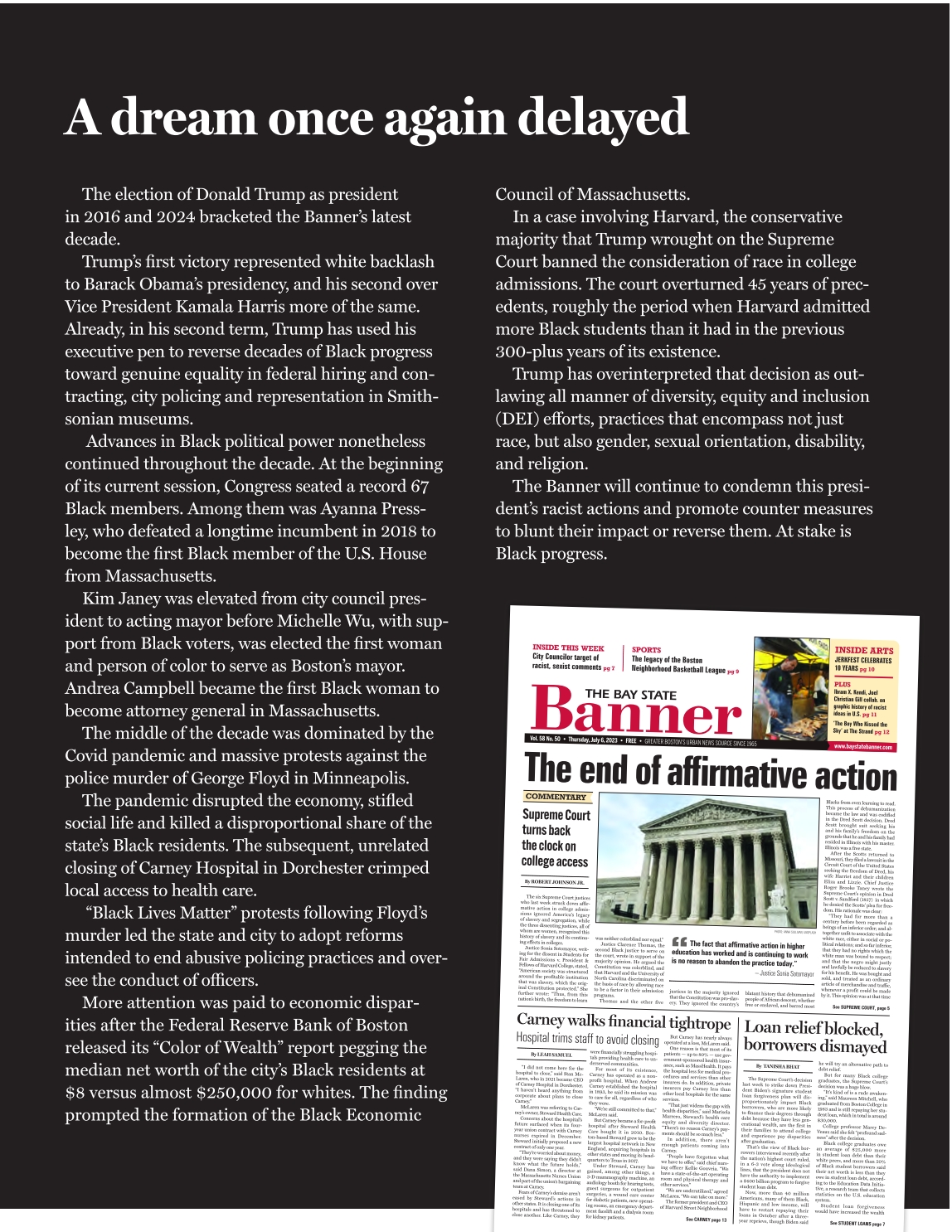
In a case involving Harvard, the conservative majority that Trump wrought on the Supreme Court banned the consideration of race in college admissions. The court overturned 45 years of precedents, roughly the period when Harvard admitted more Black students than it had in the previous 300-plus years of its existence.
Trump has overinterpreted that decision as outlawing all manner of diversity, equity and inclusion (DEI) efforts, practices that encompass not just race, but also gender, sexual orientation, disability, and religion.
The Banner will continue to condemn this president’s racist actions and promote counter measures to blunt their impact or reverse them. At stake is Black progress.