The ultimate prize, and a lasting legacy
There were more stories than just of political figures in the Banner’s fifth” decade.
But
few more captivating. Most significant was the 2008 election of Barack
Obama, a world-changer with roots in the Boston area where the future
president attended Harvard Law School under the tutelage of Professor
Charles Ogletree, who would also mentor the woman later to be his wife
and keen adviser, Michelle Robinson.
The
election of an African American leader by a majority white populace was
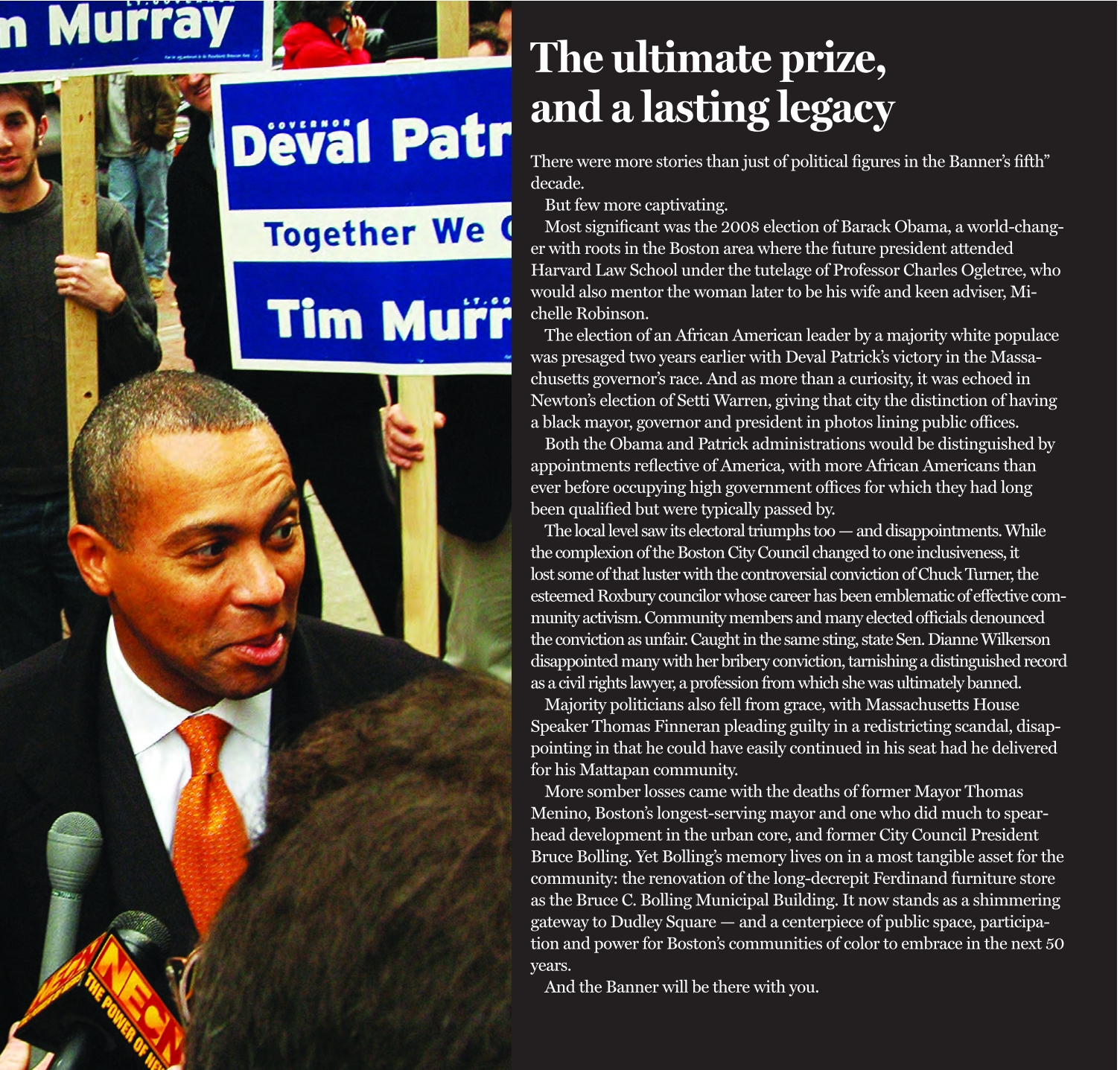
presaged two years earlier with Deval Patrick’s victory in the
Massachusetts governor’s race. And as more than a curiosity, it was
echoed in Newton’s election of Setti Warren, giving that city the
distinction of having a black mayor, governor and president in photos
lining public offices.
Both
the Obama and Patrick administrations would be distinguished by
appointments reflective of America, with more African Americans than
ever before occupying high government offices for which they had long
been qualified but were typically passed by.
The
local level saw its electoral triumphs too — and disappointments. While
the complexion of the Boston City Council changed to one inclusiveness,
it lost some of that luster with the controversial conviction of Chuck
Turner, the esteemed Roxbury councilor whose career has been emblematic
of effective community activism. Community members and many elected
officials denounced the conviction as unfair. Caught in the same sting,
state Sen. Dianne Wilkerson disappointed many with her bribery
conviction, tarnishing a distinguished record as a civil rights lawyer, a
profession from which she was ultimately banned.
Majority
politicians also fell from grace, with Massachusetts House Speaker
Thomas Finneran pleading guilty in a redistricting scandal,
disappointing in that he could have easily continued in his seat had he
delivered for his Mattapan community.
More
somber losses came with the deaths of former Mayor Thomas Menino,
Boston’s longest-serving mayor and one who did much to spearhead
development in the urban core, and former City Council President Bruce
Bolling. Yet Bolling’s memory lives on in a most tangible asset for the
community: the renovation of the long-decrepit Ferdinand furniture store
as the Bruce C. Bolling Municipal Building. It now stands as a
shimmering gateway to Dudley Square — and a centerpiece of public space,
participation and power for Boston’s communities of color to embrace in
the next 50 years.
And the Banner will be there with you.