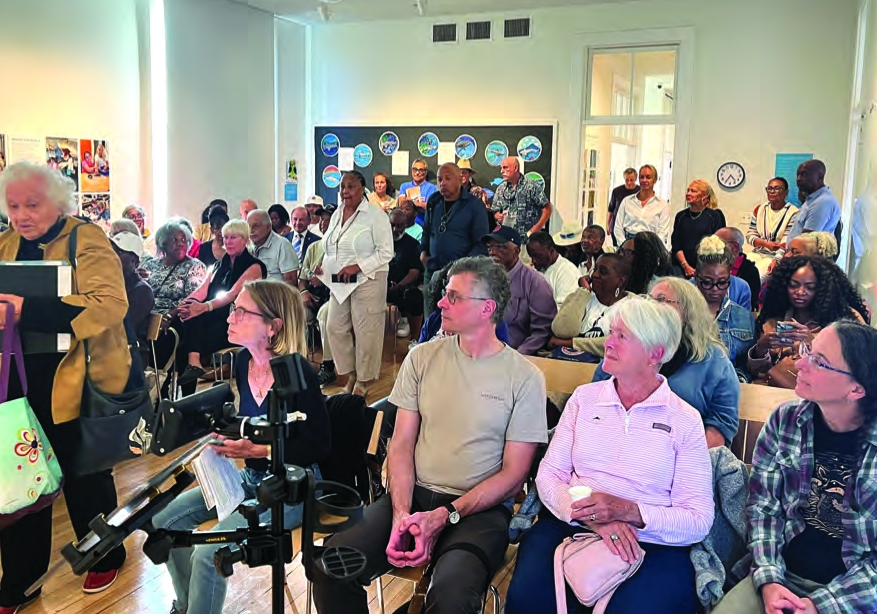
Guests
gathered in the Martha’s Vineyard Museum watching as freedom fighter
Yvonne Smart (left) makes her way to the front of the room.
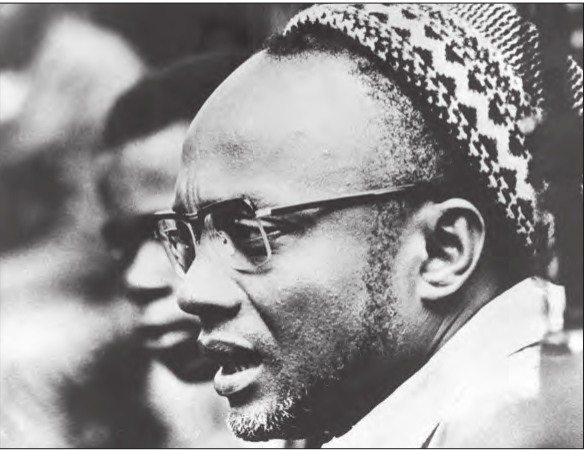
Founder of the African Party for Independence of Guinea and Cape Verde, Amílcar Cabral.
Martha’s Vineyard may be best known to New Englanders as a picturesque vacation spot, but it also holds deep roots for some of the region’s first Cape Verdean settlers.
Last month, more than 100 people gathered at the Martha’s Vineyard Museum to honor that heritage during “A Cape Verdean Experience — Amílcar Cabral: Freedom, Resistance, and Rhythm.” Event sponsors included the Underground Railroad Café, Cruz Companies and Sideline.
Celebrating the 50th anniversary of Cape Verdeans’ declaration of independence from Portugal, the event coincided with what would have been the 100th birthday of Amílcar Cabral, known as the father of Cape Verdean independence.
Cape Verde is a small cluster of islands located off the western coast of Africa, which was under Portuguese colonial rule from the 15th century to 1975. While the first steps toward independence began with peaceful protests, after resistance from the government, Cabral realized that the system needed a radical change.
Cofounder of the African Party for the Independence of Guinea and Cape Verde (PAIGC) in 1956, Cabral was at the forefront of the liberation struggle. A revolutionary and political theorist, he believed that to achieve independence, the people of Cape Verde needed to move away from the Portuguese colonial system.
A
key figure in the fight for independence, Cabral placed importance in
cultural expression and the need for the people of Cape Verde and
Guinea-Bissau to return to their Indigenous cultures. He believed that
through embracing their cultures, they would be able to move toward
liberation.
Cabral was
assassinated on January 20, 1973. Although his monumental contributions
were widely recognized later, he didn’t live to see the results of his
efforts. Guinea-Bissau, his birthplace, declared its independence just
eight months after his death, and Cape Verde followed a little over a
year later in 1975.
The
highlight of the evening was a conversation about Cabral’s life,
beginning with his first involvement in the fight for liberation and the
founding of the PAIGC.
The
guide for the evening was Carleen Cordwell, a second-generation Cape
Verdean American and New Bedford native, who led the conversation and
provided historical input from Margaret Mott, the research administrator
of the program.
“I
decided I would put together a program that sort of talked about how
Cape Verde got its independence from Portugal, and because some of the
individuals that were involved with the movement are still alive,” said
Mott. “I wanted to bring them to the forefront.”
The
evening program featured three freedom fighters: Yvonne Smart, who
shared firsthand accounts of the fight for independence; Antonio P.
Gonsalves Jr., an activist who worked alongside the PAIGC; and Salahudin
O. Matteos, who founded the PAIGC-USA Support Committee.
There
were also many other notable speakers and artists, including Tem
Blessed, a hip-hop artist and youth advocate; Iva Brito, a well-known
poet; and Vava, a Cape Verdean musician.
Many
of the special guests in attendance, according to Cordwell, were the
children of first-generation immigrants, aside from Blessed and Brito,
who were both born in Guinea and Cape Verde.
By
sharing their stories and art, they were able to take portions of their
creative works and mix them with their own experiences, thereby helping
to establish a connection between the history of Cape Verde and the
community.
According to their mission
statement, the MVM dedicates itself to promoting diversity, aiming to
connect visitors to the island and its rich, diverse heritage.
Originally inhabited by the Wampanoag tribe, some of the first settlers
to Martha’s Vineyard, aside from the English, were the Cape Verdeans.
Prominent
in the whaling industry throughout the late 19th and into the 20th
century, many Cape Verdeans inhabited the Vineyard, Nantucket and New
Bedford. To this day, many of their descendants can be found in numerous
communities throughout Massachusetts and Rhode Island.
While
this was a standalone event, Cordwell explained that it would surely
not be the last at the MVM to celebrate Cape Verdean heritage. As the
owner of the Underground Railroad Café, Cordwell is dedicated to
providing spaces where the community can prosper and learn about the
diaspora.
Located in
New Bedford and built in 1887, the cafe has served as a gathering space
and a source of food in the community, according to Cordwell. Although
it hasn’t operated as a cafe in a number of years, the space is expected
to reopen within the next six months as a commercial kitchen.
“The
local culinary artists in the community will have a legal kitchen to
produce and market the awareness from because that doesn’t exist,” said
Cordwell. She says that the space will also educate the community on the
hazards of processed foods and how to eat healthy foods affordably.
As
a second-generation Cape Verdean, Cordwell believes that both the cafe
and events like the one at the MVM are crucial to preserving the voice
and history of the Cape Verdean community.


