
With summer’s end comes a new academic school year cycle, and with it, a wrap on the Suffolk County Sheriff’s Department (SCSD) Summer Enrichment Program (SEP). Having finished its eleventh run, the eighteen students of the 2025 SEP cohort have taken to re-imagining the hallmark capstone project.
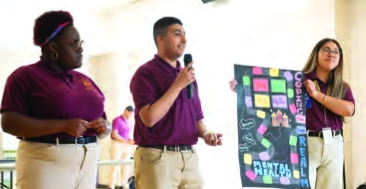
As a culmination of the knowledge acquired throughout the 7-week program, the final capstone has historically asked students to pair into groups and devise research-backed proposals addressing public safety’s most pressing intersectional challenges. Presented at this year’s SEP graduation ceremony, held at Roxbury Community College’s Reggie Lewis Center on August 22, the day joined SCSD colleagues, program mentors, and families alike. Only this time, participants broke away from the expected slides and research reports to install a board game showcase, in turn, teaching a thing or two about effective learning strategies for the classroom.
At graduation, audience members rolled dice, moved pieces, and confronted scenarios that forced them to weigh questions such as: Should public safety agencies adopt artificial intelligence tools to predict crime?
Would investing in neighborhood mental health clinics reduce harm more than increasing police patrols? What does fairness look like when communities have competing needs?
Such questions came to fruition through the students’ direct introduction to the domains these issues govern.
Throughout the course of the summer, participants traveled across Greater Boston and beyond to engage with a plethora of sectors in the public safety sphere, meeting industry-leading professionals and lawmakers along their route.
Among these community leaders, Gary Bracey, CEO of Chief Bracey’s Promotions and instructor at the Suffolk County House of Correction and the Suffolk County Jail, adapted his tutelage of his Mind Boost class to meet the unique needs of the SEP.
In his own words, “Mind Boost consists of three basic [components]: speed reading, mind mapping, and memories.”
Bracey’s course encourages out-of-thebox notation taking, deemed “compatible with the way the human brain remembers,” in accordance with neuroscience principles. Speed reading and memory retention strategies similarly train the brain for greater memory retention, creative processing, and discerned information synthesis, advancing students’ accumulation of knowledge; an evermore necessary skill in the current literacy and education crisis. Beyond traditional learning environments, such mind-boosting strategies can elevate problem-solving thinking for workforce readiness.
The defining theme of the capstone was to engage young people as active participants in their own learning. A 2014 meta-analysis of 225 college courses conducted by Scott Freeman and colleagues found that students in “active learning” in classrooms— where they solve problems, debate, or apply knowledge—outperform their peers by 0.47 standard deviations, or nearly half a letter grade. As published in their report “Proceedings of the National Academy of Sciences (PNAS),” students in lecture-only settings were 1.5 times more likely to fail compared with those in active learning environments.
The board-game format added another powerful layer. Studies consistently show that project-based learning, where students research, design, and present solutions, pro duces measurable gains in problem solving and collaboration. A 2023 meta-analysis of 66 studies published in Frontiers and Psychology found project-based learning had a moderate but significant positive impact on academic achievement and higher-order thinking skills. Researchers who study game-based learning have found that games, when well-designed, boost both engagement and comprehension. A comprehensive review in the review of Educational Research concluded that game-based approaches enhanced learning outcomes by a meaningful margin, particularly when players had to make decisions, face consequences, and reflect on outcomes.
This summer, we saw that truth play out in real time. The board-game format transformed abstract topics into lived experiences. With titles including Heart-2Heart, Battleship AI Destroyer, The Coping Realm, and Crimenopoly, the SEP 2025 cohort tackled expansive topics from mental health awareness needed in our own communities, to substance use disorder education for youth, to safety guidelines for navigating the digital age.
As our students return to school this fall, we hope they carry with them the lessons of this summer: that creativity is a strength, that grappling with tough questions builds resilience, and that they already have the power to shape a safer, fairer world. And we hope we, as a community, carry forward the lesson that teaching works best when it engages lateral thinking and robust experiential learning together.
In this installment of the Intersection, We would like to give special thanks to our SCSD staff, whose constant dedication to local youth engagement helps keep this program thriving for current and future generations. Thank you, Community Outreach & Youth Programs Coordinator Lucretia Goodson, Sgt. Stacey Wood, Officer Estherline William, and Administrative Assistant Stephona Wilson-Singleton.


