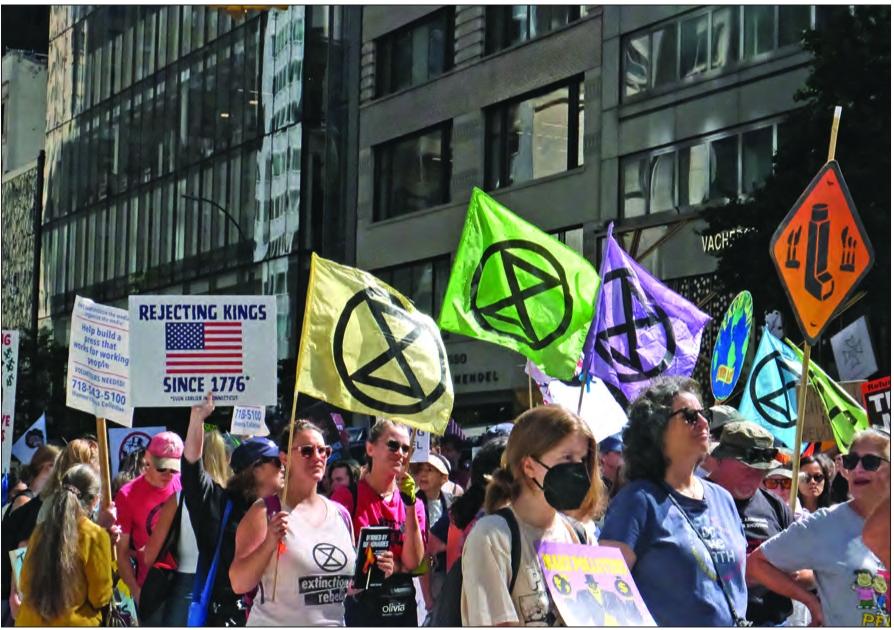
Extinction Rebellion Boston members raise their flags and voices in protest as they march down the streets of New York.
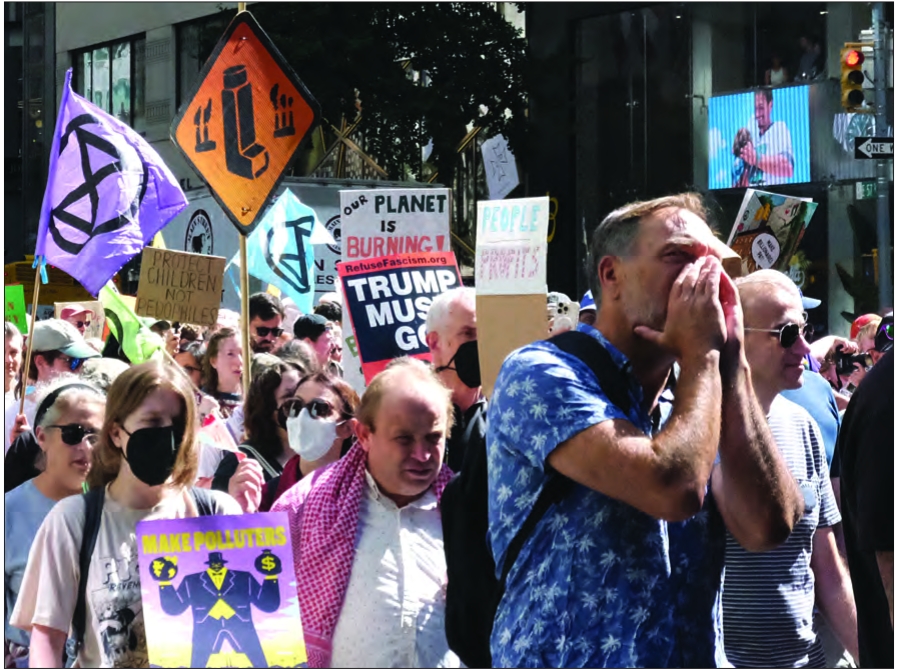
Protesters crowd the streets of New York during the Make Billionaires Pay march, Sept 20.
On Sept. 20 at 7 a.m., while most Bostonians were still asleep in their beds enjoying the last day of the weekend, a gaggle of locals stood on the corner of Summer Street and Atlantic Avenue. Just as the sunlight began to spill onto the streets, members of Extinction Rebellion (XR) Boston stretched as they prepared to board a bus with a destination in New York City to participate in the Make Billionaires Pay protest.
Aligning with the beginning of Climate Week and the UN General Assembly, Make Billionaires Pay was planned as part of the global week of action for climate justice titled “Draw the Line.” Convened by Women’s March, 350.org, Desis Rising Up and Moving (DRUM) and Climate Defenders, the New York march is one of many that occurred across the nation.
According to the Make Billionaires Pay’s official website, the group has three core demands: 1. “Shut down billionaires. Fund our future. 2. Shut down fascists. Protect migrants and the global majority. 3. Shut down polluters. Defend Mother Earth.”
Make Billionaires Pay reached out to XR Boston in mid-spring to organize how to get a bus to and from New York to allow people to participate. Founded in 2018, Extinction Rebellion is a global climate change advocacy group that focuses on nonviolent forms of protest.
While they usually organize several events throughout the months, for them, having the chance to be solely participants was like a weight off their shoulders.
“It’s so magical because Extinction Rebellion Boston, we are so often the ones organizing actions, we’re constantly, constantly responsible for situations like this,” said Jamie McGonagill, the media and messaging director for XR Boston, “This is like a vacation.”
The group traveling from Boston to New York included staff members from XR Boston, students from the Boston area, and several other participants willing to give up their time to travel the long distance for a cause they believed in.
For Sarah Hobbs, a Boston local who had participated in XR protests in the past, this was a trip she had done before and was more than willing to do it again. With the hope that rallying together would show the nation that people are angry, scared and want change, Hobbs explained what her perfect world would look like.
“A world where we prioritize taking care of our planet and our air and our waters, the earth that we all live on, and seeing that, that’s a priority,” said Hobbs.
As Hobbs and many others boarded the bus with backpacks filled with snacks for the day with posters and flags tucked into the baggage compartment of the bus, the air was filled with a buzz of excitement.
With a turnout exceeding 25,000, McGonagill said she was more concerned about people taking care of their health during the march than the possibility of police interference. She did however express a slight concern over the possibility of counter protesters.
“But the beautiful thing about an anti-millionaire action is like, who’s fighting on behalf of the billionaires you know, who’s gonna show up as a counter protester to an anti-billionaire action?” she said.
While concerns regarding police interference seemed to be the least of her worries, not everyone shared the same sentiment.
The risks present during any type of protest for a person of color are significantly higher than for a white person due to systemic racial biases in policing.
According to the Climate Reality Project, people of color are disproportionately harmed by the effects of climate change. It is through policies and practices that work to place low-income communities of color next to some of the most polluted areas.
A study conducted in 2024 by Stanford Medicine published in “Nature Medicine” found that people of color, particularly Black people, are much more likely to die from causes related to air pollution. This is due to higher exposure to these areas because of societal disadvantages rooted in systemic racism.
A study released by the Metropolitan Area Planning Council (MAPC) in 202 found that in Boston, 45% of the area’s Black residents live in the highest-pollution areas compared to 29% of the area’s white residents. In other words, communities of color, while at the forefront of the effects of climate change, are not at the forefront for the fight against it.
Throughout the majority of climate activism history, the demographic that has been represented the most are white people. McGonagill went on to state that the reality of the situation is that most participants are white men who have the funds, and the privilege, to protest and take on the risks that come with it, such as arrest.
According to a 2023 report by the Yale Program on Climate Change Communication, communities most affected by environmental disparities are often underrepresented, and their inclusion in climate policy and decision-making is essential.
“The people who suffer the results of the climate crisis first are women, people of color, children, the disabled, the elderly,” She said, “People in that category are fighting for basic rights that are affecting them right now as opposed to the climate crisis.”
XR is working toward extending the climate conversation to other underrepresented groups throughout Boston. McGonagill then explained their ties to East Boston with people from Latino and East Asian communities.
While protesting is a privilege with a risk that looks different to different individuals, that did not stop the over 40 Boston locals from traveling. Among them included Daniel Moss, a member of the Service Employees International Union Local 509 (SEIU 509), who said that protesting felt natural to him.
“I always take solidarity and kind of confidence from being around other people who share my values and share the importance of raising our voices at this time,” said Moss.
When asked about how he felt about the risks of protesting as a person of color himself, he acknowledged the risk.
“I mean, you know, everything is a risk, and you really don’t know what’s going to happen from one second to the next,” he said.
Despite that, he said he had faith in the organizers to take all precautions for what was organized to be a peaceful protest.
“If there’s anything that we need to do at this time it’s to look at ourselves internally and to think about ways that we can improve the way we interact with people, the way we communicate, the way we understand the reality of our situation,” said Moss.
With an arrival time of around 1 p.m. the Bostonians found themselves on the streets of New York to join thousands of like-minded individuals who came to show their support. Amid the growing crowd of thousands, XR Boston joined the sea of protesters holding their red, white and blue banner with bold letters that stated, “Make Polluters Pay Massachusetts,”
Another XR participant had changed the moment the bus had arrived in the city into a polar bear suit wearing a sandwich board that stated, “Keep Ice where it belongs.”
Starting along Park Avenue between 46th and 49th streets, thousands of protesters took over the streets of New York City and XR joined their banners and flags in hand chanting: “When earth is under attack what do we do? Stand up, fight back. When immigrants are under attack, what do we do? Stand up, fight back. When Palestine is under attack, what do we do? Stand up, fight back!”
Despite the fact that climate activism has had a long history of being led by white activists, Make Billionaire’s Pay brought together thousands of people of all ages, genders and cultural backgrounds.
Parading down 57th Street past Billionaires’ Row, the crowd stopped more than traffic; their chants and signs caused many people to stop and look, some even deciding to stay for a while or join in.
The march concluded at Columbus Circle overlooking the Trump International Hotel, where after hours of marching the crowd began to disperse as police began to gather at the location.
King, a protester with XR Boston, explained the importance of events like this because they foster community.
“Just to hear everybody saying what we’re all thinking all the time, it’s really helpful like hearing your own voices and to feel that community,” they said. However, they went on to say how they were not expecting the crowd to disperse so easily and thought everyone would congregate in Central Park.
Despite this, and facing a fivehour journey back to Boston, King spoke of the value in events such as a protest where people can gather for a common cause.
“But it’s still important to speak your truth.” King said, “Get out there and meet people who understand the same values that you do.”