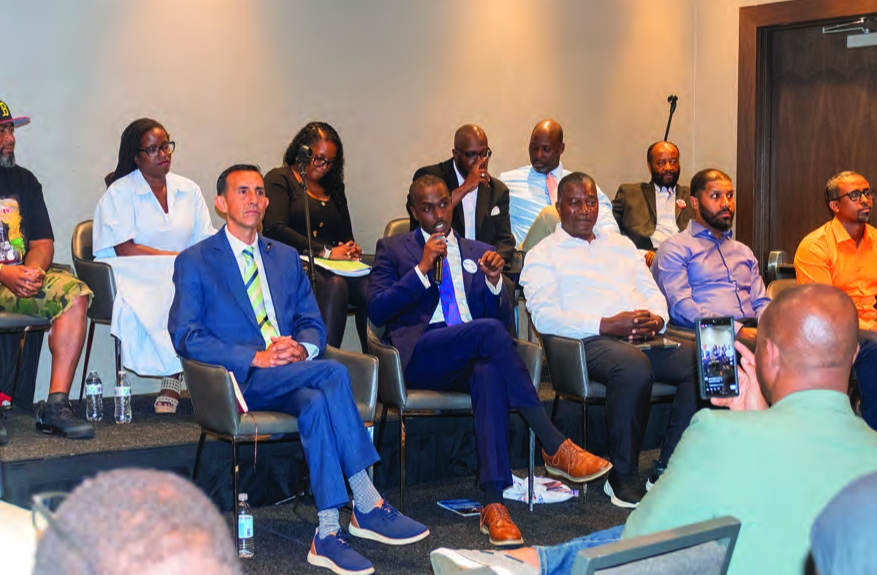
Candidates
for Boston’s District 7 city council seat sit at a forum, Aug. 19. The
event, hosted by Roxbury Main Streets in collaboration with the Urban
League of Eastern Massachusetts, The American City Coalition, and
Urbanica at the Roxbury Residence Inn focused on issues including small
business development, expanded night life, arts and culture, workforce
development and housing.
As the race for District 7 city councilor speeds toward September’s preliminary election, the 11 candidates in the running promoted policies that would support the economic development of the district at a forum, Aug. 19.
The event, hosted by Roxbury Main Streets in collaboration with the Urban League of Eastern Massachusetts, The American City Coalition, and Urbanica at the Roxbury Residence Inn, covered topics ranging from small business growth to arts and culture, and economic support such as workforce development and housing.
Candidates were also asked about their vision for expanded night life, a major topic in city conversations in recent years.
William Watkins, vice president of the Urban League of Eastern Massachusetts and vice president of the Roxbury Main Streets’ board of directors, said the forum and election were an important moment for District 7 residents to have a say in who represents them and their interests.
“We understand when you’re going to the hallowed halls of City Hall, there are people who are working against our interests,” Watkins said. “We are looking for someone who will protect our interest, as well [as] move forward the call.”
Increasing small business support
The Roxbury Main Streets forum prioritized conversations around support for the area’s small businesses.
Top of mind for candidates was the need to bring more resources directly into the district to cut down on what they said was restrictive red tape keeping prospective local business owners out of the market through processes like licensing and permitting.
“People want to start businesses; people want to have our district thriving,” said candidate Said Abdikarim. “They want to start a daycare. You know, they want to start a retail store. However, when they go into the city website or the state website, there’s a lot of confusion.”
For some, like candidate Jerome King, that meant bringing small
business advocates out into the community to speak to business owners
about their needs. He called it getting “back to basics.”
Others
proposed steps to bring licensing processes directly into the
neighborhood. Candidate Tchad Cort called for expanded opportunities
like broader hours and weekend “popup offices” to make permitting
processes more accessible.
“People work,” she said. “Sometimes they can’t get to an office in time because they’re working.”
Candidates
also largely called for internal support for existing businesses.
Miniard Culpepper said that bringing more attention and traffic to
neighborhoods like Roxbury requires first seeing local patronage and
investment.
“We need to start buying Roxbury ourselves in order to get people into the community,” he said.
Efforts
to increase traffic to District 7’s commercial areas would also require
steps like making sure there are solid transportation options to them,
Cort said.
She pointed
to the MBTA’s announcement this month to extend hours on all subway
lines and eight bus routes — including the 1, 22, 39, and 66 buses, plus
the Silver Line 5 route — by an hour, and she said that transportation
to commercial districts shouldn’t be a cost burden.
Some
candidates punted on questions about specific policy proposals they’d
push for, deferring to conversations with business owners to figure out
what changes are best. Candidate Wawa Bell called for “going back to the
drawing board,” but said specific solutions should come from community
business owners.
“I’m
not an expert in that, but I know that the expertise is in the
community,” Bell said. “My first step is to work with the grassroots to
figure out what those best steps are.”
Expanding and balancing nightlife economy
Candidates
faced questions at the forum about expanding nightlife opportunities
within District 7’s communities. They said that making more
opportunities for Roxbury residents to get a meal or a glass of wine
without heading downtown is an important step.
“Then
you don’t have to go to New York to get a sandwich at 11:00,” Culpepper
said. “You can do it at Nubian Square or Grove Hall.”
Some candidates also emphasized support for existing businesses as the district looks to expand with new offerings.
In
discussing growing nightlife — an effort for which candidates generally
voiced some level of support — candidates took varying tacks on how to
balance it with other neighborhood concerns like late night noise.
Candidate
Natalie Juba-Sutherland said that “we want the businesses to thrive”
but that officials also must look out for local residents.
That need for a balance and for community input was shared by a handful of candidates.
“We’ve
got to play; we’ve got to give young people the time but also remember
our seniors and respect for our seniors,” said candidate Said Ahmed.
They
widely suggested that, for an increased nightlife to be effective and
sustainable, areas like Nubian Square would need to see increased
security effort.
Conversations
regarding increasing nightlife in neighborhoods beyond places like
downtown and Seaport have increased in recent years.
In
February 2023, the city announced the new position of director of
nightlife economy in the Economic Opportunity and Inclusion cabinet,
with the focus of fostering more varied and diverse late-night
opportunities.
Since
the creation of that position, held by Corean Reynolds, the city has
explored the potential for “social districts,” which it attempted
through a downtown pilot that allowed open containers from 8 a.m. to 8
p.m.; late night food trucks at seven sites across the city — mostly
downtown or around Fenway; and “Wake Up the Night” grants that supported
nighttime programming across the city.
A
combined effort from the city and state has also sought to support the
growth of nightlife opportunities in the community through an increase
in liquor licenses to support more dine-in restaurants — something that
community leaders have voiced the need for.
Last
year, following advocacy by the city and other groups, state
legislators passed a law that will create more than 200 liquor licenses
in Boston over the next three years. The number of liquor licenses the
city is allowed to distribute is capped by state law.
Under
that law, the bulk of those licenses will be restricted by zip code and
will go to five restaurateurs each in 13 codes across the city; four of
those ZIP Codes include portions of District 7. The law also created an
additional 12 transferable licenses and 15 licenses restricted to arts,
culture and community spaces.
The first batch of 37 licenses was approved by the city in February. Another 21 were released in June.
Supporting residents’ employment and housing
In
response to questions about workforce development, candidates
emphasized the importance of homeownership and connecting residents with
existing job training programs.
Candidates
like Mavrick Afonso, Samuel Hurtado, Cort, Juba-Sutherland and King
emphasized support for BPS students, especially at Madison Park
Technical Vocational High School.
Juba-Sutherland
called the school “a gem” and called for more links between employers
and its students. Similar proposals were highlighted by Hurtado, Cort
and King.
More
broadly, candidates also proposed a clearinghouse for job training and
workforce development programs to help connect more residents with
various pathways.
Bell
said that, if elected, he’d work towards bringing together
organizations in the workforce space together to create a system of 360°
opportunities for residents. Juba-Sutherland, too, called for a
“one-stop shop.”
When
it came to housing, candidates focused on making sure “affordable
housing” is actually affordable for District 7 residents. They proposed
steps like making sure area median income is accurate for local
neighborhoods.
They
also focused on homeownership as a way to ensure that community members
can avoid displacement. Bell called it a “resounding answer” to keeping
residents in the district.
On Sept. 9, voters will go to the polls for the preliminary election, where the 11-candidate field will be narrowed down to two.
Voter
registrations are due Aug. 30, 10 days before the election. Voters may
check their registration status online and may register through the
Secretary of the Commonwealth’s website or by mail with forms provided
by the Secretary of the Commonwealth.
In-person
registrations are accepted at Boston’s Election Department in City
Hall, at the office of the Secretary of the Commonwealth Elections
Division at 1 Ashburton Place downtown or at a regional office of the
Secretary of the Commonwealth.
Early
voting runs Aug. 30-31 and Sept. 2-5. Voters can find an early voting
location through the city of Boston. Any voter can request a mail-in
ballot through the Secretary of the Commonwealth, but requests must be
received by Sept. 2, five business days before the election.
Voters may also cast their ballots in-person at their specified polling place from 7 a.m. to 8 p.m. on election day, Sept. 9.


