
Beyoncé Martinez as Dixie Montclair and Rachel Hall as Tessie Montclair in “The Meeting Tree.”
Beyoncé Martinez as Dixie and Jacqui Parker as Katherine “Kitty” Montclair.
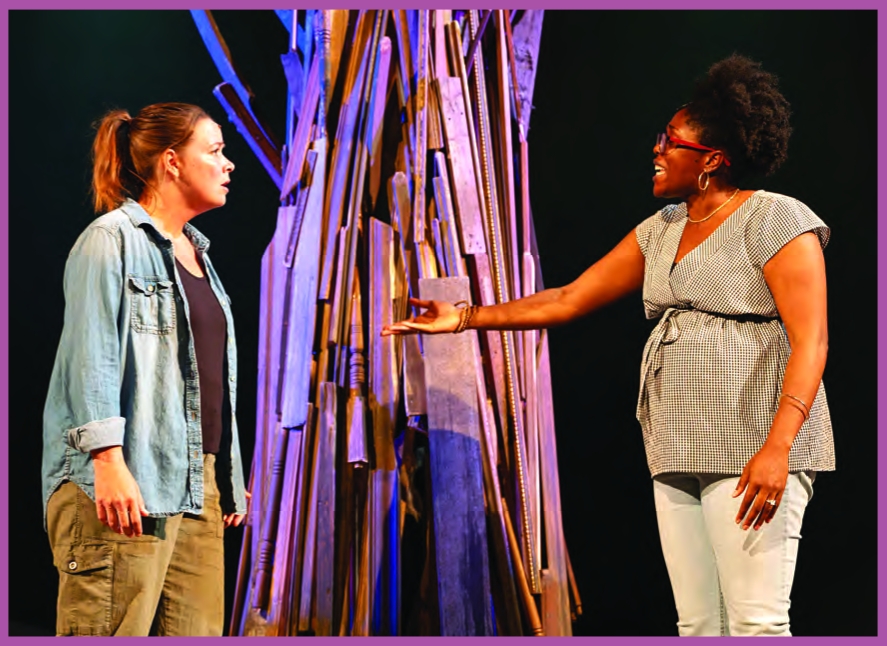
Sarah Elizabeth Bedard as Alison Browning and Anjie Parker as Sofia Langton in “The Meeting Tree.”
The joyful abandon of a friendship between two girls is the heart and soul of the poetic play “The Meeting Tree” by B. Elle Borders, on stage through Aug. 9 in a world-premiere production by Company One Theatre (C1) at the Strand Theatre in Dorchester.
Inventively directed by Summer L. Williams, C1’s associate artistic director and cofounder, C1 is producing “The Meeting Tree” in partnership with the Front Porch Arts Collective and the City of Boston’s Office of Arts and Culture and offers pay-what-you-want tickets.
The first play by Borders, a Boston theater artist and educator, begins as Sofia, who is pregnant, arrives at the Alabama farm where her ancestors were once slaves. She is determined to obtain rights to the land she believes her family has been granted before she brings a new generation into the world.
“I wrote ‘The Meeting Tree’ to imagine a new ending for my family story,” said Borders. In an interview with C1’s dramaturg afrikah selah published in the production’s program, Border describes the play as inspired by her grandmother’s memories of a childhood friendship with a white girl on the farm where Border’s ancestors had been slaves. Her grandmother later learned that she and her friend had ties of blood as well as spirit.
The production’s fine program includes a family tree of the play’s six characters, all female, as well as a timeline aligning their lifespans with real events, from the Civil War and Reconstruction to the Great Migration and on to present day.
Tender at times but not sentimental, the play unfolds with the open-ended suggestiveness of a poem through a series of encounters between characters within and across generations.
Artful staging by Williams employs Cristina Todesco’s deft haiku of a set and lighting by Elmer Martinez to engage the
audience in imagining the story. Against a black backdrop, spare and
evocative elements conjure the play’s journey across time. Stage left,
the fragment of a grand staircase leads to a lone white pillar
suggesting an antebellum mansion.
Midstage,
a tall construction of slender slats represents the now lifeless pecan
tree that was once cherished as both a source of food and a magical
meeting place where strangers find mutual understanding and even love.
On the far right is a single bed covered with a quilt, the product of a
traditional craft practiced by generations of Black women.
When
the show begins, the house lights go dark and then go back on, for a
moment making the audience as visible as those on stage. In the course
of the play, as characters emerge from the past, the lighting casts
shadows of dappled leaves on the audience as well as the stage, drawing
all into the scene. Props by Jason Ries are also expressive. Sofia
(Anjie Parker) arrives bearing a
brass urn that contains her grandmother Dixie’s ashes. Together with her
yet-unborn child Sofia brings multiple generations together.
Costumes
by Amanda Mujica also tell the story. Dixie wears plain farm clothes
while Tessie is attired in fancy dresses. Jacqui Parker’s Kitty, Dixie’s
grandmother, is attired in homespun garb and a headwrap. Alex
Alexander’s statuesque and severe Elizabeth, the
grandmother of Tessie, stands motionless in a long, dark dress. Alison,
played by Sarah Elizabeth Bedard, the white descendant who inhabits the
farm, is outfitted in overalls and brandishes a gardening tool that at
first looks like a weapon. Urbane Sofia wears a pert maternity top with
ruffles.
In the first
scene, Sofia and Alison warily take the measure of one another. Each
woman insists on her ancestral claim to the land, which is being worked
by Alison, who hopes to restore it.
The
tree that once supplied shade, a meeting place and pecans for pies
baked by Kitty is worn out and even the land, Alison observes, is “brown
and dead.” They trade creds. Alison describes herself as “progressive
enough” and a graduate of Auburn University. Sofia lets Alison know that
she graduated second in her class from Yale. In later exchanges, mutual respect ebbs into their dialogues and together they seek — and uncover — the truth.
The
scene shifts to Dixie and Tessie as they first meet while gathering
pecans from the tree. Nuts tumble down when Dixie shakes it — and even
more when expertly wacked by Tessie. Rachel Hall is a captivating
Tessie, here as a whistling, high-spirited nineyear-old and later as a
21-yearold dressed for her wedding, still whistling and playful with her
beloved Dixie. But Dixie, played by the compelling Beyoncé Martinez —
astonishingly nimble as both preteen Dixie and later as a young woman
attired as a domestic — tells Tessie that she will soon “start acting
like a lady” and predicts that their bond will not survive the
transition. However, the story does not end here.
Each
character, even Elizabeth, gains a sympathetic moment. And last but not
least, the long-dead patriarch, “Senior,” gets his say. Open minds and
hearts go a long way in this parable of redemptive healing in a
polarized time.
ON THE WEB
Learn more at companyone.org/the-meeting-tree


