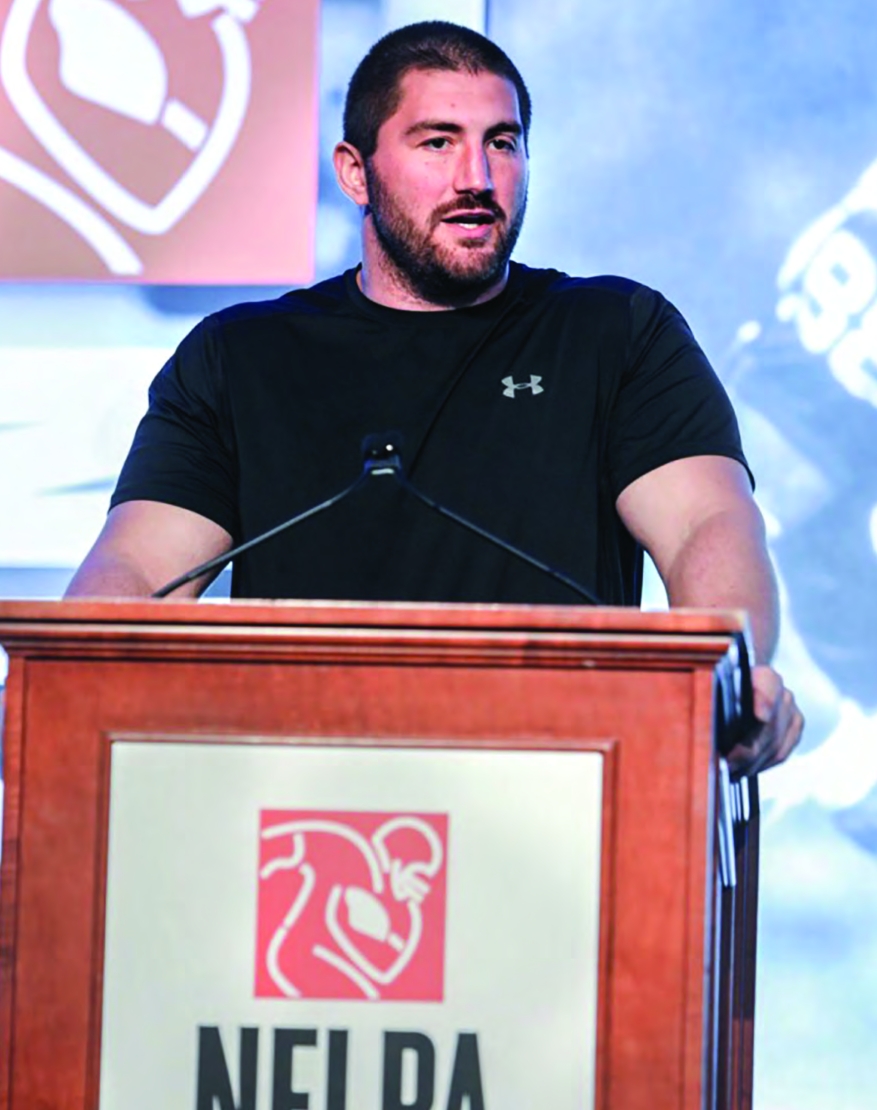
J.C. Tretter served as president of the NFL Players Association (NFLPA) from 2020 to 2024. 
Lloyd Howell Jr. recently resigned as the executive director of the NFLPA.
With the official opening of the National Football League’s training camps this past week, news of a scandal at the executive level of its players’ association has made headlines. Lloyd Howell Jr. resigned as the executive director of the National Football League Players’ Association (NFLPA) amid allegations of conflicts of interest and expense impropriety.
This situation is an embarrassing turn of events for a union that has prided itself on stability at the top of its organization over the past 42 years. In that time, there have been only three men to hold the position of executive director: Gene Upshaw (1983-2008), DeMaurice Smith (2009-2023), and Howell (2023 to the present).
Pro football players, like all professional athletes, take the matter of their money very seriously. And they expect the highest level of legal and fiduciary responsibility to their members, the athletes who pay the dues to run the organization.
An ongoing investigation into Howell’s stewardship has raised numerous questions, one of the most serious being the expenditure on strip clubs by Howell and other executive board members. Expenses incurred during Howell and colleagues’ visits to these establishments in 2023 and 2025 were submitted for reimbursement to the NFLPA. The entries for one reimbursement were listed as “Player Engagement Event(s) to support & grow our Union.”
The line items on the 2025 expense report included numerous cash withdrawals Howell made during a visit to these clubs. Compounding the issue of malfeasance is the fact that Howell reportedly instructed another employee, who was present at the event, to file the expense reports, masking the total spending for the evening, thus allowing Howell to approve his expenses if the employee was his subordinate.
In the legitimate workings of the business world, expense policies prohibit such activities because they indicate a willingness to circumvent internal controls that have broader implications.
The WilmerHale Law firm handling the investigation into Howell has also expressed significant concerns regarding conflict-of-interest issues, suppression of potential collusion allegations, a sexual discrimination and retaliation lawsuit at a previous employer, as well as an ongoing FBI investigation into personal
enrichment through the NFLPA’s OneTeam investment. Mr. Howell’s conflict
of interest charge stems from his work with the Carlyle Group, a firm
that has received approval to invest in NFL teams. The former NFLPA
Executive Director was advised to resign from his position, but chose
not to do so.
Given
the concerns over conflicts of interest and the abuse of internal
controls, investigators and federal forensic accountants will also look
closely at vendors paid by the NFLPA during Howell’s tenure to see if
they provided legitimate services for money paid to them. Anyone who has
ever had to deal with forensic accountants knows that it is a harrowing
experience. Howell and any of his associates involved in this
investigation are about to be introduced to this experience.
The
WilmerHale investigation will employ several methods to gather the
information needed to paint a clear picture of the methods Howell
allegedly used to defraud the NFL Players Association of an amount
estimated in millions of dollars. The player membership of the NFL is
outraged over these developments. Like most people who get scammed, they
would like to see Howell, and everyone involved in this scandal, spend
years in prison for stealing their money.
Then there is the question of restoring faith in the NFLPA’s executive branch, which is going to be an arduous process.
J.C.
Tretter, the former NFLPA president, was considered one of the two top
candidates to replace Howell. However, that idea went up in smoke
because Tretter resigned amid public criticism for his role in hiring
Howell and other issues raised by concerned parties such as Will
Compton, who recently said, “We’ve gotta be the dumbest union in all of
sports. The NFLPA is constantly outmatched and it’s truly our own
doing.”
Transparency
is likely to be a significant issue of interest to both the players’
union and the federal government, as labor laws have been violated. As
history has shown us, the federal government takes it seriously when
taxable money is spent in strip clubs and should be going into its
coffers.
These are
difficult times in the history of the NFL Players Association. With the
current collective bargaining agreement with NFL owners about to expire,
the next NFLPA executive director will take the oath of office knowing
that there will be a lot of suspicious eyes watching him.
We are a long way from the days when Gene Upshaw ran the NFLPA and built it from a struggling entity to a powerful organization.
Upshaw
was never considered a polished speaker, but there was never a doubt
about his love for the players and their union, which he helped bring
into existence. A Hall of Fame lineman for the Oakland Raiders, Upshaw
was a no-nonsense man of impressive size and stature. He stood
toe-to-toe with NFL Commissioner Pete Rozelle and the NFL owners and
made his points on behalf of his union members.
Because
of strikes, the media and football fans vilified him during his tenure;
however, he left a legacy to be remembered. The same will never be said
for Howell and the severely damaged legacy he leaves behind. Thank you,
Eugene Upshaw, for helping to establish the NFLPA in its present form.
No, thank you, Lloyd Howell Jr., for bringing shame to it.


