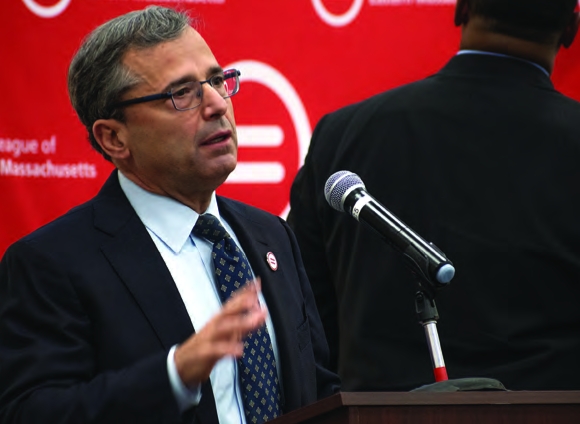
Josh
Kraft delivers remarks at the Jan. 31, 2024, meeting of the Urban
League of Eastern Massachusetts, where he was appointed chair of its
board.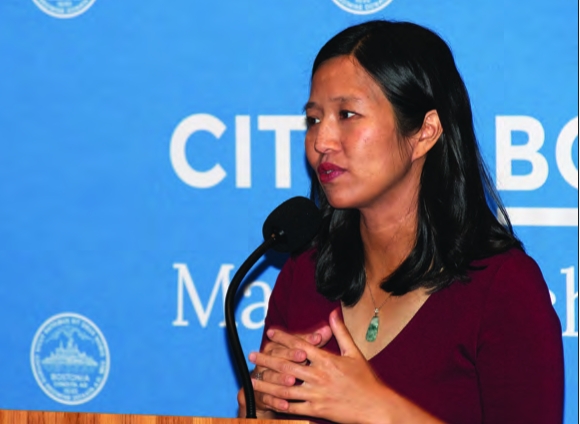
Mayor Michelle Wu answers press questions following her State of the City address at MGM Music Hall Jan. 9, 2024.
During Boston’s last mayoral election four years ago, Michelle Wu was hailed as a climate leader, but she wasn’t the only candidate staking a position on how the city should better serve its residents while building environmental justice initiatives aimed at addressing disparities in access and impact.
All five of the main candidates who ran in the preliminary election had an explanation of their policy positions around climate and environmental justice.
This year? Not so much. On her campaign website in this year’s race, Wu devotes a paragraph to some of the city´s climate work during her first term but has no webpage dedicated to explaining her position as a candidate.
Domingos DaRosa, a community activist and Dorchester resident running to unseat Wu, mentions “green space and environmental justice” in a list of key priorities.
But otherwise, in official campaign webpages, the topic is generally unmentioned.
For Hessann Farooqi, executive director at the Boston Climate Action Network, that limited conversation leaves gaps that need to be filled for voters looking to inform themselves about the various positions of the candidates.
“I don’t think it’s been covered enough in this campaign so far, except for on the narrow issue of bike lanes, which have been a big source of discussion — which certainly have a climate component to them — but overall, we haven’t seen a tremendous amount of coverage of this,” Farooqi said.
Though Farooqi said he’d like to hear more from candidates about their views and policies on climate and the environment, voters at large may not share that priority. In a July poll from Suffolk University and the Boston Globe, of the 500 respondents, 10 listed climate change and the environment as their top priority in this year’s race.
But,
in that arena, Wu may still hold sway. Of those 10 respondents, the
bulk of them said they were leaning toward Wu, of the four candidates,
as their first choice in the 2025 election.
The
Banner reached out to all four mayoral candidates to get a better sense
of their climate plans and priorities. The campaign of Bob Cappucci did
not respond to a request for comment.
Wu: Building off an existing record
While
the topic hasn’t been widely broadcast in this year’s election, Farooqi
pointed to the personal histories working in the space from the
candidates, especially the two leading ones: Wu and Kraft.
In
the Suffolk University and Boston Globe poll, almost 90% of respondents
listed Wu or her opponent Josh Kraft as their top choice; about 60% of
respondents overall cited Wu as their top choice, with a
30-percentage-point lead over Kraft.
For Farooqi, Wu’s growing track record in the climate space is an important consideration.
In
her first term is as mayor, Wu took steps to restructure the city
government to better address climate issues: creating an Office of Green
Infrastructure and an Office of Climate Resilience, as well as
retooling the head of the city’s Environment, Energy and Open Space
Cabinet to a “chief climate officer” position, tasked with also setting
up a climate cabinet to help steer city government.
The
administration has also divested the city from fossil fuels, launched a
regional agreement that will train 1,200 Boston residents and place
them in green jobs, and expanded the fare-free bus pilot program to
include the MBTA’s 23 and 29 routes. The fare-free pilot on the Route 28
bus began in August 2021, before Wu took office.
That
list of achievements is one that the Wu campaign has hung its hat on.
In July, Wu’s campaign held a press conference highlighting the climate
initiatives she has pursued over the past four years; the event also
featured an endorsement of her bid for reelection by Sen. Ed Markey, a
longtime climate advocate in Congress.
And
in response to a Banner request for comment, a spokesperson for the Wu
campaign shared a bullet list with nine climate achievements and a list
of climate-focused campaign promises from the 2021 election that Wu has
taken steps on.
For Farooqi, Wu’s track record is hefty, and one that leaves the field “unbalanced.”
“It’s
a bit of an unfair comparison, because one of these people is actually
doing a whole lot of things on climate, the other one has done nothing
on climate and hasn’t really said much on it either,” Farooqi said.
Kraft: ‘Touching nearly every aspect of policymaking’
While
Kraft’s campaign site has no specific material focused on climate and
the environment, in a statement to the Banner, the campaign said Kraft
“views the fight against climate change and resulting threats to our
environment as something that touches nearly every aspect of
policymaking.”
A spokesperson also shared a list of policy ideas that the campaign said Kraft is exploring.
That
list included siting more electric vehicle charging infrastructure in
parking lots through partnerships with commercial businesses, which the
campaign said would do better to increase accessibility and availability of charging.
And
the campaign said Kraft is exploring steps the city can take to improve
coastal resilience, including close coordination with regional partners
and academic institutions to “ensure that we are using every lever we
can to protect and safeguard our coastal communities.”
The Kraft campaign did not reply to a request for clarification regarding how Kraft’s plan would differ
from steps taken by the Wu administration since she assumed office in
2021, or plans assembled by previous mayoral administrations, like the
Climate Ready Boston initiative, launched in 2016, which drafted coastal
resilience plans for the city’s 47-mile coastline.
And
Kraft’s campaign said there is a need for increased and more equitable
access to green space across the city, alleging that public parks in a
number of the city’s Black and brown communities have not been
maintained at the same level as other green spaces across the city.
As an example, he pointed to the city’s plans to renovate White Stadium, which include the removal of 145 mature trees.
“The
recent removal of hundreds of trees in Franklin Park near White Stadium
is a perfect example of this. Climate resilience must be woven into
nearly every aspect of policy decisions, particularly at the local level
where small changes can have a big impact,” the campaign said in a
statement.
DaRosa: Focus on equity and education
The
ongoing battle over White Stadium and the loss of over 100 mature trees
was a point with which DaRosa, one of the other candidates, also raised
concerns.
“Those
trees cannot be replaced in my generation or my kids’ generation,”
DaRosa said. “Those trees, some of them go back a couple of 100 years,
and that’s a real thing.”
The
Wu campaign pointed to city plans that would plant more than 500 trees
in the space over the next decade. And the city has said that most of
the removed trees are invasive species that were slated to be removed
anyway following the guidance of a 2022 Franklin Park Action Plan.
That equity focus is an element that DaRosa said would guide his environmental policy, if elected.
If
elected, he said that he would lead a citywide audit on Boston’s
climate and environmental policies to understand where things stand in
the city now and how resources can better be used.
“With
anything I do, I’ll always start off with an audit to make sure that we
have an idea of what is and what isn’t, to make sure that we’re
addressing it, equitably and efficiently with the funding that we do
have,” DaRosa said.
That
effort would be paired with education through municipal efforts to make
sure residents understand what programs exist and how to access them.
And
his educational push would extend to efforts in Boston Public Schools
as well. DaRosa said he’d like to see forestry and arborist training
included at Madison Park Technical Vocational High School.
“That’s
something that I would bring in to make sure that we educate our next
generation on what it is and why it is important to continue to support
Mother Nature,” he said.
The
city currently runs its PowerCorpsBOS program, a workforce development
program for young people aged 18 through 22 years old that trains in
skills around urban forestry, green building operations and urban
greening.
DaRosa
said that the program, which began in 2022 under the Wu administration,
is similar to his vision, but he’d like to see that sort of education
available for even younger residents, like those in high school.
Climate leadership in the age of Trump
Despite
relatively limited public communication about climate priorities, now
may be an increasingly important time for city leadership when it comes
to green issues. Since November, as advocates stared down anticipated
decreases in federal funding and support for climate efforts under a
reelected President Donald Trump, municipal and state efforts are all
the more important, they said.
Funding,
perhaps, will be one of the large concerns with reduced federal
support. Over the past four years, the city has relied on federal grants
to support efforts like transitioning part of Boston Public School’s
bus fleet from diesel to electric school buses, or to take steps to try
to close gaps in the city’s tree canopy.
Its fare-free bus route pilots were funded through COVID-19- era American Rescue Plan Act funds.
“We
can’t count on the same kinds of federal investments that we’ve seen in
the last federal administration anymore,” Farooqi said. “It is all the
more reason that cities and states need to step up their commitments in
funding the kinds of climate infrastructure that we really need to see.”
DaRosa said he views reduced federal support as a moment to better balance the books on climate efforts.
“It
seems like the more we give, the less is being done,” he said. “We have
to do an audit on how we go about using the funding that we do have; we
can’t just be spending money because we have it.”
To close potential gaps in funding, DaRosa suggested an additional fee or tax on tourists coming into downtown Boston.
“Folks
come in and use city services within that downtown area, and we’re not
getting anything compensated to help offset the cost of putting on
these, you know, these events,” he said.
The
Wu campaign said that it was grateful for the federal funds that have
been used to advance various city projects and lay the foundations for
their operations. While the Trump administration is forcing tough
choices, the campaign said, a second Wu administration would remain
committed to preparing Boston to deal with the threats raised by climate
change and seek new partners to fund the existing programs.
The
Kraft campaign did not respond to requests for comment regarding its
position on addressing or funding climate issues in response to federal
shifts.
As the race
progresses, Farooqi said it will be important for whichever candidate
ultimately wins in September’s preliminary election and November’s
general election to determine how to address widening gaps in federal
climate policy, such as Trump’s so-called “One Big Beautiful Bill,”
which made significant cuts to the Inflation Reduction Act and its
environmental measures, as well as steps from the EPA to shut down its
research arm and overturn a 2009 finding that has allowed it to take
action to rein in climate change.
“We
have to keep doing as much as we possibly can and then some to make up
the gap to the best of our ability that the federal government is
creating,” Farooqi said.


