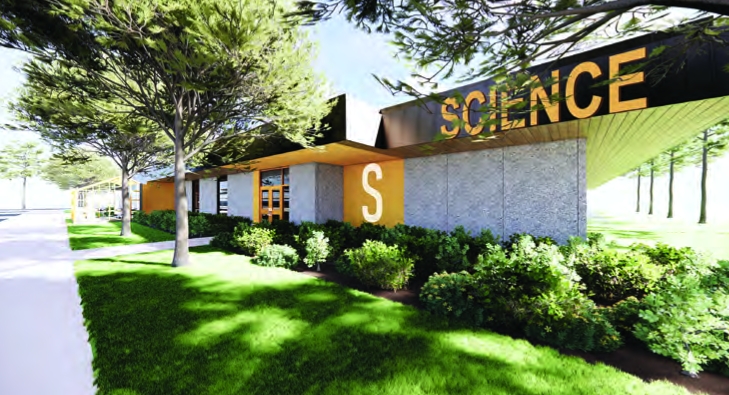
A rendering of the new science building at Massasoit Community College, expected to open in 2026. Facility will foster increased STEM participation, college admin. says
For students at Massasoit Community College’s Brockton campus, a $52 million investment means new facilities for the school’s slate of science, technology, engineering and mathematics programming.
The college broke ground on its new science building, which will replace a morethan-50-year-old facility, in a ceremony July 16. Next year, construction is slated to begin on a new health sciences building.
The new construction, which Massasoit leadership said they hope will attract and welcome new students to its STEM programs, comes as across the state, community colleges join a push to help grow and diversify the workforces in fields like the life sciences, information sciences and climate-related spaces.
The science building is expected to open in fall of 2026. The health science building is expected to be completed in time for the fall 2027 semester.
The new buildings will be better situated to serve students and increase access to the school’s STEM programming, said Katie Ruggieri, Massasoit Community College’s dean of the school’s science and math division.
The updated space will be better designed to house the program’s research equipment and will be furnished with new whiteboards. The existing science building still uses some chalkboards. The space will be designed to have better storage and increased technology, like microscopes that can hook up directly to a computer to display on a screen or projector, rather than needing each student to look through the eye piece.
The current building has served the school’s science offerings well, Ruggieri said, but can’t fully match the program’s modern needs.
“They have obviously done their best, but they’re struggling to keep up with the modern demands like what we need in the lab and such,” she said.
As the program has grown and gathered new equipment, it has maxed out the labs’ electrical capabilities. Its current infrastructure presents other limitations, such as the limited visual range on the projector set-ups.
Storage space is also currently limited, so items are stashed under desks and on counters. The new building will include storage in other places, like hidden behind whiteboards, to create a cleaner look in the labs.
All
of that, Ruggieri said, should improve operations of the school’s STEM
programming, which includes a research program focused on local
pollinators, where students and staff work on looking at the genetics of
bees and the pollen they carry. That research program was launched
about 10 years ago.
Jones
Architecture, which is working on the project, has worked with the
school to match their needs, Ruggieri said, and has shown best practices
from other lab spaces and STEM projects elsewhere. And staff input has
helped shape how the project was planned.
“We’ve
learned lessons from the past decade about what we need, so we’ve had a
larger input into their design versus, I’m assuming, when the school
was first built,” Ruggieri said.
In
addition to those steps toward modernization, Ruggieri said that the
design for the new space is all about making it a “warmer learning
environment” that is more accessible and inviting.
The
building, she said, should be proudly a science building while trying
to lean away from a design that comes across as cold or sterile. And
inside, it’ll be open, so a student who might be there for a general
biology course can see the paid technicians working in the labs and
consider what other opportunities might be out there.
“The
hope is that it’s a more inviting building overall, and it gets them
more jazzed to jump into some of these career programs,” Ruggieri said.
That
sort of step can be an important one to make sure that students feel
welcome and comfortable, especially in STEM fields, which have
“something of a fearsome reputation,” said Bill Heineman, chair of the
Community College Council of Presidents.
“It’s
crucial that the facilities that students are learning in are designed
in a way that makes them feel comfortable, that makes them feel at
home,” Heineman said.
The
effort at Massasoit to make the building more welcoming is part of a
broader effort from the community college to increase access to the STEM
workforce, which they’ve tried to tackle through a research program
focused on native pollinators — something Ruggieri said is uncommon for
community colleges like Massasoit — as well as a more recent push to
create and expand micro credentials, small degrees with a shorter
timeline and fewer requirements than an associate degree or a
certificate that focuses on a specific skill employers might be looking
for in the life sciences space.
Similar efforts are taking place in community colleges across the state.
Roxbury
Community College has partnered with the Massachusetts Clean Energy
Center to launch an energy auditor program to introduce local students
to that developing career field. And across the Boston region, in 2024
the city announced $4.7 million in funding for life science training
programs, many of which are housed at community colleges.
That
sort of programming can help create more access to a broad array of
jobs that exist across Massachusetts, and often have vacancies, said
Heineman, who also serves as president of North Shore Community College
in Danvers.
“No matter what part of the state you’re in, STEM-related business and employers are a significant portion,” he said.
Connecting
students to those roles can help the local community and its economy,
which Heineman said is central to the mission of community colleges.
For
supporters and staff, those two-year programs offer students a more
accessible entry into the education that can prepare them for careers in
potentially lucrative fields, compared to likely more expensive
fouryear programs, and can provide a way to access the education with
on-ramps and off-ramps that provide more flexibility as students juggle
other life responsibilities.
And
community colleges can be more accessible to communities of color and
groups less represented in STEM fields. According to data from the
state’s Department of Higher Education, students of color made up about
59% of community college enrollees in the fall of 2024, but 37% of state
university enrollees.
Black
students made up about 16% of the student bodies at community colleges,
but 9% in state universities, while Latino students made up about 26%
of community college students and 15% in state universities.
“The
community colleges serve a much larger percentage of students of color
than the rest of the higher ed sector in Massachusetts,” Heineman said.
“We naturally attract a student body that gives us the opportunity to
help diversify that field.”
At
Massasoit, that work has also included fostering connections with local
high schools, hiring interns and creating a “through line,” from
pre-college, through Massasoit to four-year institutions and beyond,
Ruggieri said.
She said she hopes that smoother operations in the tailored, new space will help foster that work.
“I’m
hopeful that we just, first and foremost, keep up on the momentum that
we currently have,” Ruggieri said. “And then we see the sort of the
explosion of these micro credentials is what we’re hoping for.”
For
Ruggieri, the effort to add the new STEM buildings to Massasoit’s
Brockton campus is one step toward that broader goal of fostering and
supporting a more diverse workforce.
“We
have the infrastructure and now we will have the updated equipment,”
Ruggieri said. “It’s kind of the perfect melding for them to really see
that they don’t have to go into Cambridge or into Boston to get this
training; they can do it right here in Brockton.”


