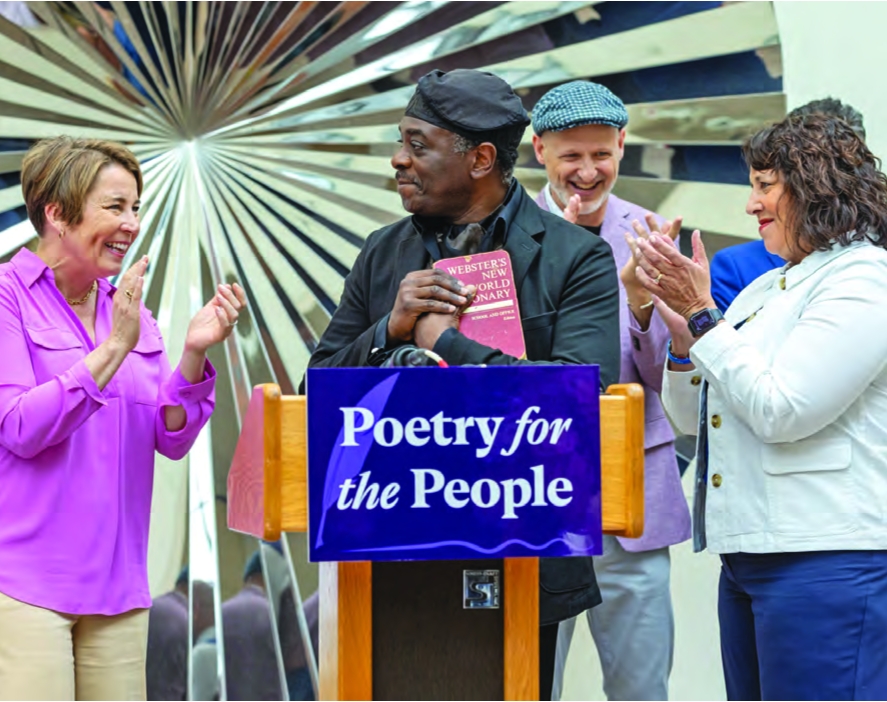
Regie
Gibson (center), flanked by Gov. Maura Healey (left) and Lt. Gov. Kim
Driscoll, was named the inaugural poet laureate of Massachusetts, May 30
at the Peabody Essex Museum.On May 30, the Commonwealth of Massachusetts gained its first poet laureate, joining 46 other states and the District of Columbia in designating an emissary to further the appreciation of poetry.
Regie Gibson, a spoken-word poet whose work often addresses social and historical themes with humor and hope, was named the inaugural poet laureate by Gov. Maura Healey and Lieutenant Gov. Kim Driscoll.
“Regie Gibson is a talented poet with a proven commitment to community engagement and a deep appreciation for the history, beauty and resilience of our state and our people,” said Healey, who signed the executive order to establish the role earlier this year.
“He sees his poetry as a means of bringing people together, finding common ground and building stronger communities.”
The two-year appointment of Gibson was announced at the Peabody Essex Museum on the opening day of the 13th biannual Massachusetts Poetry Festival, which hosts more than 60 events at venues throughout Salem.
Selected for the two-year appointment from more than 100 applicants, Gibson is an assistant professor at Berklee College of Music, where he teaches courses on performance and spoken-word poetry and an instructor at Clark University, where he teaches introduction to poetry. He has also lectured and performed widely in the U.S., Cuba and Europe. He holds a master’s in fine arts in creative writing from New England College and lives in Lexington, where he is poet-in-residence at Cary Memorial Library.
Gibson will advance poetry and creative expression across the state through public readings and other events as well as innovative collaborative projects. Also he will advise schools on developing and enhancing poetry programs.
At the announcement, Gibson
said, “Through engaging with poetry, we get a clearer sense of our own
thoughts, feelings and inner music, but also our inspirations,
aspirations and desperations — not only ours, but of many who have
walked before us, and many who will walk after. Poetry, for me, is a
sustained dialogue with ourselves across time. At a time when arts
funding is being curtailed and so many civic programs are on the
chopping block, I am so gratified to be in a state that believes poetry
is not only a worthy endeavor but a civic good.”
Speaking
by phone, Gibson said he regards poetry as “a binding tool that can
help us get back to a better civic space with one another.”
As a practitioner of spoken-word poetry, said
Gibson, “I pursue a tradition that goes back to the beginnings of human
language.” His practice, he said, is informed by the blues, music rooted
in the African diaspora. “It is mother’s milk to me. I came from
Mississippi and then moved to Chicago, the same route traveled by blues
musicians. For me, blues is the stem cell of American music. Based in
African rhythmical patterns, the blues deals with all of the experiences
we can have — love, betrayal, death, celebration. It’s a tragic-comic
genre that all other American musical forms have either built upon or
borrowed from.”
The
recipient of multiple awards, Gibson published a poetry book, “Storms
Beneath the Skin,” in 2001 and has composed and performed works that
have earned him the title of “slam minstrel” as well as partnerships
with traditional ensembles such as the Handel and Haydn Society. A new
project will tell the story of the Middle Passage, the trans- Atlantic
route of the slave trade from the west coast of Africa to the Americas;
and his production “Massachusetts: A Song of Itself ” uses music and
poetry to celebrate the state’s endurance and growth through hardship,
turmoil and change.
Asked
how he discovered poetry, Gibson recalls the visit of Illinois poet
laureate Gwendolyn Brooks, the first Black poet to win the Pulitzer
Prize, to his third-grade classroom. “She read Carl Sandburg’s 21-word
poem ‘Fog,’” Gibson said, “and showed us how a poem works.” Gibson’s
great-grandfather was the first poet in his life. “He was illiterate and
often told me stories in rhymes. His verses helped him remember things
that were important to him.”
As
poet laureate, Gibson says he is looking forward to mining the power of
poetry as a catalyst for creativity across the arts and other sectors.
“The
arts offer a way of envisioning the impossible and bringing together
disparate interests — and can even help further our economy,” he said.
“The history of this commonwealth shows its people are willing to
wrestle with hard questions and do the right thing. This state was the
first to legalize slavery, and the first to abolish it. Poetry helps us
summon our better angels and bring our demons in line. Massachusetts is
rebellious. You know, the British had a problem here.”
ON THE WEB
Learn more about Gibson at regiegibson.com


