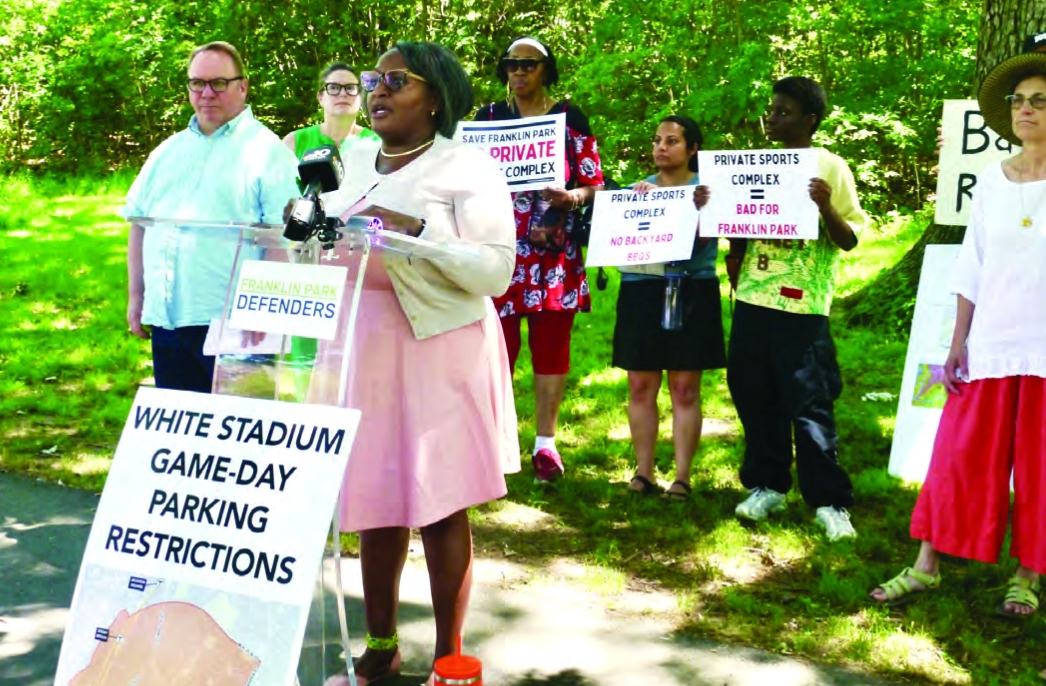
Renee Stacey Welch of Franklin Park Defenders addresses reporters during a press conference Tuesday.The city’s traffic planning for the redevelopment of the White Stadium has been riddled with contradictions and unsupported assumptions, according to a traffic planner hired by the Emerald Necklace Conservancy.
Traffic planner Bill Lyons told reporters the city’s plans for bringing spectators to the planned 11,000-seat women’s professional soccer venue via shuttles, ride shares and for accommodating pedestrians walking from the Orange Line are unrealistic.
“The project’s analyses rely on flawed data comparing this project to Fenway Park instead of other facilities of comparable attendance, scale and context,” he said, speaking during a press conference Wednesday.
“It is a concept of a plan that is not going to work for this community,” said Renee Stacey Welch, a plaintiff in the lawsuit backed by the Emerald Necklace Conservancy.
The city’s most recent iteration of a transportation plan — released April 25 — calls for up to 6,600 people to arrive to the stadium on shuttle buses that will ferry them from MBTA stations and remote parking sites. The city has not identified where the remote parking sites would be situated. It also estimates up to 2,200 people arriving from MBTA stops, 1,100 riding bikes or walking and 1,100 using ride shares.
How the ride shares and shuttle buses would make it into and out of the park remains unclear, Lyons said.
“In the April 2025 document, the city did not submit any traffic analyses to help the public understand the impact of the projects on local streets,” he said.
A spokesperson for the city responded to Lyons’ report with a statement.
“Franklin Park has always been home to large events, including some of the City’s most beloved annual concerts and cultural festivals that regularly draw tens of thousands of attendees,” the statement reads.
“But until now, there has never been an organized transportation plan
to actively coordinate and manage traffic, parking, and enforcement. The
renovated White Stadium transportation plan will set a new standard for
crowd events in Boston: Residents will benefit from new resident
parking and visitor passes, visitors will travel on team-provided
electric shuttles, and Franklin Park users will have their access to the
park protected.”
Under
the city’s April 25 plan, 40 shuttle buses would arrive at White
Stadium via Walnut Avenue and discharge passengers along the western
side of the stadium, then turn around at a yet-to-beconstructed traffic
circle and exit the park via the stadium’s Walnut Avenue entrance. Lyons
said the city has not appeared to conduct a traffic study to determine
the effects of the shuttle traffic or rideshare trips to the stadium.
The
shuttles entering via Walnut Avenue would bring passengers from remote
parking facilities and the Ruggles Orange Line station.
The
plan calls for 104 shuttle buses to discharge passengers at an existing
parking lot on Circuit Drive: 30 from the JFK/UMass Red Line station,
25 from remote parking would enter via Blue Hill Avenue and 49 would
arrive from remote parking via the Arborway and from the Forest Hills
Orange Line station.
Lyons
told reporters the planned shuttle trips, totaling as many as 144,
would require a football field-length of curb space in order for buses
to arrive and depart every minute, as called for in the plan. Because it
takes a minimum of three minutes for a fully loaded bus to discharge
passengers, multiple buses would have to compete for curb space that
does not yet exist.
Creating space for the shuttle buses could spell legal trouble for the city.
A
Suffolk Superior Court judge in April ruled against a Franklin Park
Defenders lawsuit that sought to block the city’s lease of the stadium
to Boston Unity Soccer Partners on the grounds that the arrangement was
effectively privatizing park land. In his April 2 ruling, Judge Matthew
Nestor said the stadium, which was transferred to the ownership of the
Boston Public Schools, is not park land.
But
Karen Mauney-Brodek, president of the Emerald Necklace Conservancy,
said during the Tuesday press conference that the city’s plans to use
land that surrounds the stadium for shuttle buses would constitute a
taking of parkland. The land surrounding the stadium is not owned by
Boston Public Schools. Mauney-Brodek says
the surrounding parkland is protected by the state’s Public Lands Act.
The city’s plan to bring shuttle buses into parkland for Boston Unity
Soccer Partners benefit would violate state law, she said.
“It’s
an easement for access for people to use for a leased or for-profit
entity inside what is public space that was established to be public
space,” she told The Flipside.
In
his remarks to reporters, Lyons also questioned the city’s estimates of
1,100 trips to the stadium via ride shares and the city’s plan to site
drop-offs and pickups for ride shares at the Seaver Street entrance to
the park opposite Humboldt Avenue.
“At
this point, it is hard to take any of these trip generation analyses at
face value as the city has abandoned any pretense of using a scientific
method to project the number of new trips the site will generate for
the soccer matches,” he said.
Others
at the Tuesday press conference spoke about the city’s planned parking
ban, which would allow parking only for those with resident permit
parking stickers provided to those who live within a proposed White
Stadium parking district, an area within about a mile of the stadium.
The proposed district would include Grove Hall, follow Warren Street to
Martin Luther King Boulevard, come a block shy of Jackson Square and
extend along Chestnut Avenue to Green Street in Jamaica Plain.
The
parking ban would remain in effect from 3 p.m. until as late as 10 p.m.
on game days. Those lacking a parking permit would be ticketed $100 and
towed, under the city’s plan. It’s not clear how businesses in
commercial districts such as Egleston Square and Grove Hall would
function with such a parking ban.
“They’re
creating something that is going to make life extremely difficult for
the people who live here for people who would not even want to live in
this community or be part of this community,” said Renee Stacey Welch, a
plaintiff in the Franklin Park Defenders lawsuit against the city.
“There is no care about our community when you don’t think about what is
going to be the bad part of all of this.”
This article first appeared on flipsidenews.net.


