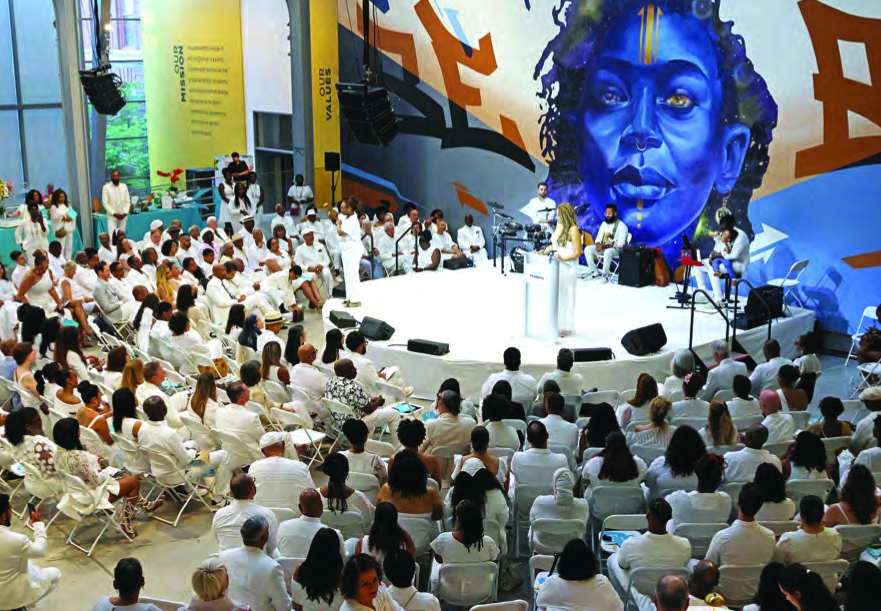
NBC10 Boston anchor Latoyia Edwards hosts the event at MassArt. 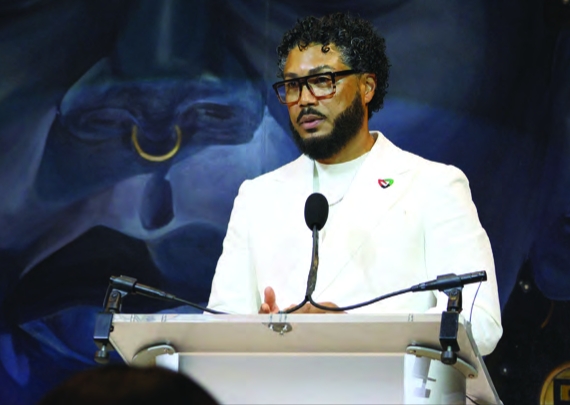
Imari Paris Jeffries addresses the crowd on the importance of community.
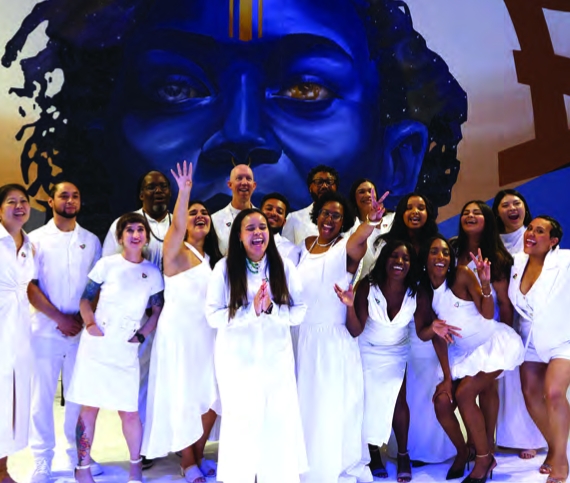
Embrace Boston team gets together for a group photo.
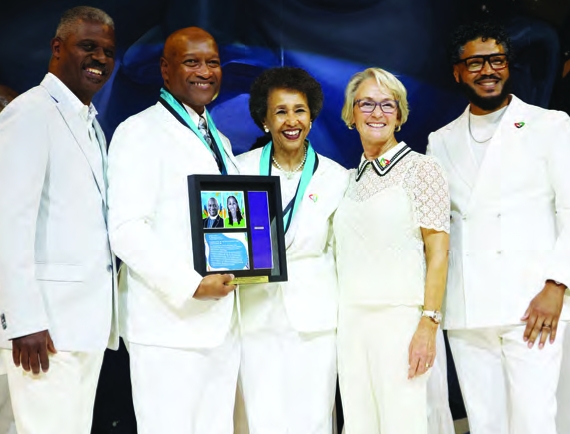
(From
left) Embrace co-founder Rev. Jeffrey Brown, honorees Rev. Ray Hammond
and Dr. Gloria White-Hammond, Vice Chair Alison Quirk and Embrace Boston
CEO Imari Paris Jeffries gather on stage.
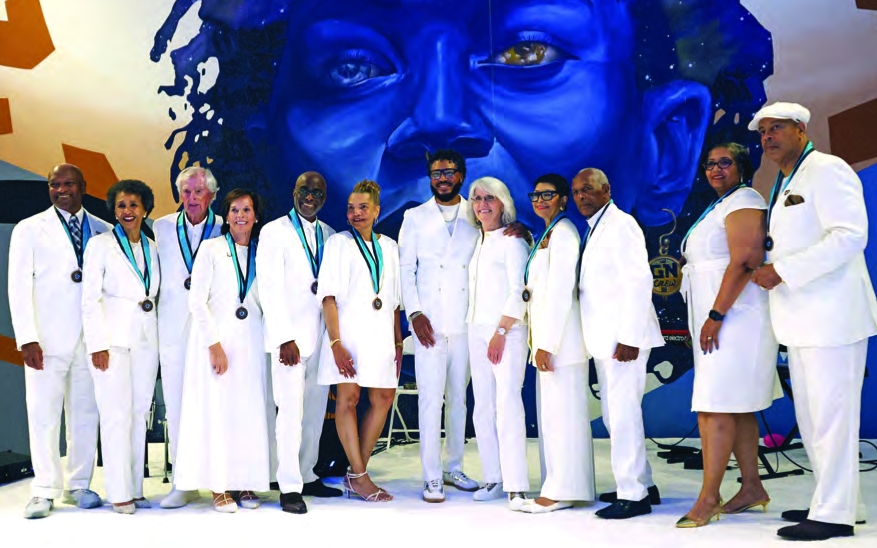
Honorees gather together for a group photo.
On the night before Juneteenth, hundreds of members of the Black community and their allies commemorated the 72nd wedding anniversary and the civil rights legacy of Dr. Martin Luther King Jr. and Coretta Scott King and honored local leaders committed to building a more racially just and equitable city.
Held at the Massachusetts College of Art and Design in the Fenway, it was a night full of joy along with gospel music, uplifting spirits, and fostering a space of civic engagement and belonging.
Hosted by the nonprofit Embrace Boston, the Embrace Honors Juneteenth event brought together artists, leaders and community members to celebrate Black freedom and culture, and to recognize the continued struggles faced today. The event was part of the multi-day annual Embrace Ideas Festival, which included a panel discussion on Friday, focusing on bringing together local and national leaders to combat racism, and a vision to create an inclusive and equitable Boston by 2030. The aim is to dismantle structural racism by promoting racial equity, healing and well-being through arts, culture and community building.
President and CEO of Embrace Boston, Dr. Imari Paris Jeffries, said it is increasingly important today that people lean toward love and hope to combat the attacks on culture and history, particularly Black American history, currently. He explained that cultural events can provide a powerful medium to spread and preserve lived experiences. “When you think about how events are places for democratic maintenance, social infrastructure and belonging in moments like this, events are one of the few places where placemaking occurs.”
At a time when the Trump administration is making
efforts to end programs like diversity, equity and inclusion and to
remove Black history instruction in classrooms, the need to continue
building communities by creating social infrastructures has become even
more urgent to fight back against these initiatives.
“Many
of the commitments and promises that our country committed to, we’ve
seen a withdrawal, we’ve seen this attack on diversity, equity and
inclusion. We see this anti-intellectualism. Every time we see advances
in racial equity, we see these backlashes where people want to ‘Make
America Great Again,’ ” said Jeffries.
A new report published by Embrace Boston describes
how creating cultural spaces and events like these can foster and build
social infrastructure in Black communities that are vital to the sense
of belonging, Black joy and building social capital. The report
emphasizes that these events are a way to provide healing and a vision
for a more just society. Ultimately, this fights back against the
increasing attacks on diversity, equity and inclusion by centering Black
voices and empowerment.
For
Dr. Quinton Hurd Sr. and Dr. Takesha M. Hurd, attending Wednesday’s
celebration meant more than just connecting with the community; it meant
recognition. “A lot of times, the local heroes, the individuals that
are in the trenches doing the work, don’t get recognized. At Embrace,
they recognize that, and they see value in recognizing its local heroes,
so that’s critically important,” said Quinton Hurd.
Such
cultural events provide a platform for awareness and reflection, which
is essential in addressing the growing backlash fueled by the distorted
narrative of race in the United States. This skewed narrative is often
used to reinforce the negative connotations of Black history and racial
awareness, which becomes weaponized to dismantle the progress in racial
justice and inclusion.
“People
have misled the word ‘woke’ and now they made ‘wokism’ as a bad thing
when woke just means that you read the books, you know the history,
you’ve talked to people and know their lived experience. That you’ve had
experiences engaging in other cultures and other races. So, this is an
opportunity for people to be woke,” said Michael Curry, a vice chair of
Embrace Boston.
Understanding the history of discrimination and prejudice against the Black community is essential
to fix the damage done by systemic racism. The honorees who were
celebrated at Embrace Honors Juneteenth continue their drive to push for
change toward racial equity as well as to educate.
“I
feel it’s my responsibility as a Black elder to make sure that our
young people are knowledgeable of our history. If people are trying to
eradicate your history, what you have to do is step up and put yourself
in those spaces where you can communicate that history to our young
people,” said longtime attorney Joseph D. Feaster Jr., who was honored
for his lifelong commitment to forwarding equity, justice and community
empowerment.
When
teaching and learning about race and Black history are increasingly
under attack in many states by threats to funding, it’s crucial to
continue to share and discuss history through cultural spaces and social
events. It builds community resistance against policies that aim to
erase Black history and culture.
“It’s
been a challenging year and all of us need to look to Martin Luther
King and Coretta Scott King and the battle that they and others fought
for freedom, because today we, too, need to fight for our freedom,” said
Carol Fulp, honored for advancing corporate diversity and driving
equity in the workplace.
For
Takesha Hurd, Fulp’s book on diversity, equity and inclusion has been
transformational and inspirational for her and the people working in the
field of DEI. “I salute those women; as an African American woman
myself, they have been role models to me here in the city of Boston,”
she said.
During one
of the seminars on Friday, Massachusetts Senator Liz Miranda and chief
of economic opportunity and inclusion for the City of Boston, Segun
Idowu, talked about how they are uplifting Black residents in Boston
through policy efforts.
Miranda explained how the policy reversals done by the Trump administration has been
damaging in the community. “The state has a responsibility and that’s
why I pay attention to the $64 billion dollar budget we have, to ensure
that money comes to our communities,” she said.
Miranda described how the state must take control when the federal government fails to provide to the people.
“It’s
a very scary time for policy makers to legislate from your values, and
know that due to the administration, it’s counteracting everything.” One
of the policies that Idowu explained was important was on the supplier
diversity initiative and how it was something that helps boost Black
owned businesses.
“It’s
important that we’re growing Black companies, not because it’s socially
good or morally appropriate to address past bonds, all of those are
important, but it’s economically imperative because when we’re not
included in people of color, particularly Black communities and the
economy, everyone else loses,” he said.
Policies like these threaten the progress already made and worsens inequities for Black Americans.
“Racial
equity allows us to explore the differences in each other, learn and
become more educated about one another, and be better people,” said
Fulp.
This movement of
events and cultural spaces that Embrace Boston cultivates for the
community sends a message to those who are trying to suppress the
culture and history of being Black in America. Coming together to learn
from one another builds the social infrastructure to fight racial
injustice.
“It’s like a
spreading of consciousness that more and more people through these
events, through relationships, the word will spread, the commitment to
justice and culture will spread, that’s really what this is about,” said
Curry.
As Trump
continues his efforts to reverse DEI initiatives, the work of these
individuals and the communities that represent them will continue to
fight his policies.
“If
people were able to survive the Middle Passage, if people were able to
survive slavery and made it to the other side, I think we can survive
what’s going on now during the Trump administration and the MAGA beliefs
that are taking place,” Feaster said.


