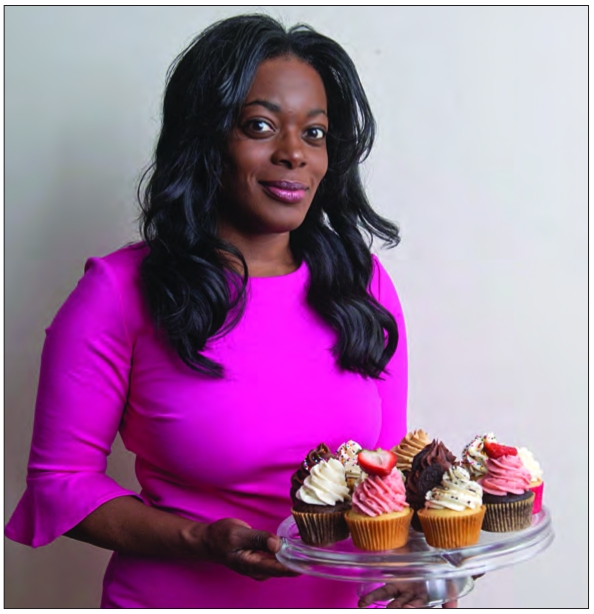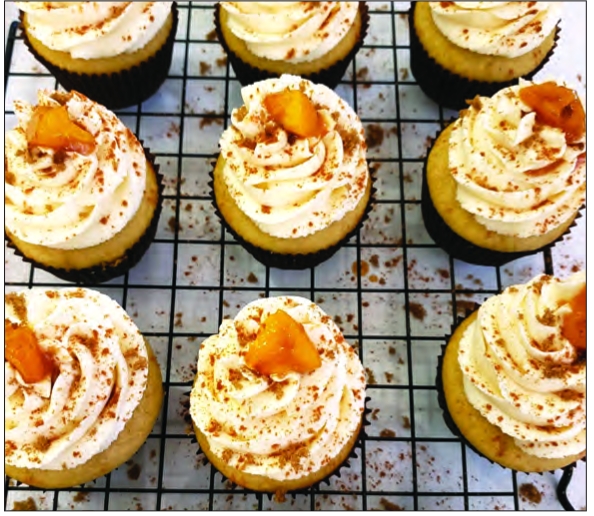
(Left)
Shironda White, owner of Cupcake Therapy, (Above) Cupcake Therapy
offers over 100 options of regular, vegan, gluten free, sugar free, soy
free and Halal cupcakes. Premium cupcakery coming to North End/Waterfront this summer
With an abundance of free time during the COVID-19 pandemic, Shironda White turned her passion for baking for her friends into a sweet career pivot.
“I was baking as a hobby. I was actually running a FinTech company that stalled during the pandemic, and I was bored, and so I was baking as a hobby. And friends would ask me to bake for them. And at first, I would say ‘I do FinTech so…,’ but after a while, I just had just too much free time, I guess. And so I put up a website and just said, if you want to order, that’s great, if not no pressure. And so, friends started ordering,” she said.
The founder and CEO of Cupcake Therapy says that once word got out about her baked goods, more and more people began placing orders.
“The next thing I knew, it just kind of snowballed and became this big thing. … We got our first corporate client, and at that point I realized we have to get legal — because it wasn’t just baking for friends anymore, and so that’s when we took the steps to make it an actual company,” she said.
Fast forward to now where White is running a full-fledged “premium nut-free, allergy-friendly, cupcake company,” that offers over 100 options of regular, vegan, gluten free, sugar free, soy free and Halal cupcakes — with the goal of making sure that as many people as possible can choose what they want to sink their teeth in — regardless of dietary restrictions.
Along with their many options, White said that what makes Cupcake Therapy unique is her being a “foodie with many allergies.”
“Being a foodie means that if something is not good, I’m not going to eat it. I really try to make sure that our vegan cupcakes don’t taste vegan, gluten free cupcakes don’t taste gluten free, sugar free cupcakes don’t taste sugar free. And I primarily test on people who are not vegan, or not gluten free, or not sugar free, because if they like it, then I think everyone’s going to like it,” she said.
Another unique trait of Cupcake Therapy is that White likes to experiment with different ingredients, which leads to many options for customers to choose from.
“We
don’t just have one sugar free option. We don’t just have, you know,
two or three vegan options. We have over 20 vegan options, over 20
gluten free at this point. We have four sugar free options, but we’re
expanding. … We just have so many more options, so that people aren’t
coming in feeling like, ‘Okay, there’s one gluten free option today. I
guess I’ll take that one.’ [We are] just making sure that people who are
gluten free or vegan feel included, feel safe, and feel that they’re
just as included as everybody else,” she said.
White
acknowledges that she and her company would not be where they are
without her supporters, which includes her mother Shirley White, who is a
co-owner of Cupcake Therapy, the Ujima Fund, BECMA, VistaPrint, and a
$25,000 grant from the Boston Celtics.
“I
was getting so overwhelmed with orders at one point that I called [my
mom], and I was like, I need help. And she actually sold her house in
Atlanta and moved to … New England, and she helped me start the
company,” she said.
The Ujima Fund was instrumental, going beyond financial support and providing advice and guidance throughout the process.
“It wasn’t just ‘here’s a check,’ it was ‘here’s a check, but also here’s support,’” White said.
“BECMA
has also been a great resource for us in ways that we didn’t even
anticipate initially. There’re so many more resources that they offer
than what you would initially assume, and so that’s been just a really
great help for us as well.”
Although
Cupcake Therapy is thriving at its Brookline location, White struggled
to find the right “ghost kitchen” in which to prepare the sweet treats.
Also known as cloud kitchens, these shared cooking spaces function as
prep hubs for multiple businesses who do their business online and via
delivery.
“When you’re
dealing with ghost kitchens, dealing with, in our case, [sharing space
with] 13 other kitchens and [you’re] hoping that people are clean and
that there are no issues that come into your space from their space.
That’s not what happened,” she said.
And
then it took three years to find the right storefront location for
Cupcake Therapy to reside. White went through a number of lease
negotiations that fell through.
“Part
of the challenge was that, when we were looking in neighborhoods, like,
let’s say the financial district, for instance, or just certain other
neighborhoods, their attitude was like, ‘Oh, why
don’t you go to Roxbury or Dorchester or Hyde Park?’ But if we go to
those areas, and then the response from those landlords is, ‘We don’t
think the neighborhood will support this price point. We don’t think
you’ll be successful.’ And so it was kind of like, well, how do we find
the right fit where we have a good landlord who’s not going to make any
kind of excuse to not take us?” she said.
White said that there are spaces that they were turned down from that are still vacant today.
“They’re
still vacant years later, and it’s like, ‘wow, you’d rather have
anybody but us or nobody rather than us.’ And so, that’s been the
biggest obstacle,” she said.
They
were, however, able to secure a lease in the North End/ Waterfront that
is set to open this summer, which will be a dessert and non-alcoholic
bar.
“We came to this
landlord, and we said, here’s our proposal, here’s our proof of concept,
here are our financials. And they said, ‘Okay.’ And it was like, ‘Wait,
okay, what?’ They said, ‘Okay.’ I mean, that was all we needed … a
landlord [who] was going to look at just our financials, our proof of
concept, our proposal, and judge us based on that, not based on looking
at us and saying, ‘These are two Black women, we don’t think they can
make it.’”
Although the process was frustrating, White feels that they ended up where they belong.
“We
are excited. So when I say, if things don’t work out, they’re not
supposed to, that is what I mean. We are exactly where we’re supposed to
be,” she added.
Given
everything that she experienced, White has some advice for
entrepreneurs of color who may want to open a business of their own.
“Number
one is, don’t take rejection personally. Sometimes it is personal, but
you’re going to end up where you’re supposed to be. … Know which fights
are worth fighting. We spent tens of thousands of dollars in attorney’s
fees fighting against racism and sexism and everything else,” she said.
“The reality is we didn’t have the money to do that, so at a certain
point we had to just walk away from it and just say, ‘Let’s go where
we’re wanted,’” she said.
She
also shared this piece of advice from her father that she hopes
aspiring entrepreneurs take hold of when opening their businesses.
“His
answer to every dilemma was just hire somebody. And I used to think, ‘I
don’t have that budget that you do, so I can’t do that.’ But the
reality is, there are things that are going to cost money, that are
going to be beneficial to you, and it will cost you more if you don’t
hire somebody when it’s something that you know you are not able to
effectively do on your own.”
ON THE WEB
Learn more at cupcaketherapyboston.com