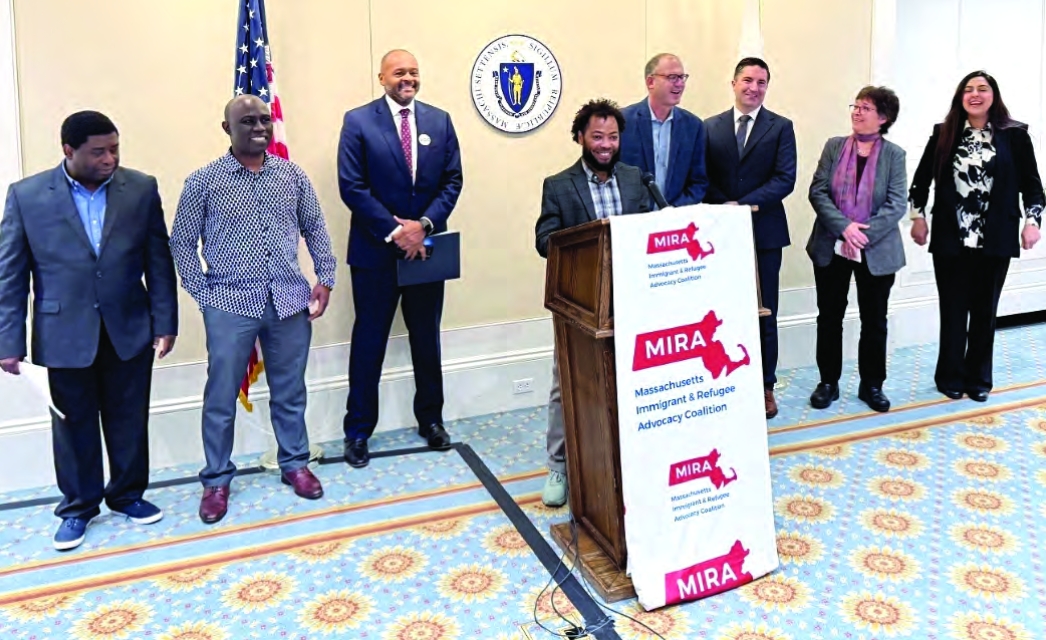
From left: Dr. Anthony Omale; Emmanuel Owusu, Executive Director of African Bridge Network; Michael Curry, President and CEO of the MA League of Community Health Centers; Maroni Minter, Political Director of MIRA; Senator Jason Lewis; Rep. Jack Patrick Lewis (D-Framingham); Rep. Mindy Domb (D-Amherst) and Dr. Saira Asjad attend the Physician’s Pathway Act Press Conference.A local immigrant advocacy group will be getting new support to connect physicians who were trained in other countries to the ability to practice medicine in Massachusetts.
The Massachusetts Immigrant and Refugee Advocacy Coalition, or MIRA, was selected for the World Education Service’s Strengthening Immigrant Inclusion Program Demonstration Opportunity. This 18-month program offers funding and other support to programs connecting college-trained immigrants with better jobs in the United States.
The effort that MIRA will be working on builds on a legislative step taken last year to create easier pathways for physicians who trained and worked in other countries to be licensed in the state.
MIRA’s inclusion was announced last month.
For advocates at MIRA, the step is an important one to support the state’s immigrant population and address physician shortages across Massachusetts.
“There are so many immigrants who come to Massachusetts, especially with affluent backgrounds, of having practiced professions in their home country, of having all different kinds of educational backgrounds,” said Liz Sweet, MIRA’s executive director. “Yet, for many professions, there are real barriers to being able to bring all those skills forward.”
Massachusetts included its process to support the licensure of foreign-trained physicians in the almost $4 billion economic development bond bill, signed by Gov. Healey last fall.
As an organization, MIRA advocated the passage of that legislation.
The process created in that law allows doctors who were licensed and practicing in another country to receive a limited license, under which they can practice medicine at certain facilities approved by the state.
After
practicing for a year under the limited license, the physicians may
receive a so-called “restricted license” that lets them practice
independently in an area that has a designated physician shortage.
After two years on that license, they may pursue a full, unrestricted medical license.
Before
the passage of this bill, said Sweet, physicians who were trained in
another country would often have to redo their residency, even if they
had practiced for years in their home country.
Accessing
those residencies could prevent barriers, said Mikaela Santos, a WES
senior program manager for the demonstration opportunity program.
Doing
a residency can be costly — the application process has fees and may
require travel for in-person interviews — and the number of seats in the
program are limited. According to a press release from the National
Resident Matching Program, the organization that matches medical school
graduates to residency programs, in 2023, there were nearly 43,000
individuals seeking a residency, but only 40,375 positions were
available.
In that ecosystem, Santos said, internationally trained physicians may lose out if the
residency programs are less familiar with the medical schools they
attended compared to better-known U.S. schools.
The
new effort led by MIRA and supported by WES will keep the group as part
of conversations regarding the legislation as the state goes through
the process of developing regulations for it and preparing to implement
it.
Sweet said
specific metrics for how they plan to measure success are still being
developed, but they’ll likely revolve around how the group can support
the process as the regulations are finalized, seeing institutions join
the program, engaging with internationally trained physicians and
connecting them to the start of the process.
These licensure pathways are an important measure in a state grappling with physician shortages.
A
2023 report from the Massachusetts Health Policy Commission identified
rising levels of turnover in health care roles since 2010, with a spike
in 2020 with the COVID-19 pandemic. A different 2023 report from the
state’s Center for Health Information and Analysis found that physician
roles statewide had a vacancy rate of 11%.
Massachusetts
isn’t alone in the struggle. A 2024 report from the Association of
American Medical Colleges projected that the country will face a
shortage of up to 86,000 physicians by 2036.
Lowering the barriers presented by licensure pathways can help close some of those gaps, Santos said.
“There’s lots of talent already in the U.S. that can help if they just have pathways to be able to access them,” Santos said.
Sweet
called the legislation a “win-win for everyone,” for its intention to
support internationally trained physicians in getting licensed and
closing gaps in specifically underserved areas across the state.
The
same issue — and similar actions to address it — can be seen across the
country. Creating new pathways to licensure has momentum nationwide,
said Santos.
One of
the early initiatives selected for the Strengthening Immigrant Inclusion
Program was under The International Medical Graduates Academy, formerly
the Washington Academy for International Medical
Graduates, which was selected to support immigrant physicians in that
state after it passed its own pathways law in 2021.
Santos
said that, given the nationwide momentum, she hopes that the work MIRA
can do through the program can serve as a “blueprint” for other states
starting to do this work.
It was a sentiment that Sweet echoed.
“We’re
hopeful that Massachusetts will be a real example to other states,” she
said. “That we might then encourage them to enact similar laws and
learn from how this actually plays out, once it’s fully implemented and
internationally trained physicians are actually serving in clinics
across the state.”
The
advocacy fits into a broader goal of MIRA to support immigrants who
bring with them advanced skills but face barriers like the previous
licensure process for physicians.
“There are so many individuals who are working at jobs
that are not really reflective of the skills and expertise that they
have, and that doesn’t benefit us, right?” Sweet said. “We would love to
see more folks who come here be able to use those skills and
expertise.”
WES’s
Strengthening Immigrant Inclusion Program has been running since 2018
and its “demonstration opportunity” — the specific initiative under
which MIRA is receiving support — launched in 2021.
In
that time, WES has worked with organizations and state and local
governments across the country to support efforts to connect more
trained immigrants to workforce pathways both in health care and other
fields more broadly.
“WES’s
lens and perspective is that immigrants are in our communities and
oftentimes have the skills and experience to fill these gaps and aren’t
able to fully contribute their skill set to doing so,” Santos said.
Sweet said the programming run by WES is an important resource to support immigrant populations across the country.
“It’s
really valuable for there to be a space that’s helping all of us learn
from other states and other experiences, while there are a lot of states
right now that are experimenting with this and learning from it,” she
said.