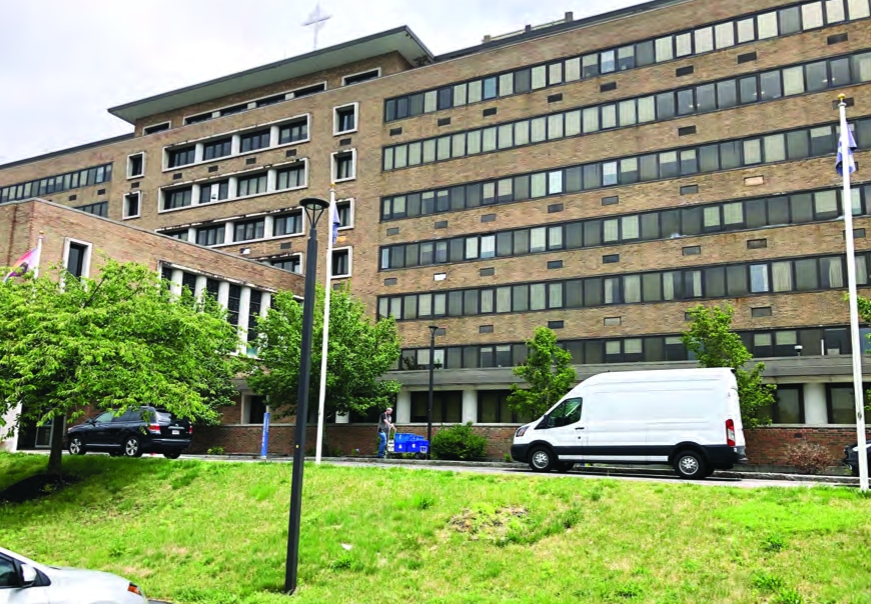
Carney
Hospital in Dorchester closed in August 2024. A new report from a
state-organized working group offered recommendations for how to close
gaps in access to health and health care in the area formerly served by
Carney. Primary care, behavioral health, social needs centered in recommendations from working group
In
the wake of the closure of Carney Hospital, behavioral health, access
to emergency medical services and social elements that support health
are among the key recommendations for how to best support health in the
community the hospital previously served.
The
recommendations come from a report released April 23, about eight
months after the hospital shut its doors at the end of August, by a
state-organized working group convened to identify gaps in care left by
the closure.
For
leadership of the working group, the closure, even with the challenges
it presents, also offers an opportunity to close gaps that existed
before Steward Health Care closed the hospital last summer, during
bankruptcy proceedings and as Gov. Maura Healey worked to push the
forprofit health care company out of the state.
“If
we could envision the future for that campus, what would it look like?”
said Bisola Ojikutu, the city’s public health commissioner, who
co-chaired the working group.
The
working group was formed by Gov. Maura Healey alongside a parallel one
to address the same issues around the closure of Nashoba Valley Medical
Center in Ayer at the end of September. Over nine meetings and six
months, the working group talked to experts and local community voices
to understand what needs existed. The work was also informed by
thousands of conversations with residents in an effort from local
nonprofit Health Care for All.
The
current landscape, impacted by both the closure of Carney Hospital and
previously existing gaps in access, were recorded in the 60-page report
that offered six overarching recommendations and a host of proposed
action steps, focused on access to emergency services, primary care and
behavioral health; reuse of the Carney Hospital campus; and increased
support for social determinants of health — factors like affordable
housing, access to healthy food and economic mobility that impact the
health of residents before they even step foot in a hospital.
Much
of the work and the recommendations stemmed from the community’s
feelings of disappointment and anger left by the closure of the
hospital, said Michael Curry, president and CEO of the Massachusetts
League of Community Health Centers, who co-chaired the group.
“It’s
the hospital they either relied on or that their families have relied
on for generations,” Curry said. “To have that loss weakens their access
or diminishes their access to health within their neighborhoods, closer
to home.”
What’s next for the shuttered hospital site?
Central
to the discussion and recommendations is the question of what happens
next on the nearly 13-acre site where the now-shuttered hospital stands.
Since its doors were shut in August, most of the Carney Hospital
facility has sat unused. The building, the report said, faces years of
deferred maintenance.
On
the smaller, one-acre parcel on the site, the Seton Medical Office
Building has continued some operations, offering primary and some
specialty care services.
The
working group, in its report, recommended that the two parcels be
facilitated to be reused for high-quality health care services and
social services to meet community needs. That work, the report proposed,
should maintain offerings previously provided by the hospital, like its
emergency department, as well as include lab capacity and diagnostic
imaging such as MRIs, mammography, ultrasounds, and X-rays.
The
future of the site, the report proposed, should also continue to offer
or include a replacement ambulance garage and radio infrastructure that
is currently included at the Carney Hospital site.
The
working group declined to take a stance on specifics around ownership
structure or on the reuse of existing facilities versus the construction
of new ones.
The
report recommended that local authority be used to ensure site owners
include health care offerings on the site — something Mayor Michelle Wu
has said she intends to do.
In
a letter last August to the property owners, Wu said she would use the
city’s authority to oppose any attempt to rezone the land for uses other
than health care.
Wu
has also stepped in more recently, as the real estate trust that owns
the parcel on which the Seton building stands sent notices to physician
tenants in the building that their leases will be terminated on May 22.
According to the working group’s report, Wu issued a letter to the property owners demanding they reverse the decision.
Expanding health beyond clinical care
A
major part of the report includes recommendations that whatever happens
next with the site includes an expansion of what services can be
offered there.
In the
report, the working group said that case studies they reviewed showed
that in other instances of hospital closures across the country,
leveraging the land to address health-related social needs — the social
determinants of health — can be an effective way to improve community
health.
“We’re all
aware that health outcomes — particularly big picture health outcomes,
like life expectancy, like premature mortality — they don’t begin or end
within the walls of healthcare facilities,” Ojikutu said. “Carney
Hospital is not where health inequities in that neighborhood either
began or it wasn’t necessarily solved by that hospital.”
Throughout the process, community members raised that desire for those expanded services, the report said.
“It
became an opportunity to say, ‘Let’s reimagine this site, where it’s
not just a provision of health care, but we’re now addressing that 80%
of what drives your health status that has nothing to do with the care
that’s provided to you,” Curry said, citing public health statistics
that suggest that clinical care only makes up about 10% to 20% of an
individual’s health.
In
communication with residents, the working group found affordable
housing, economic mobility, homelessness and housing insecurity, food
access, community safety and access to care as key social determinants
of health impacting their communities.
Throughout
the working group’s process, a focus on social determinants of health
and factors beyond just the medical care provided within the hospital
has been a point of focus.
More
broadly, addressing those big-picture outcomes has been a priority for
the Boston Public Health Commission, which in July launched a health
equity agenda called the Live Long and Well agenda to target gaps in
life expectancy, especially focused on drug overdoses, cardiometabolic
diseases and preventable cancers.
The report specifically referenced that effort — as well as the state Department of Public Health’s Advancing Health
Equity in Massachusetts initiative, which is focused on maternal health
disparities and social factors around cardiometabolic diseases — as
steps to address health disparities in the community formerly served by
Carney Hospital.
In
the shorter term, pending decisions about how to use the site, the
working group recommended improving outreach through services like the
Health Commission’s Mayor’s Health Line; supporting increased
transportation through services like the MBTA’s reduced-income RIDE
program and the shuttle from the city’s Age Strong Commission; and
supporting programs that push for things like increased food and housing
access.
Closing gaps in behavioral and mental health
Another
longstanding concern raised in the report is the loss of behavioral
health care in the area. Before its closure, Carney hosted 50 in-patient
behavioral health beds, which served patients across a wide range of
ages and those with co-occurring mental health and substance use
disorder needs.
The
loss of those beds was highlighted as a point of concern by residents
and other community members before the hospital shut its doors last
summer.
“When you look
at mental health needs in the city of Boston, and particularly in this
neighborhood, and you think about the lack of access to care and the
inequities that we know are present in access to behavioral health and
mental health services, we know that this particular area surrounding
Carney … were at a particular disadvantage in terms of their access,”
Ojikutu said. “The fact that there are behavioral health beds that were
lost from Carney, we see that as a major issue.”
It’s
part of a broader challenge statewide, Curry said. Massachusetts faces
an ongoing shortage of mental health professionals, according to a
December 2024 report by the Massachusetts Taxpayers
Foundation, and research has found that language and cultural barriers,
as well as long wait times for MassHealth Patients, have contributed to
these gaps for low-income patients of color.
“It’s
not just about Carney Hospital, quite frankly. It’s about
Massachusetts; it’s about Boston; it’s about Worcester; Springfield,”
Curry said. “We need to explore and find ways to greatly increase access
to mental health services along the whole spectrum of conditions.”
To
address those gaps, the report proposes advocating expanded financial
support for local community health centers and other programs, like the
Boston Public Health Commission’s youth mental health initiative.
Many
of those same organizations are centered in the report’s proposal to
preserve and improve access to primary care services, something Curry
said will make sure community members can get the right care at the
right cost and at the right time.
Formerly,
before Carney Hospital shut down, some of the patients seeking out care
at the hospital’s emergency department would have been better served by
primary care at a health center, he said.
“If we can address the
access issues and make sure that health centers and others are
available, have the resources, have the provision physicians they need,
the nurses they need, the clinical support they need, they’re the best
place to provide care to these populations,” Curry said.
Not smooth sailing on the horizon
The recommendations offer a vision for how the area can move forward,
Ojikutu said, but aren’t unhampered by the reality and challenges of the
current landscape for health care operations and for the funding of
projects generally.
Part
of the working group’s discussions included how to adjust and account
for health care financing challenges, and ways to make sure the site,
however it is used to improve health, can be profitable and sustain
operations.
“We’ve
clearly set forth recommendations, and that’s an important step, but
paying for those interventions, paying for those services, is really the
bigger issue,” Ojikutu said. “That’s what we need to figure out, and
how we will move forward, particularly in this current fiscal
environment.”
Within
the next months, she said the working group will reconvene to address
that question. In the meantime, it will continue to meet with
stakeholders like the city and state, as well as Apollo Global
Management, which owns the land through a subsidiary, to “map a feasible
and sustainable way forward.”
The work, Ojikutu said, will require collaboration, but addressing those challenges is an important next step.
“What will we do to make sure that this happens, that these aren’t just recommendations that don’t go anywhere?” she asked.