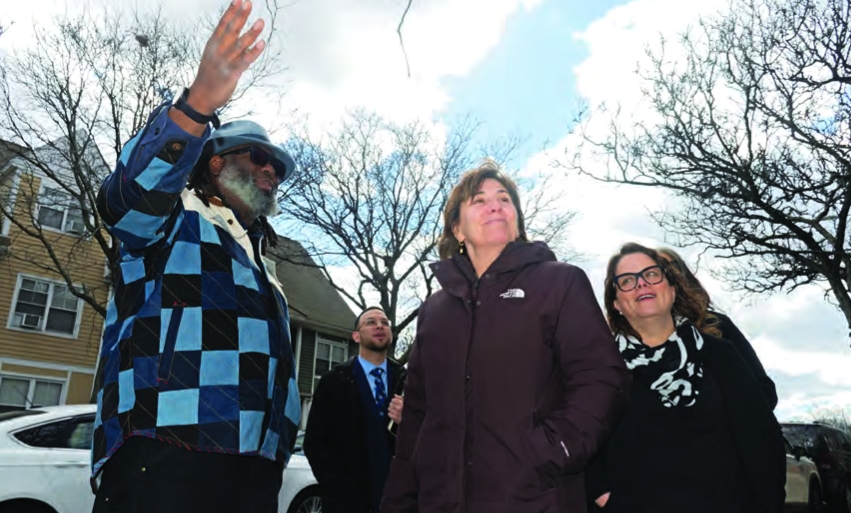
Dwaign
Tyndal (left), executive director of Alternatives for Community and
Environment, shows off Roxbury during a tour with Rebecca Tepper
(center), Massachusetts secretary of energy and environmental affairs,
and María Belén Power (right), environmental justice undersecretary,
Feb. 26. The tour, led by ACE, highlighted various parts of Nubian
Square’s history with environmental harms and justice.This year’s change in federal leadership has created new barriers to attempts to further environmental justice efforts across the country.
But in Massachusetts, state leadership said they are still committed to their goals of creating equity in environmental harms and benefits faced by communities across the state.
As part of ongoing outreach, Massachusetts Secretary of Energy and Environmental Affairs Rebecca Tepper and Environmental Justice Undersecretary María Belén Power, along with other staff from the office, joined staff from Alternatives for Community and Environment, a Roxbury-based environmental justice nonprofit, for a tour of the Nubian Square area’s history of environmental harm and justice, Feb. 26.
From
a small cluster of offices — what Dwaign Tyndal, the nonprofit’s
executive director, called ACE’s “Batcave” — on the third floor of the
Nubian Square building, which also houses a state Department of
Transitional Assistance office, state officials from the Executive
Office of Energy and Environmental Affairs gathered with staff from the
local environmental justice nonprofit to take the pulse of a local
history of environmental injustices.
The
route of the group’s Toxic Tour wrapped for about three-quarters of a
mile past sites where the community has faced environmental harms.
Much
of the tour focused on air quality. The area around Nubian Square has a
long history of fighting the issue, which has been close to home for a
community that has dealt with high bus traffic that for a long time ran
on diesel fuel.
The
tour included stops both at Nubian Station, with its constant flow of
bus traffic, and the Bartlett Station development, which formerly served
as an MBTA bus yard from 1970 until it was closed in 2005. Two years
earlier, in 2003, bus operations were transferred from the site to the
Arborway garage in Jamaica Plain.
For
much of that time, the yard housed diesel buses, which Hakim
Sutherland, ACE’s director of youth organizing and one of the guides for
the tour, said filled the air with black carbon.
“Often
times people would open their windows, and they would have black carbon
soot on their window sill, have black carbon soot on their kitchen
table,” Sutherland said.
The
importance of that legacy persists. Tyndal highlighted air quality as
the number one environmental justice issue faced by the community.
“It
is the issue that we don’t see — like housing, like transportation —
but may have a bigger impact on long-term quality of life than anything
else,” Tyndal said.
Particulate
exposure, especially at higher concentrations, can trigger illnesses
and premature death. According to a 2024 report from the American Lung
Association, fine particulate matter is responsible for nearly 48,000
premature deaths nationally each year.
And air pollution increases the risk and severity of diseases like asthma.
According
to a 2023 report from the Boston Public Health Commission, Black adults
in the city were more likely to have asthma. They were reported to
visit the emergency department and hospital for asthma more than two
times as frequently as Boston residents overall, and about nine times as
frequently as the city’s white residents.
Roxbury,
along with the South End and parts of Dorchester, had noticeably higher
rates of asthma than the city overall. Roxbury, Mattapan and Dorchester
ranked highest for youth asthma emergency department visits.
ACE’s
priority around air quality is in line with state efforts. Last year,
the state launched a $775,000 grant to put new air quality sensors in
environmental justice communities.
Already the state operates 24 large air quality monitoring stations across Massachusetts.
The smaller softball-sized sensors funded by the grant track air quality
by measuring fine particulate matter — solid and liquid particles small
enough to be inhaled deep into the lungs that may enter the bloodstream
— in the air.
Another
portion of the funding under the grant was allocated for the
Massachusetts Department of Environmental Protection to partner with two
or three communities to pilot more advanced air monitoring technology
in or near environmental justice communities. Those sensors would track
multiple pollutants and black carbon — a fine particle formed by the
incomplete combustion of fossil fuels, including diesel for
transportation.
At the time, Power said that clean air is a right that all residents in the state should have access to.
“Our
administration is prioritizing environmental justice communities as we
empower residents, take action to reduce air pollutants, and measure the
progress we’ve made with programs like these,” she said in a statement
about the launch.
Overall,
the state’s environmental justice efforts, as structured under Power’s
undersecretary role, are relatively new. Her position was created in
February 2023, and Power was the first person to fill it. Previously,
she served as associate executive director at Green-Roots, a
Chelsea-based environmental justice nonprofit.
In
the early days, she said she was focusing on an environmental justice
listening tour in communities across the state. Her first visit started
locally, in Chinatown.
Since
then, that process has continued with visits across Massachusetts, with
stops in Springfield, Mashpee, and Lowell. Later, following the tour,
Power said she had a visit scheduled in Westfield, and had two more
stops set before the end of the fiscal year, this summer.
Power
said that much of what she’s heard has been focused on the clean energy
transition, as well as the siting of that infrastructure. She said air
pollution has also been a priority for communities.
When
Power was still in the early days of her role, Tyndal expressed
cautious optimism — what he then described as “moderate hopes” — about
what her role and her listening tour might mean for communities like
Roxbury.
“I think
intentions and execution could be as far apart as anything else,” he
said then, in an August 2023 interview. “We’ll see as time goes on; how
does that look in real-time?”
Now,
a year-and-a-half later, Tyndal said he’s been encouraged by dynamic
leadership, but the group is keeping an eye on things and keeping
expectations high.
“We are looking for future partnerships with the office,” he said.
But he did speak positively of Tepper’s and Power’s visit and participation on the tour.
“It’s
a reminder that we have allies and resources in many places that really
care about environmental and climate justice issues,” he said.
More
broadly, Massachusetts’ environmental justice effort may be facing a
moment of fluctuation. When she was kicking her listening tour into
gear, Power said she envisioned most of the work being done at a
municipal level with the state serving as a channel for funding through
federal sources.
In an
interview at the time, she said she planned to seek “as many [federal
dollars] as we can” to support local environmental justice goals.
Under
the new Trump administration, however, federal dollars might be a more
limited resource. In the first days of his administration, through a
handful of executive orders, President Donald Trump took immediate aim
at environmental justice efforts as a broader attack on diversity,
equity, and inclusion.
That
effort was paired with an attempt to freeze much outgoing funding as
his administration sought to align federal dollars with his priorities.
But Power said that, despite that changing landscape, the state’s commitment and priorities remain the same.
“The commitment of the state is just strengthened because there’s going to be a void of leadership,” Power said.
For
example, last month, the state announced a $500,000 grant program from
the state’s budget to fund environmental justice efforts. That program,
which opened for proposals on Feb. 21, will provide grants of up to
$75,000 to community organizations aimed at expanding skills and
knowledge, fostering greater community connection, and supporting
technological and infrastructure improvements.
Power’s
sentiment has been expressed by others in the space as they prepared
for the second Trump administration. In the wake of November’s election,
a handful of conservation and environmental officials and groups said
they expected reduced federal funding and said the outcome wasn’t what
they were hoping for, but that it would just require a greater effort
from state and local leadership to address the same needs that had
received increased support under the Biden administration.
Now,
on the other side of Trump’s inauguration, Tyndal said that the first
100 days are a waiting game where ACE plans to keep its head down,
before seeing what they can do to respond.
“The first 100 days are theirs,” he said.
But
even in that time, there are work groups like ACE that can continue to
do on the local level, efforts like education and organizing — what
Tyndal called “the fundamentals.”
And
in those fundamentals, he said, groups like ACE might have the
advantage to push back on the “shock and awe” of Trump’s federal actions
and continue control of on-the-ground efforts.
“Community work is quiet work,” Tyndal said. “It’s watching grass grow, but we know the grass will grow.”