
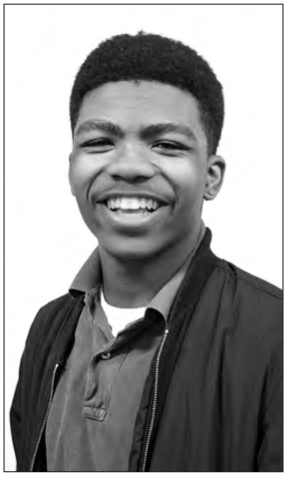
Latray Barber Washington
This Black History Month, the Banner is teaming up with Write Boston’s Teens-In-Print Program, highlighting young voices of color. Each week, we will feature the work of three new students, who will deliver their perspectives on Black History and what it means to them.
Black people, embracing our natural hair isn’t ghetto
Every generation of Black people grapples with the deeprooted history and pressure surrounding our hair — an experience tied to both personal identity and societal perception.
For centuries, natural Black hairstyles like cornrows, Afros, Bantu knots and dreadlocks have held profound cultural significance across the African continent. Cornrows were often used to signify social status, age, or even serve as maps for escape routes during slavery.
Afros became a powerful symbol of pride and resistance during the Civil Rights Movement, representing a rejection of Eurocentric beauty standards.
Bantu knots, originating from the Zulu people of Southern Africa, carry spiritual and cultural heritage, while dreadlocks — worn by various African ethnic groups long before their association with Rastafarianism — embody spiritual strength and a deep connection to cultural roots.
However, with the transatlantic slave trade and the forced displacement of African people, this cultural pride was systematically suppressed. In the United States, where African Americans now make up approximately 15% of the population, discrimination against natural Black hair has endured through laws, social stigmas, and Eurocentric beauty standards. From schools to workplaces, these biases persist today, though the reasoning behind them has evolved. What remains unchanged is how Black hair continues to challenge societal norms, asserting its power as both a cultural legacy and a form of resistance.
There is no better way to combat ignorance than to educate yourself on its history. The Halo Collective is an amazing source that gives great background information on Black hair. Discrimination against Black hair goes back to the fifteenth century, stemming from European colonizers who believed their hair was better than Afro-textured hair. They told Black people that our hair was inferior, that it was closer to wool, and called it “dreadful.”
These negative attitudes towards Black hair continued even after colonization and slavery, causing internalized disdain amongst Black people, and continuing to push negative attitudes towards Black hair from within the community as well. As a result of this, Black people have used dangerous products like hair relaxants to appeal to Eurocentric beauty standards.
The first step to eliminating hair discrimination is addressing it. “The ‘Good Hair’ Study,” by the Perception Institute, was conducted to analyze attitudes towards Black women’s hair. Bias towards Black hair occurs in various communities including Black communities. More specifically, when Black and white women were asked about “textured styles” such as Afros and twist-outs, compared to “smooth styles” like straight hair and pixie cuts, Black women always found the textured styles more beautiful and professional. White women found textured styles less favorable compared to smooth styles.
But when asked about how the U.S. would rate the hairstyles Black women and white women always put the textured styles at low scores, and the smooth styles at higher scores.
This study highlights the significant impact societal standards have had on Black hair.
Constantly being pushed into fitting in with white beauty standards, society has perpetuated this idea that natural Black hairstyles cannot be seen as beautiful, attractive or professional.
By allowing these standards to dominate, we find ourselves unable to embrace our natural hair for what it is and always feel the need to fit into those white beauty standards.
But how can we embrace our natural hair when society doesn’t even allow us to take care of our hair? In Woburn, Massachusetts, Woburn Memorial High School implemented a bonnet ban in December 2023 that impacted a considerable amount of the already low number of Black students attending. I asked a friend who attends the school how she felt about the ban. She told me that a few days before the ban was implemented, she took her braids out and was preparing to get them redone a few days after, so she went to school thinking that if she wore a bonnet there would be no problem.
When she got to school, she was immediately told by her white teacher that she had to take the bonnet off, and when she tried to explain why she couldn’t do that, she got sent to the principal’s office with a group of white people and one other Black person. I asked her why her school decided to ban bonnets, and she told me that they included it in the no hats and hoods ban.
This situation is just one of many others that happen all over the United States. Cases like Darryl George, Mya and Deanna Cook, and DeAndre Arnold are just some examples of hair discrimination in schools. All these schools share something in common: They incorporate rules against significant things to Black individuals in their dress code. These aren’t just things like hoodies and hats either, they include specific and popular Black hairstyles and accessories but somehow fail to see that there is underlying racism in doing so.
Bonnets and hairstyles, like braids, are essential to the Black community, and not allowing them is basically denying them their culture and individuality. Schools need to recognize this before implementing rules.
These racist beauty standards continue to harm places like workspaces and schools when they consider straight hairstyles more professional than natural Black hair. They don’t recognize the historical significance and negative stigma that Black hair has always faced. They don’t recognize that Black hair is more than just hair, it is a symbol of our history, the individual, the community, and so much more. So the next time you think your natural hair doesn’t look “professional” enough for your job, or “appealing” enough for people at school, remember that your hair is beautiful and important. Embrace it and don’t let other people’s opinions affect how you view your hair.
Latray Barber Washington is a senior from Massachuesetts with a passion for writing. Known for an optimistic and joyful outlook on life, he combines positivity and creativity in every aspect of his writing.