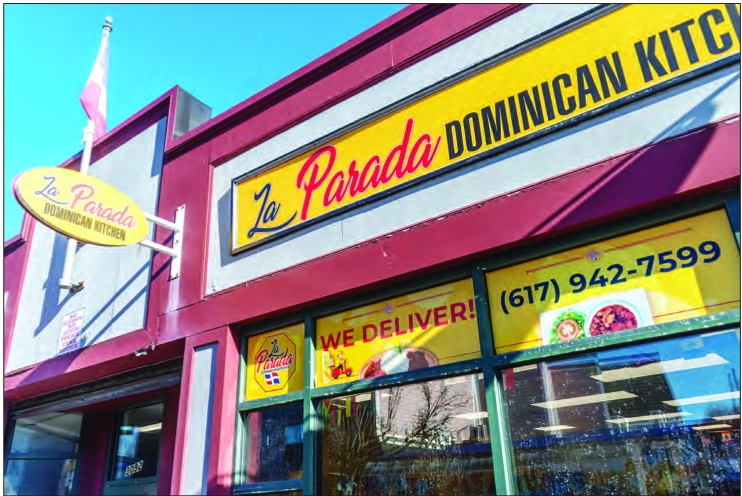
La
Parada, shown Feb. 22, has been serving up Dominican eats in Egleston
Square for four years. The restaurant was one of 37 restaurants across
the city to be awarded a new liquor license in February under
legislation passed last year allowing for the allocation of 225 new
licenses across the city. For the past four years, La Parada Dominican Kitchen in Egleston Square has been dishing up mofongo, chofan — a Dominican fried rice — and bucketfuls of beans.
Now, the restaurant is preparing to start serving wine and beer, as well as an expanded menu, after being awarded a liquor license, part of 225 new permits allocated under legislation passed by the State House and pushed by the city government last year, targeting licenses toward communities of color.
For La Parada, the license will mean new menu items and new opportunities, said Yonathan Peña, the restaurant’s owner.
With the license, Peña said he plans to start offering new options at La Parada, like small, personal pizzas, grilled sandwiches, smoothies and juices, as well as keeping the restaurant open later and on more days. Currently, it closes at 7:00 p.m. and isn’t open on Sundays.
He said he expects changes under licenses like his, and the almost 40 others approved by the city, to bring benefits to his restaurant and to the community at large.
“They’re very important to us,” Peña said. “It can foster a sense of community. …”
The city announced the approval of the 37 licenses on Feb. 13. In October, its spokespeople said that they would release the licenses in clusters, deferring their votes to consider all applicants at the same time, to give all operators a fair shot as they work to distribute the heap of new permits.
The approval is only one part of a multistep process that also requires state approval from the Massachusetts Alcoholic Beverages Control Commission.
This first release marks the latest step in a process that has taken years. Nick Korn, a principal at the firm Offsite, called the moment, “really amazing.”
The legislation directs five new licenses to 13 zip
codes across the city, selected to promptly distribute to communities
of color, which have seen their liquor licenses leave as a secondary
market for the transferrable permits and have seen costs soar to around
$600,000. The bill also adds a handful of other licenses to the city’s
total count, which is restricted under state law, with additions to
things like cultural organizations. For example, the Franklin Park Zoo
and Huntington Theater Company both were awarded licenses in this first
tranche.
Most of the
new licenses under the legislation are non-transferable and zip code
restricted. If a business that is awarded one closes, the permit goes
back to the city to be re-awarded. Twelve of the total 225 will add to
the city’s count of transferable licenses.
The
legislation started as a home rule petition in the Boston City Council
in early 2023. It was passed by that body in March, when it went to
Beacon Hill.
Its
journey through the State House was an extended one. It was introduced
in April 2023 but wasn’t passed by the end of the formal legislative
session at the end of July 2024.
Through
an agreement following closed-door talks between the House and Senate,
the bill was passed in early September, with Gov. Maura Healey signing
it later that month.
“There’s
plenty of times where — at least from my perspective — it might have
not happened, or it seemed like it could get derailed,” Korn said. “It
was a huge win for it to pass, but I think implementation is a whole
other kettle of fish.”
Supporters of the bill have hailed it as a way to bring economic boons to communities that have seen long-time disinvestment.
This initial approval, to him, marks a moment where an idea that became the bill is now starting to become a reality.
But
it’s not the end of the process, he said. As the licensing board works
to put the new licenses out into the city, Korn said there’s more work
to be done to make sure that they’re effective.
“I
think it’s really important that we don’t just think of getting a
license as the finish line, but almost sort of the starting line,” Korn
said. “If people are going to be able to optimize these licenses, to
really change their business model, to change their impact on the
community, to change the dining experience, there’s still a ton of work
to be done.”
Some of that, he said, should be education for business owners who may be used to running a restaurant, but not selling alcohol.
In
January, Korn’s company Offsite, which does training and development
for restaurants and the liquor industry, ran a bar management bootcamp, a
program that Korn said they had “on the shelf” and ran with some of the
license applicants ahead of the announcement of the awards.
In
that four-week-long program, operators were connected with skills like
how to start accounts with distributors, how to manage inventory, how to
set pricing and how to ensure they were in compliance with city and
state laws.
Korn said that about 20 businesses participated in the bootcamp. Many of them have now learned they were approved for a license.
Peña, one of the operators who participated in the bootcamp, said that, as he
gets ready to start selling wine and beer at La Parada, having the
chance to hear from and connect with people working in the space has
also been a significant comfort.
“That
connection makes me feel that I’m not alone on this, that now I have
people that really want us to succeed and make our neighborhoods
better.”
Now that
there’s a timeline for the next tranche of licenses under the
legislation — in announcing the 37 awardees, the board also set May 23
as the next deadline — Korn said Offsite is planning to run another
bootcamp for the next cohort, and is considering how it can support
businesses that were awarded licenses in the first bundle but weren’t a
part of the bootcamp.
The
city, too, is working on supporting new license holders. According to a
city spokesperson, newly approved applicants are connected to a
neighborhood business manager from the city’s Office of Small
Business who connects restaurant operators with subject matter and
provides guidance on a project-by-project basis.
Staff
from the Mayor’s Office of Consumer Affairs and Licensing, as well as
the Offices of Small Business and Nightlife Economy, are also running
office hours for one-on-one assistance with potential applicants and are
offering information sessions.
Peña said during the application process, he made use of city supports which helped throughout the process.
“That openness that they have with us, I applaud them for doing that and putting [in] that effort to make this work,” he said.
The
city’s process of distributing the licenses in blocks is a switch-up
from its usual process of awarding them on a rolling basis.
The change was made in response to the suddenly large number of licenses and applicants seeking them.
Korn said he sees the new process as a “pretty elegant solution to a complicated problem.”
“The
licensing board doesn’t usually have a bunch of licenses to issue, and
to have a deadline whereby they’re going to look at all of these at the
same time I do think is [fairer] than a lottery or first come, first
serve,” he said.
Peña
said he was skeptical, at first, when he thought it was going to be
first come, first serve, but that the board’s plan to approve licenses
in batches did a good job allowing everyone to apply.
“I think it gave me peace of mind that I was going to get a fair shot,” Peña said.
The
first block of 37 awards is only the beginning of a three-year-long
process to fully distribute the licenses allocated under the new
legislation, with more tranches of the permits coming out later this
year and the following two.
Korn
said that, from the perspective of Offsite, the hypothesis is the first
licenses will be targeted toward existing businesses adding alcohol
sales to their offerings, but that the subsequent offerings will provide
an opportunity for new restauranteurs to enter the business.
“Ultimately, what comes next is that there’s more
operators who see an opportunity to start the process of opening a food
business, because they can open a different kind of business, knowing
that there are potentially licenses available,” Korn said.
That’s an opportunity that Korn said presents a lot of potential.
“Because
it’s staggered over three years, it hopefully gives some people the
opportunity or the privilege of planning, of not just being first come,
first serve, and they’re all gone,” he said. “People who are a year, or
two, or three away from their dream, have an opportunity to access some
of these licenses.”
For
those businesses, especially those in low- and middle-income
communities outside of downtown that, Peña said, “provide a great
service to the community,” this opportunity presents a chance to make
business feasible.
And some are already gearing up to make light of the opportunity.
The
journey into the restaurant industry for Peña started when he pivoted
away from a 20-year career in biotechnology with plans to open a
full-service restaurant with an all-alcohol license in a property that
was set to be developed on Blue Hill Avenue in Mattapan.
That
five-story development would have included 32 rental units and 2,500
square feet of food-service space that Peña was ready to turn into his
restaurant El Camino Real, until the pandemic shuttered development
plans.
Peña said part of what would have made that possible was a plan with the city to take on an all-alcohol license for the spot.
Instead,
with no facilities and no license, he pivoted to opening the quicker
service La Parada. But now, another outcome from the Offsite bootcamp
was to rekindle his dream of opening a full-service restaurant, now that
an all-alcohol license is once again a possibility.
It’s an opportunity he said others should seize as well.
“I
hope that others get encouraged to bring unique restaurants to more of
these neighborhoods, and not focus on, ‘let me go open one in the
Seaport or Back Bay,’” Peña said. “Hopefully some others get encouraged
to put their dreams into action.”


