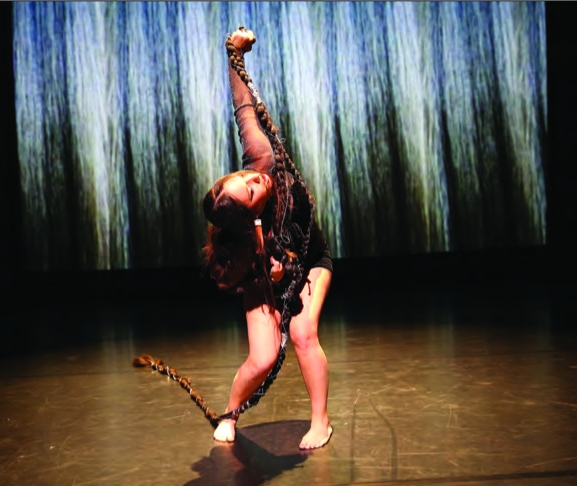
“Phehín kin líla akhí oke. (Her hair was heavy.),” 2019. Performance at REDCAT, Los Angeles. 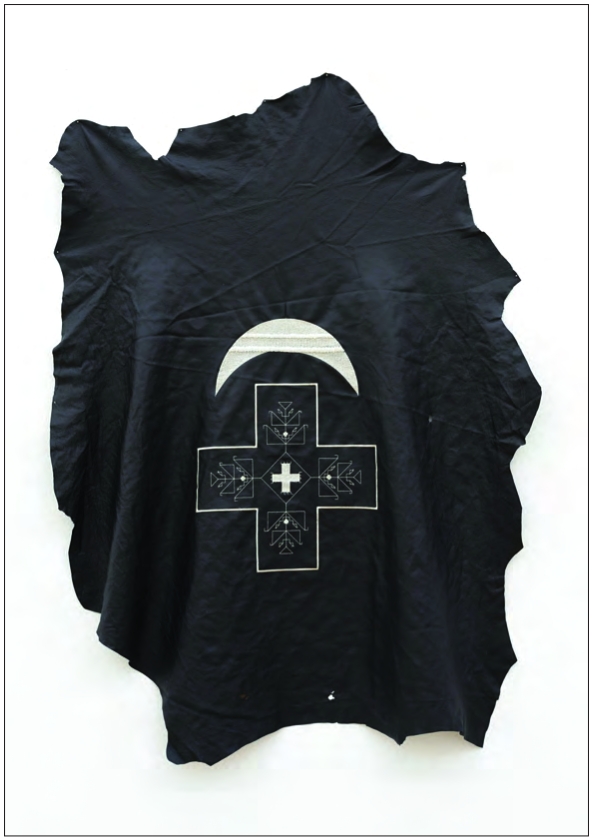
Kite, “unh éla wíle hala, for Nathan Young (Waxing Crescent Peyote Moon),” 2020. Silver thread and beads on black leather.
Indigenous history meets contemporary technology in “List Projects 31: Kite,” an installation by Oglála Lakhóta artist Kite at the MIT List Visual Arts Center. Through seven different works, the artist translates Oglála Lakhóta ontology and epistemology through machine learning and AI in the form of musical compositions, videos, immersive installations and live performance.
Dreams are a central theme of the exhibition. Kite uses the Lakhóta visual language, which has traditionally been stewarded by women and two-spirited people, to create visual representations of dreams. These dreams are also translated into musical scores and performances.
The show centers on “Wicháhpi Wóihanbleya (Dreamlike Star),” an immersive environment made with sculpture, video and sound. Viewers can walk into the space and see a large projection of stars on a purple night sky and a pattern of stones on the floor that reflect a visual translation of the artist’s dreams. These images, sky, stars and stones, are rooted in nature, but translated through projection and technology they feel less grounding and more intergalactic.
Kite will create a solo live performance within this space on April 17, activating the environment in real time.
Selby
Nimrod, assistant curator, and Zach Ngin, curatorial assistant at the
List say Kite utilizes “new methods, new collaborators, new media and
new ways of thinking—displaying a unique ability to surpass the
limitations of artistic, musical and academic disciplines through
embracing elasticity and invention and working nimbly while engaging
respectfully with collaborators, communities and the unknown.”
Collaboration
is key within the show. Kite collaborates with technology and nature,
and examines the ethical boundaries of those relationships, but also
with other artists including Lakhóta musician Santee Witt and Muscogee
artist and choreographer Olivia Camfield.
A
number of pieces in the exhibit showcase a length of braided hair that
has been interwoven with digital sensors to control sound, video, light
or AI-generated text in response to Kite’s movement or touch. This is a
visceral fusion of machine learning, AI and Indigenous tradition.
Rather
than shying away from artificial intelligence and the impact it’s
having on creative spaces, Kite examines how AI can be harnessed
ethically using the Lakhóta philosophy of the Good Way. This strategy
makes ethical decisions looking generations into the future, a type of
ancestral foresight that could be used to make a more ethical balance
between humans, technology and nature that mutually supports each party
without exploitation.
“List Projects 31: Kite” is on view at the MIT List Visual Arts Center through May 18. The center is free to all always.
ON THE WEB
Learn more at listart.mit.edu/exhibitions/list-projects-31-kite