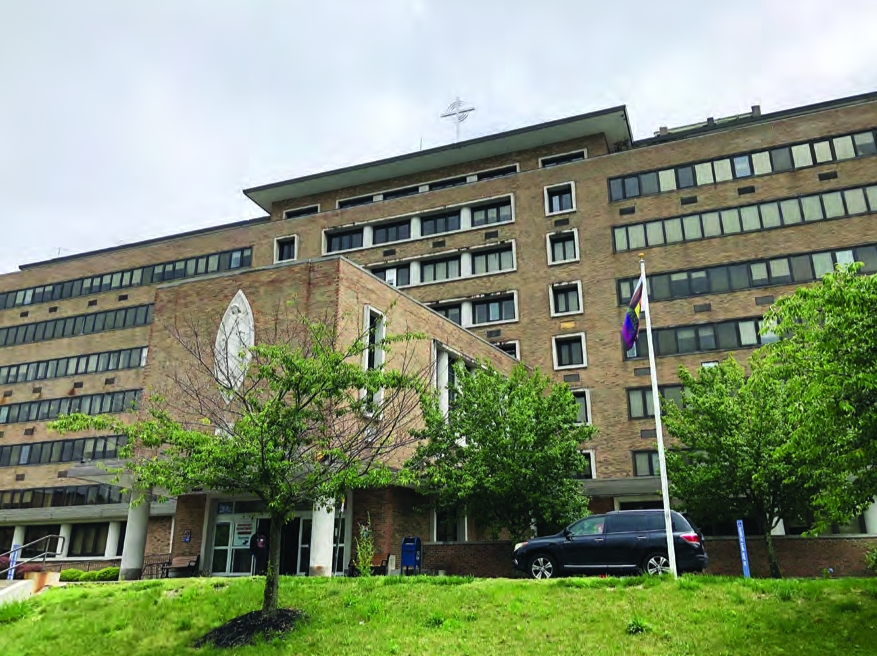
Carney Hospital closed last August as a part of the Steward Health Care bankruptcy.The working group assigned by Gov. Maura Healey to figure out what to do with the shuttered Carney Hospital is planning to look more broadly at the roots of health disparities in the Dorchester community.
The group had originally planned to complete its recommendations by now. But the nuanced nature of their work has required additional time, said Dr. Bisola Ojikutu, the working group co-chair and head of the Boston Public Health Commission. She told GBH News last Thursday that the group now plans to make its final recommendations on the site of the former hospital in March.
Ojikutu said the 32-member group has identified gaps in emergency services, urgent care and behavioral health in the community that was served by the hospital. She said addressing the intersection of those health care needs as well as societal needs, such as transportation, intrigued the group and will influence its recommendations.
“We’ve also explored innovative health delivery models,” Ojikutu said. “So, ways to combine health care with health-related social needs and actually think about broader community-level social determinants of health.”
What that may look like, Ojikutu said, is a campus with health care services alongside day programs for seniors or workforce development services.
“I think it’s important to really think innovatively about what we could do that would truly improve health and wellness for residents of the city of Boston,” she said.
It was taking this more
holistic approach that caused the extended timeline of the group’s
recommendations. Carney closed in August as part of the bankruptcy of
Steward Health Care, which owned the hospital.
The
working group was established in October with a 90-day deadline to
present its recommendations to Healey and Boston Mayor Michelle Wu. The
past four months have been “a complicated process,” Ojikutu said,
providing many nuances that the group has had to be more comprehensive
in its work.
“The reality is that that area has suffered from some pretty
deep health inequities for a long time,” Ojikutu said. “It’s not just
about fixing what may be worsened, but it’s fixing what may be deeply
embedded in regards to disparities throughout these communities.”
One
of those nuances is that Carney was a major employer in the area.
Valerie Burton worked at Carney Hospital on weekends for 21 years.
Carney’s closure has left Burton, a Dorchester resident, without her
weekend job. It also means she, and countless others, have to trek to
Beth Israel Deaconess Hospital in Milton for care, which can be
challenging to reach for those without means.
“We
feel that we lost a great deal in our community,” Burton said, who is
also president of the River Street Civic Association. “We have people in
the community that have been going to Carney for most of their lives
and they had a connection with it.”
The
Carney working group has no future community engagement sessions
planned before making its final recommendations. The last one held was
in December, and Burton spoke about the physical and monetary challenges
the hospital’s closure was creating.
She
told GBH News she felt heard by the working group and is hopeful that a
medical facility of some kind will return — but the need for that
return is urgent.
“Time
is definitely of the essence,” Burton said. “It’s definitely a need —
to have something close in our community that can service us at this
trying time.”
Wu and
the Boston Public Health Commission released a report Thursday on the
city’s commitment to address over the next decade the gap in life
expectancy between the city’s predominantly white neighborhoods and its
neighborhoods of color.
Trajan Warren is a reporter with the GBH News Equity & Justice unit.


