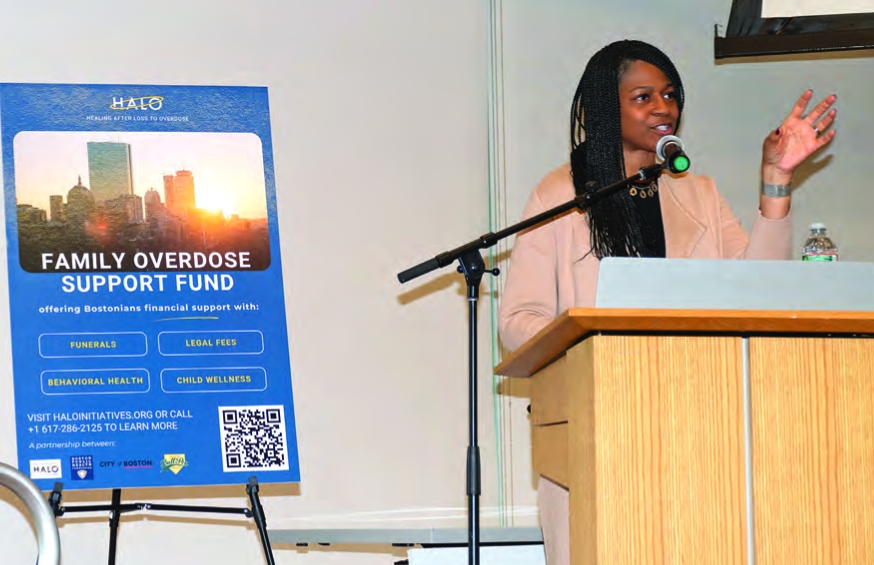
Dr. Bisola Ojikutu, Boston’s health commissioner, announces the city’s new family overdose support fund at the Bruce C. Bolling Municipal Building during the Jan. 29 meeting of the Nubian Square Task Force. The $250,000 fund will offer Boston residents who lost a family member to an opioid-overdose-related death up to $5,000 to cover costs like funeral expenses, legal services and mental health support.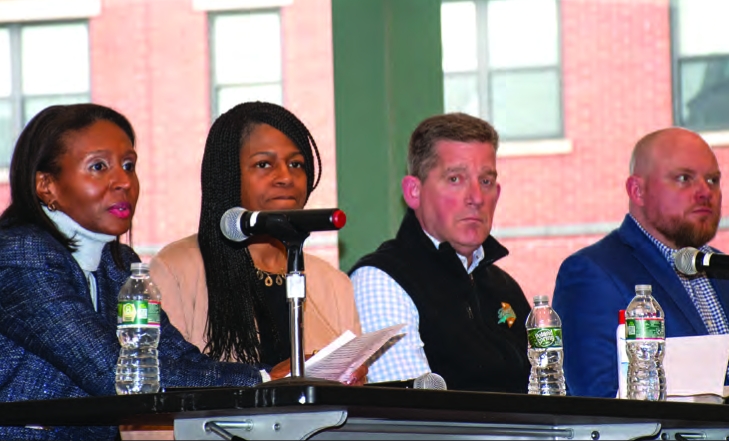
Elsa
Gomes Bondlow (far left) speaks about the new Boston Family Overdose
Support Fund, which she co-manages, alongside (left to right) Dr. Bisola
Ojikutu, health commissioner; Steve Alperin, president and co-founder
of Boston BullPen Project; and Brendan Little, co-manager of the fund,
during the Jan. 29 meeting of the Nubian Square Task Force.
Boston families who’ve lost loved ones to opioid overdose deaths can find a little support from the city through a new fund announced by the Boston Public Health Commission.
A Family Overdose Support Fund, potentially the first of its kind nationwide, will offer families impacted by the overdose crisis financial aid to pay for things like funerals and mental health support.
That fund, announced at a meeting of the Nubian Square Task Force on Jan. 29, will make use of $250,000 directed to the city through settlements with opioid companies.
For the team working on distributing the fund, supporting families is about dignity and respect, but it’s also about breaking cycles and keeping families healthy.
“Whenever we’d bring it up to people — like funders or people who had to say and changing things
— they didn’t quite see it as a valid investment, I think, because it
seemed like it was too much after the fact that it wasn’t a prevention
program or an intervention program,” said Brendan Little, one of the
co-managers of the fund, in an interview. “But what we argue is that it
absolutely is.”
During remarks at the fund’s launch, he said a little bit of money can go a long way.
“Investing
in somebody who’s just lost somebody to overdose can be a form of
prevention; it can be a form of intervention; it can be a way to disrupt
patterns of addiction,” he said at the event.
The
fund is intended to support not just residents in the immediate
aftermath of a family member’s death, but also in addressing longer
impacts around mental health and grief.
Elsa
Gomes Bondlow, who is co-managing the fund alongside Little, has been
doing similar work through her own Social Equity Access Fund for years.
She said the support around longer-term impacts is important. She
recalled a family with six children for whom her fund paid for a
funeral, but nothing further.
“All I could think about is, so I paid for the funeral, and that’s it, right?” she asked. “What happens to those six children?”
The
fund will provide up to $5,000 to eligible family members to pay for
funeral expenses, legal fees, behavioral health costs, and efforts to
support child wellness. It’s an opportunity that Little said stems from
“once-in-a-generation” money from the settlements.
To qualify, the applicant must be a Boston resident,
and his or her family member must have died from an opioid overdose in
the past two years and must have been an immediate family member —
either by marriage or blood, including grandparents and grandchildren,
as well as parentsin-law or legal guardians.
The
fund will be administered by Boston BullPen, a local nonprofit that
partners with social service organizations to identify and fill gaps in
funding or policy.
Approved applicants will not receive the money directly. Instead, the fund will directly pay for the requested services.
“This
money certainly doesn’t take away the pain of losing a loved one. What
it does is it supports the costs that I know that are burdensome,” said
Dr. Bisola Ojikutu, executive director of the Boston Public Health
Commission.
The
concept for the city fund came out of a community engagement process
conducted by the city’s Public Health Commission to decide what was the
best use of the opioid settlement money coming to Boston. It is
estimated that the total will be at least $37.5 million, incrementally
through 2038.
“What we
heard from them was that, if we’re going to use the opioid settlement
dollars in any way that’s most meaningful, then we need to allocate
money, first and foremost, to families with lost loved ones,” Ojikutu
said at the task force meeting where she announced the fund, “mothers,
fathers, children, parents who were left behind in suffering, and not
only suffering from the tragedy of loss but also struggling
financially.”
The
launch also marks the formalization of an effort that started years ago
when Little, then the policy director of the city’s Office of Recovery
Services — a department he helped form under the Walsh administration —
started receiving requests for support from residents who had lost loved
ones to overdose-related deaths.
Without a direct way for
the city to support all the families who needed it, Little connected
with Gomes Bondlow, who had launched the Social Equity Access Fund in
2020, a COVID-19-era effort to support families struggling during the
pandemic.
Since then,
Little and Gomes Bondlow have pushed for an official fund like this one,
pointing to existing efforts like the Massachusetts Office of Victim
Assistance, which helps victims of violent crimes and their families,
but doesn’t extend its services to opioid overdose deaths.
The
city first announced its intention to develop the family overdose
support fund in January 2024. Another $1 million grant announced by the
commission last spring, also using funds from the city’s opioid
settlement pot, offered up to $200,000 to community organizations to
fund education programs, connections to treatment programs, and to
distribute naloxone — a harm reduction drug that reverses the effects of
an overdose, increased access to which has been a priority for the
city.
Supporting the
families of those who have died from opioid overdoses is an area where
Gomes Bondlow said she has seen lots of need. And since the program was
announced, she said she has heard from more and more people who have
been affected by substance use disorder.
“It’s not even six degrees of separation,” she said. “It’s probably one or two for everybody.”
Within
a week of launching, the Halo Initiatives — the group within the Boston
BullPen Project which is codirected by Little and Gomes Bondlow and is
tasked with managing applications and allocating the funds — received
nine responses through the official application and another five or six
responses over email.
Part of the benefit of the fund, Gomes Bondlow said, is the relatively unrestricted way the funds are distributed.
Residents
seeking the fund must provide some documentation. Halo Initiatives has
to confirm the death was related to an opioid overdose and that the
applicant is a direct family member who lives in Boston. But generally,
they try to keep the process from being too onerous to block people out
just through procedural reasons.
“We want to be responsible stewards of the money, but we don’t want to make it so stringent that nobody applies,” Little said.
Gomes Bondlow said it’s about making sure that the money has an impact.
“We’’re
being very thoughtful and very caring about every single penny and
every single dollar, but we don’t have to let the perfect be the enemy
of good,” Gomes Bondlow said.
It’s something she said she would like to see change more broadly in the philanthropic ecosystem.
“We
can now say to other funders, ‘No, you don’t have to give money in a
very hard way and ask for a 40-page grant that the organization doesn’t
have the time to write, and you don’t have the time to read,’” Gomes
Bondlow said. “You can be more trust-based to the community.”
In
that way, Gomes Bondlow said she hopes the fund will help foster
community and address issues that have developed at the society level.
“These
people lived in our communities, and if we let it happen, then we have
to help fix it,” she said. “We have to come together and figure out a
way to repair some of it.”
Though
just in its early days, Little said he would like to potentially see
support from Halo Initiatives be able to support, too, workers who are
on the frontline of the crisis.
“You
go and ask a street outreach worker who works at Mass and Cass, how
many people do they know that have died of overdose that they care
about?” Little said. “You know it’ll be in the multiples of tens.”
Gomes Bondlow said that they also have goals to bring in academic institutions to do some evaluation of the program.
But
more than anything, in the future, the team said they hope that the
concept of a family support fund — to their knowledge, theirs is the
first — can be a model for other municipalities or states. Already,
they’ve received requests for financial assistance from people who live
in other parts of the state, outside of their purview.
Steve
Alperin, Boston BullPen Project president and cofounder, said that the
fact that the fund is likely the first of its kind is something they
discuss frequently as they focus on getting the program with the Boston
city funds up and running.
“Making
that successful would be a model, hopefully, for other municipalities
to follow suit, who may have the money and really don’t maybe appreciate
the best way to distribute funds,” he said.
At
the same event launching the family support fund, Ojikutu announced new
city data that found that opioid overdose deaths between May and August
of 2024 were 40% lower than the year before. Among Black residents,
those deaths were 56% lower.
The
announcement of the preliminary data continues a trend. In October, the
city announced that between January and May 2024, opioid overdose
deaths were 33% lower compared to the same period in 2023.
Ojikutu
said the decline may be because of efforts like increasing access to
naloxone and recovery and detox services, as well as work to decrease
stigma and wider factors like changes in drug supply.
The
new data isn’t a victory lap, she said, and she stressed that the
numbers are preliminary, but still called the decline “a big deal.”
“We
have a lot of work to do, but I believe that together, in partnership
and in collaboration, we’ll continue to make progress,” she said.


