Sasha
Nario, who is studying to get her associates degree in physical
sciences at Roxbury Community College, poses for a photo next to a
poster presenting the work she completed during an internship through
her program.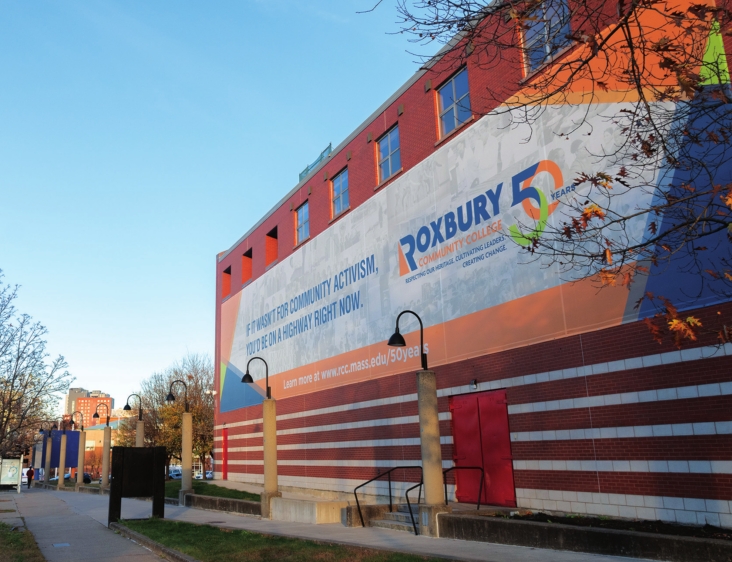
Roxbury Community College, shown at sunset, Nov. 14.
For Sasha Nario, her educational experience wasn’t always the best.
She pursued, for years, a business degree that didn’t excite her. She struggled to connect with it and to stay engaged.
Then she switched to studying physics and her love of education came back with a passion. Part of that has been the opportunity to get hands-on experience in a lab through an internship program at Roxbury Community College.
“My past experiences with school weren’t the best. I still got my opportunity, and I would never trade it for anything. It was a very impactful internship,” said Nario, 21, a Dorchester resident working on an associate degree in physical science from RCC.
Nario, who completed an internship at Northeastern University’s Center for Theoretical Biophysics, is one of 50 RCC students who participate each year in internships through the school targeted at science, technology, engineering, and mathematics — or STEM — fields.
It’s a program that Hillel Sims, associate vice president of academic affairs, said is important to expose students to real-life roles in the field, as well as provide mentorship and networking connections.
Throughout his almost 10 years at the school — he has previously served in roles including dean of STEM and associate vice president of workforce development — he has been pushing for more students to complete an internship, he said.
“We always talk about the fact that you can get two identical students; they’re both at graduation, and one of them has
completed things like an internship and other related opportunities in
the field, and that is what distinguishes them,” Sims said.
“Their
degree opens the door, but it’s everything else about them, including
the internship, that walks them through a door — whether that’s into
another job, another internship, or their next degree.”
The opportunity for students to get their hands on work in the field can help them decide if it’s a good fit, he said.
“If
nothing else, it allows them a chance to experience what it’s like to
work there, to see whether or not it’s something that is really going to
appeal to them while they’re still early on in their careers,” Sims
said.
For Nario, her
internship experience did just that, bolstering her renewed love for
education as she dove into her physics education.
“I
was very unfamiliar with what this career path would look like,” she
said. “It gave me the experience to kind of have a sneak peek into what
it’s like.”
At RCC,
the program can bring students into two types of roles. With a wide
swath of biotech companies in and around Boston, students can pursue an
internship at a life sciences company in the area. Or, because RCC
doesn’t have its own research labs, the school has developed
partnerships with local fouryear institutions to place students in a
research environment.
Sims
said the program has helped connect students with employment
opportunities following graduation, or to seats in fouryear degree
programs at the schools where their labs are hosted.
“They form these real connections,” he said.
“They don’t even want to stop working at those internship sites, and
some of them don’t, and this actually helps them then to continue on.”
RCC’s
work in connecting students with internships comes as organizations
across Boston’s communities of color look to connect a more diverse
collection of workers to STEM employment opportunities.
“These
communities of color have not only the need but the desire to do these
kinds of programs and to enter these fields,” Sims said.
For him, RCC’s internships work to make connections and fill gaps for students who might otherwise lack access.
“It
can be hard for the student on their own make that connection
themselves,” Sims said. “Either they don’t know the people, or they
don’t know who to talk to, or they’ve never gotten involved in that.”
Separately,
RCC has been involved in ongoing work with the Nubian Ascends
development to build opportunities in the area. That development is set
to include the Nubian Square Life Science Training Center, a 40,000
squarefoot lab space in a broader development that will also include
arts and culture amenities.
That
training center, which received $50 million through last year’s
economic development bond bill, will incorporate education support from
RCC as well as other nearby institutions, including Benjamin Franklin
Cummings Institute of Technology, Northeastern University and Mass
BioEd.
Already, RCC
has worked with the NuSquare Life Science Training Center, pairing its
long-running summer STEM program for high schoolers with the center’s
support.
And the
community college has partnered on developing local connections to STEM
jobs more broadly through the work of the Roxbury Worx initiative, a
program run by The American City Coalition to bring middle-skill workers
— those with an associate degree or some college but don’t hold a
bachelor’s — into life science, green tech and health care jobs.
“It’s
all connected. It’s pathways, it’s a network of connecting all these
different STEM activities to try to support the students,” Sims said.
For
Nario, the experience opened her eyes to what she’s capable of. It was
one reason she said she would encourage other students to apply, even if
they don’t know that they’ll get in — a position she found herself in
when she was considering the application to the Northeastern University
internship.
“I think for many students, sometimes being doubtful of your own capabilities, that’s what kind of brings us down,” Nario said.