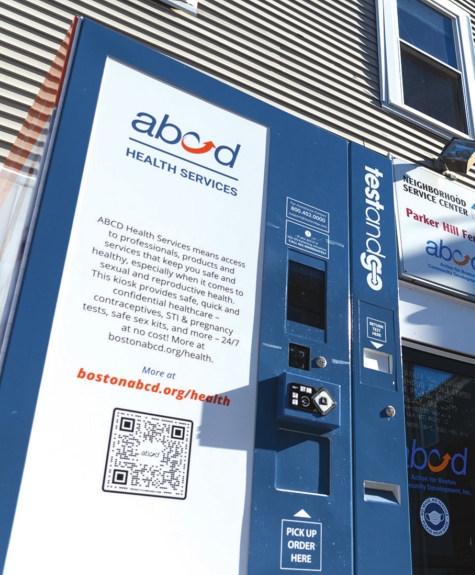
The vending machines are stocked with contraception, pregnancy tests, menstrual hygiene products and other supplies. ABCD launches three-machine pilot to address maternal health, STI disparities
For Black communities, local and national statistics have identified disparities in maternal health outcomes and transmission rates of sexually transmitted infections.
A program launched by ABCD aims to close some of those gaps by increasing free, around-the-clock access to reproductive health supplies through vending machines installed at three of its program sites.
“For these things to be available, I am in a very happy place,” said Maureen Scott, ABCD’s director of health services. “I want to see more of these available so people can better take care of themselves and have overall better health.”
Those vending machines at ABCD’s Roxbury/North Dorchester Neighborhood Service Center, Parker Hill/Fenway Neighborhood Service Center, and Dorchester Neighborhood Service Center are stocked with internal and external condoms, safe-sex kits and STI tests, pregnancy tests and emergency contraception, and menstrual hygiene products, including pads, tampons and menstrual cups.
Since October, when the three-machine pilot program launched, the sites have been used about 300 times, Scott said.
The machines can offer quick access to the supplies, Scott said. Prompt prenatal care can help decrease poor maternal outcomes. And it can be important for sexually transmitted illnesses as well.
“I have seen what STIs can do. I have seen women that access prenatal care very late in the pregnancy, that have poor outcomes,” said Scott, who has a background as a women’s health practitioner. “So, for me, having these kiosks available to people for free helps them advocate for themselves.”
Advocates working in the space said they are “thrilled” to see the presence of the vending machines and the access they offer.
“These vending machines offer an opportunity to provide confidential, stigma-free and really convenient access to [emergency contraception] so people can get it when they need it,” said Kelly Cleland, executive director of the American Society for Emergency Contraception. The organization was not affiliated with ABCD’s pilot program.
Emergency contraception refers to medications taken shortly after unprotected sex to prevent pregnancy. It is distinct from medications like mifepristone and misoprostol, which are used for medication abortion during pregnancy.
For Scott, the vending machine could help address poor maternal health outcomes, as well as disparities in sexually transmitted infections.
A 2023 report by the Boston Public Health Commission focused on
maternal and infant health found that Black infants tended to be of low
birthweight at twice the rate of their white counterparts. Black
residents in the city saw the highest rates of preterm birth. The rate
of infant mortality among the city’s Black population was also the
highest at more than twice that of the city as a whole and about three
times that of the city’s white communities.
Nationwide,
a 2023 report by the Centers for Disease Control and Prevention
tracking trends in chlamydia, gonorrhea, and syphilis found that
non-Hispanic Blacks made up nearly one-third of all cases of the
infections tracked, while only making up 12.6% of the population.
“All
of these things we were thinking about, how can we put our efforts
toward decreasing this rate, getting people to do early testing — either
because they’re afraid they may have an STI, or that they’ve had a call
from someone that they’ve had been in contact, or that they’re having
symptoms — because early testing, of course, prevents the sequela [a
complication
or condition that follows an illness or disease], or the problems that
occur when you get treatment late,” Scott said.
For
resources like emergency contraception — often referred to by its brand
name “Plan B” — vending machines like the ones installed by ABCD can
offer much need fast access to a drug that can be time-sensitive, said
Kelly Cleland, executive director of the American Society for Emergency
Contraception.
“The
pregnancy risk goes up the longer it takes to get [emergency
contraception],” Cleland said. “These vending machines offer an
opportunity to provide confidential, stigma-free and really convenient
access to EC so that people can get it when they need it.”
Easy
access can be especially important for residents who are concerned
about privacy or in communities where pharmacies can be difficult to
access.
For Cleland’s
group, which does work more broadly, that kind of availability can be
key in more rural areas, but she said it’s also important in parts of
Boston — like Roxbury, Mattapan and Hyde Park — that have, in recent
years, seen the shuttering of Walgreens and CVS stores, particularly in
the city’s communities of color.
“Often,
we think about cities as places where people have access to everything
they need, but the reality is that sometimes public transportation is
really difficult,” Cleland said. “So, if your neighborhood Walgreens
closes, then it can be difficult to get to another one. And even if
there is one down the street there is still the issue of price, which is
extremely, extremely challenging for a lot of folks.”
Scott said she’d like to
see an expansion of the program, potentially including more of the
machines, but also an increase in what supplies are available, including
new offerings like HIV and syphilis tests as well as HPV swabs.
The installation of the vending machines by ABCD marks a growth in the use of this sort of outlet as a public health resource.
When
it comes to reproductive health supplies, vending machines like these
have seen more frequent usage on college campuses, particularly
following the overturning of Roe v. Wade in 2022.
Scott
said that those college-campus machines were a reference point for ABCD
as they started considering the installation of their three kiosks.
Cleland
said the American Society for Emergency Contraception is excited about
the use of the machines at colleges, but she’s thrilled to see this sort
of resource become available to communities at large.
“A lot of times college campuses are closed to people who are not current staff or students of the university,” Cleland said.
More
broadly, this sort of vending machine has seen a spotlight for access
to other public health resources like those around opioid harm
reduction.
Last year,
the Massachusetts Bureau of Substance Addiction Services and Office of
HIV/AIDS — part of the state’s Department of Public Health — purchased
14 harm reduction vending machines to be distributed across the state.
Two of those came to sites in Boston, alongside eight kiosks installed
by the Boston Public Health Commission.
A
2023 report from the National Council for Mental Wellbeing identified
vending machines, with no fixed hours of operation and increased
privacy, as an opportunity to reduce barriers to harm reduction supplies
compared to fixed-site programs as well as mobile outreach. The
increased anonymity, in particular, can attract more people who use
drugs who may not access services otherwise, the report identified.
Some
of the growth in usage of the harm reduction vending machines, it
found, was due to the COVID-19 pandemic, when many fixed-site harm
reduction programs reduced operations under pandemic restrictions.
By
attracting community members who might otherwise be hesitant to seek
resources, there’s hope that the vending machines can bring greater
health equity generally.
For
Scott, with ABCD, the three ABCD vending machines offer a chance to
connect residents to expanded health care services. She said residents
who get a positive STI or pregnancy test should go to other providers
for continued care.
“These
kiosks are kind of opening the door to getting our community into the
health centers — the local community health centers, the hospital
clinics —sooner rather than later, which is a big thing and which
automatically points to health equity accessibility, and hopefully
decreases the disparity,” Scott said.
The vending machines offer resources for referrals to nearby health centers and clinics.
She
said the ability to advocate for one’s self is the “biggest thing” in
health care and that the tools available in the vending machines can
help make that possible.